
Vandaag of morgen in huis

Kwaliteit gegarandeerd

Welkomstaanbiedingen ontgrendelen: GRATIS bezorging | Tot 80% korting | Gratis 30 dagen JoyPlus-proefperiode
Download de app
A large cat tree can offer much more than a high perch in your living room. For large, active or multiple cats, the right model combines climbing, scratching, playing and sleeping. However, some cat trees can disappoint in practice. A narrow base may wobble, a small cat house may go unused, and thin sisal can wear out sooner than expected.
Joybuy’s Product Recommendation Officer therefore focuses on details that can be checked: dimensions, number of levels, base construction, materials and included accessories. This makes it easier to compare marketing claims with the product specifications.
A tall cat tree takes up little floor space, but its centre of gravity is also higher. Without a wide base or anti-tip feature, the furniture may move when a cat jumps down. So check more than just the overall height:
A model measuring 170 cm or more also needs enough clearance around it, so cats can jump and land safely.
A cat house, hammock and several platforms may sound appealing. However, small resting spots may not suit heavy or large cats. Check the dimensions of the resting surfaces and beds. A wide top platform or cat bed is often more important than an extra toy.
For homes with several cats, having multiple separate resting spots is useful. That way, they don’t all have to use the same platform or cat house.
Cats often stretch out fully when they scratch. A short post may therefore be less appealing than a sturdy vertical surface. Check how many posts are covered in sisal and how they are spread across the levels. Sisal scratching posts at different heights give cats several places to scratch.
According to the product descriptions of some models, the sisal areas are designed to encourage cats to scratch the tree. This doesn’t guarantee that they’ll leave your furniture alone altogether, but it’s a sensible feature to look for if you want to protect your sofa or chairs.
First, measure the space available. Remember to account for skirting boards, doors and walkways. A 170 cm cat tree won’t necessarily fit comfortably in every room. Also check the distance between platforms. A staggered layout with open access may be more convenient for cats that often move up and down.
For a cat tree for large cats, wide platforms and a spacious cat house are important. For a cat tree for multiple cats, the key is a combination of several resting areas and sufficient load capacity.
A stable cat tree will generally have a wide or double-layered base, sturdy joints and well-positioned support posts. Check whether the load capacity is clearly stated and read any conditions that apply. For example, “suitable for six cats” may depend on a maximum weight per cat.
Place the tree on a level surface. An anti-tip feature is a useful extra precaution, especially for a tall model or cats that like to jump about.
Plush feels soft, but it quickly collects hair and dust. Removable cushions are therefore handy. Check whether the parts can be washed and whether hanging toys can be replaced. That way, a damaged toy won’t immediately make the whole piece of cat furniture unusable.
A cat tree with scratching posts should also have enough sisal in places where cats can actually stand and stretch. When it arrives, check that all the posts are securely attached and tighten the fixings again after the first period of use.
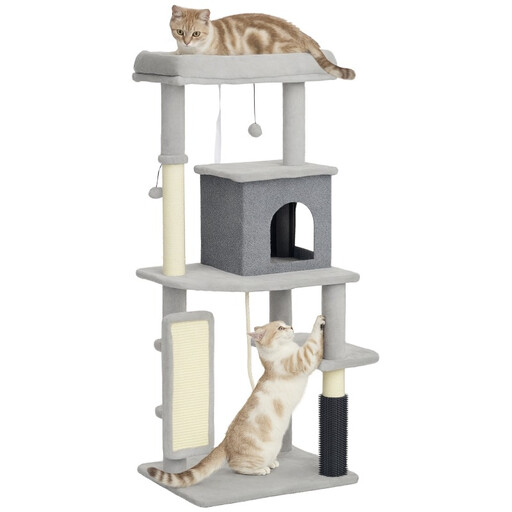
Why it suits this type of buyer: At 132 cm, this model is shorter than the other options in this selection. According to the product name, it includes a cat bed, cat house, jumping platform, sisal posts and anti-tip kit. It’s a good choice if you’re looking for a versatile piece of cat furniture without going straight for an extra-tall tower.
The listed anti-tip kit is a specific stability feature worth looking for. Before use, check the assembly and secure the furniture according to the instructions.
132 cm tall; cat bed, condo, jumping platform, sisal scratching posts and anti-tip kit, according to the product listing.
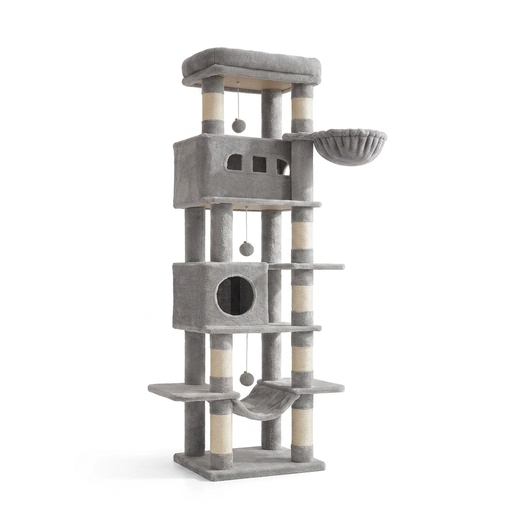
Why it suits this type of buyer: The stated dimensions, six levels and combination of large and small condos make this a good fit for households looking for several features in one large cat tree. The listing also mentions a hammock, a 30 cm cat bed and two removable cushions.
The specifications mention a widened, double-reinforced base and an anti-tip feature. Eight of the seventeen posts are also covered in sisal, providing scratching spots across several levels.
170 cm tall; six levels; eight sisal posts; two condos, a hammock, a bed and two removable cushions, according to the product description.
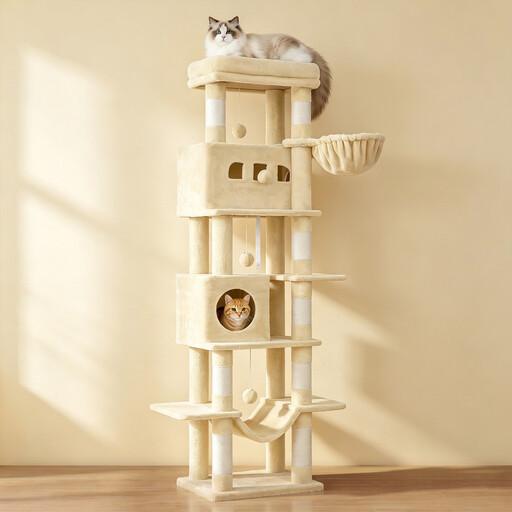
Why it suits this type of buyer: At a stated height of 212.5 cm, with six levels and two cat houses, this model is suited to intensive use and homes with several cats. The product description also lists a 65×45 cm platform, a 30 cm bed, a hammock and two washable cushions.
According to the product description, this model has seventeen support posts, eight sisal posts and a double base with an anti-tip lock. During assembly, check that all the connections are secure.
212.5 cm tall; two cat houses; 65×45 cm platform; eight sisal posts; two washable cushions, according to the product details.
We’ve put together a complete, up-to-date list of products that meet these strict selection criteria and the applicable European safety requirements.
Place a large cat tree on a level floor, leaving plenty of room around it for movement. For a tall structure, securing it to the wall is a good idea if the instructions require or allow this. Ideally, position the furniture somewhere your cats already like to spend time, but not right next to a radiator or in a damp area.
Vacuum plush surfaces regularly and check the sisal for loose threads. Tighten the screws and replace any damaged hanging balls. This helps keep the cat furniture usable and reduces the risk of wobbling or loose parts.
Don’t just look at the height. Check the dimensions of the platforms, beds and houses, as well as the stated load capacity. A wide resting area, such as a 50×30 cm or 65×45 cm platform, offers more space than a narrow shelf.
It can be, as long as the tree has several resting and scratching areas and its load capacity is suitable for the number of cats using it. Multiple houses, platforms and sisal posts mean they’re less likely to need to share one spot. Always check that the tree is assembled correctly and is stable.
Its lifespan depends on how it’s used, the weight it supports, the materials and how well it’s maintained. Sisal wears down with scratching, while plush can be damaged by vigorous jumping. Choose a model with sturdy posts, check the fixings regularly and see whether toys or cushions can be replaced individually.
