
Vandaag of morgen in huis

Kwaliteit gegarandeerd

Welkomstaanbiedingen ontgrendelen: GRATIS bezorging | Tot 80% korting | Gratis 30 dagen JoyPlus-proefperiode
Download de app
A large cat tree can give indoor cats space to climb, scratch, play and sleep. However, a model can look sturdier in a product photo than it feels in your living room. For large or heavy cats in particular, a narrow base, too little sisal or small resting spots can quickly lead to disappointment.
Before you buy, look out for these three common pitfalls:
A stable cat tree has a wide base, sturdy connections between levels and, ideally, an anti-tip kit or device. Height alone says little about safety. A tall cat tree with a lightweight base may be more prone to movement when a cat jumps on it.
Place the tree on a level floor and check that all the screws are tight after assembly. If you have more than one cat, take extra care when choosing where to put it. Don’t place it right next to a delicate cabinet or on a slippery rug that could move.
For a cat tree for large cats, the size of the resting areas matters at least as much as the overall height. A 50 × 30 cm platform gives your cat more room to move than a small round shelf. The opening of a cat house also affects how easily a heavy cat can get in and out.
A cat bed or hammock is especially practical if it has a sturdy attachment and the fabric is easy to clean. Removable, washable cushions are useful for everyday use, particularly if several cats share the same resting spot.
A cat tree with scratching posts should offer places to scratch along your cat’s usual route. Sisal scratching posts are suitable for vertical scratching, but check the length of the post too. Your cat should be able to stretch out as much as possible while scratching.
Levels with a height difference of around 20 to 30 cm can create a natural route for climbing. For older, heavier or less agile cats, wide intermediate platforms are more important than a complicated design with lots of small jumps.
The selection below is based on verifiable details in the product information, such as dimensions, number of levels, materials and included components. Any claims made by brands about suitability or load capacity are presented as product information and are not a general guarantee for every cat or home.
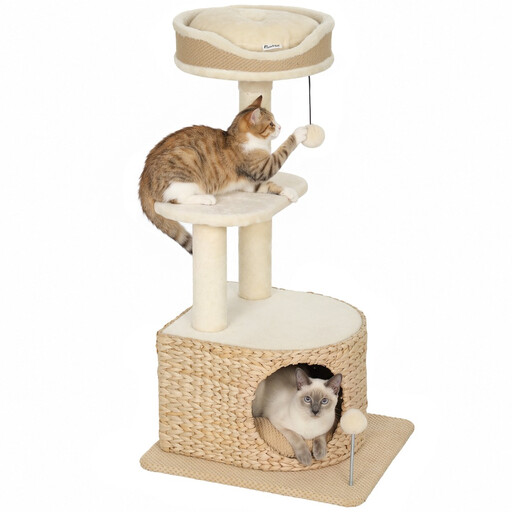
Why it suits this type of buyer: With four levels and a height of 87 cm, this is a straightforward starter model for an indoor cat and for homes with limited space.
The height and number of levels are clearly stated, making it easier to judge in advance whether the tree will fit your available floor space.
Four levels, a club-shaped cat house and a jute scratching post in a compact design.
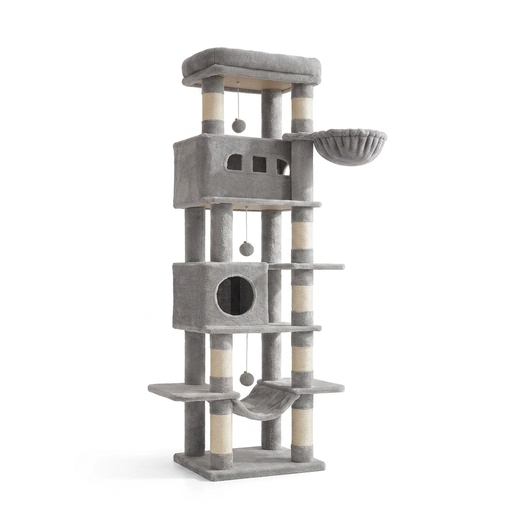
Why it suits this type of buyer: This model offers plenty of features for households looking for a tall cat tree with several places to rest and play.
The product information lists a double reinforced base and an anti-tip feature. Always check that the whole unit is stable after assembly.
170 cm tall, with six levels, eight sisal-covered posts, two cushions, a hammock and a 30 cm basket.
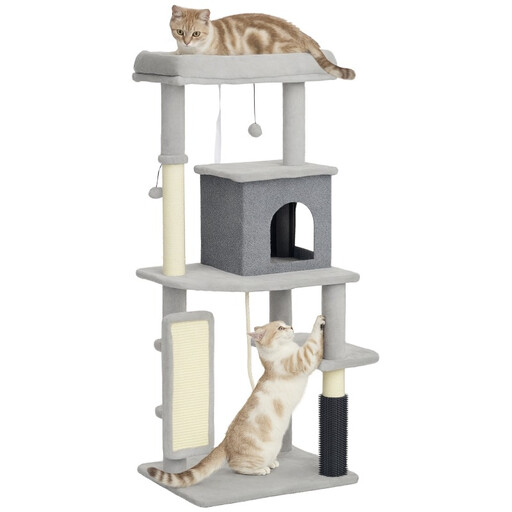
Why it suits this type of buyer: A practical choice for combining resting, climbing and scratching with extra support to help prevent tipping.
The listed anti-tip kit helps with correct positioning and assembly. The sisal posts also provide dedicated scratching areas rather than just soft covering.
132 cm tall, with sisal scratching posts, a cat bed, a cat house, a jumping platform and a grooming brush.
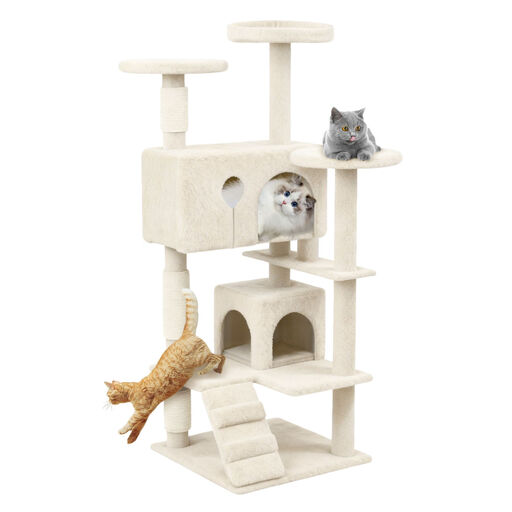
Why it suits this type of buyer: The square base takes up relatively little floor space, while the height gives indoor cats an elevated vantage point.
The base dimensions of 49 × 49 cm and the overall height of 130 cm are clearly stated, so you can assess the available space and stability more easily.
A compact footprint, a height of 130 cm and a cat bed with a scratching area, according to the product name.
We’ve put together a full, up-to-date list of products that meet these strict selection criteria and the applicable European safety regulations.
Ideally, put the cat tree somewhere your cat already likes to spend time, such as by a window or in a quiet corner of the living room. Leave enough space around curtains, lamps and cabinets that a jumping cat could bump into.
Check regularly:
A removable cushion or washable cover makes everyday care easier. It’s best to replace damaged parts before your cat starts pulling at them or gets caught in them.
It depends on the space you have, as well as your cat’s age and mobility. A model measuring 120 to 170 cm provides a clear vantage point, but wide platforms and a stable base matter more than maximum height. If you have a heavy cat, always check the stated dimensions and load capacity.
Its lifespan depends on how it’s used, the materials and how well it’s maintained. With several cats, sisal and soft coverings generally wear out more quickly. A sturdy construction, replaceable play balls and regularly tightening the connections can help keep the tree in use for longer. Check whether spare parts are available too.
The direct costs of use are usually limited to maintenance and any replacement sisal, cushions or toys. The main expense is the purchase price. So don’t look only at the number of levels: consider the quality of the connections, the size of the resting areas and whether parts can be replaced.
