
Vandaag of morgen in huis

Kwaliteit gegarandeerd

Welkomstaanbiedingen ontgrendelen: GRATIS bezorging | Tot 80% korting | Gratis 30 dagen JoyPlus-proefperiode
Download de app
A large cat tree offers more than somewhere to sharpen claws. Cats can climb, play, sleep and retreat without the sofa or curtains becoming their only scratching spots. Yet many people buy a cat tree that becomes less suitable after a few months because of a sleeping area that is too small, a wobbly base or upholstery that wears out quickly.
In this guide, you’ll find out which features to check before ordering a tall cat tree, large cat tree or cat tree for multiple cats.
A tall cat tree may look appealing, but height alone says little about stability. A narrow base, heavy top or poorly arranged platforms can cause movement when a cat jumps down. Always check the base dimensions, total weight and whether an anti-tip feature is included.
A cat tree measuring between 168 and 212.5 cm also needs enough space around it. Don’t just measure the floor area; also consider doors, windows, radiators and walkways.
A product photo may show a spacious bed, while the actual dimensions are limited. For a large cat, a 30 × 30 cm platform may be too small for stretching out comfortably. Pay attention to the stated dimensions of the top platform, bed and cat houses. A platform measuring 60 × 40 cm or 65 × 45 cm clearly offers more room to move around on paper.
A cat tree with cat houses, a hammock and toys looks versatile. However, it may prove disappointing if it has only one short sisal-covered post. Cats like to scratch vertically and stretch their bodies while doing so. Therefore, look at the number of sisal posts, their length and how they are distributed across the different levels.
Also pay attention to loose toys. According to the product information for some models, hanging balls can be replaced. Check regularly for loose or damaged parts and remove them if your cat chews on them.
A sturdy cat scratching post should ideally have:
An anti-tip feature is no substitute for correct assembly. Place the scratching post on a level floor and attach the strap according to the instructions. After assembly, check all screws and connections again. If you have multiple cats, it’s sensible to inspect the structure again after a few weeks of use.
A multi-level cat tree is practical when the levels connect logically. The product information for the models below states gaps of approximately 20 to 40 cm between levels. This can make climbing more straightforward, but the right choice depends on your cat’s jumping habits and age.
A tall structure is not automatically suitable for every home. In a flat, a vertical, relatively compact design can save floor space. However, measure the ceiling height beforehand and leave enough room for assembly.
Sisal is intended as a scratching material and is often wrapped around posts. Check that the posts are positioned along multiple routes, so cats are not limited to scratching in just one place. A cat tree with sisal posts at different heights can help direct scratching behaviour towards the parts designed for it. However, a reduction in furniture damage cannot be guaranteed; behaviour varies from cat to cat.
Washable cushions and removable platforms make maintenance easier. Plush surfaces can generally be cleaned with a vacuum cleaner or clothes roller. Always follow the product’s specific cleaning instructions.
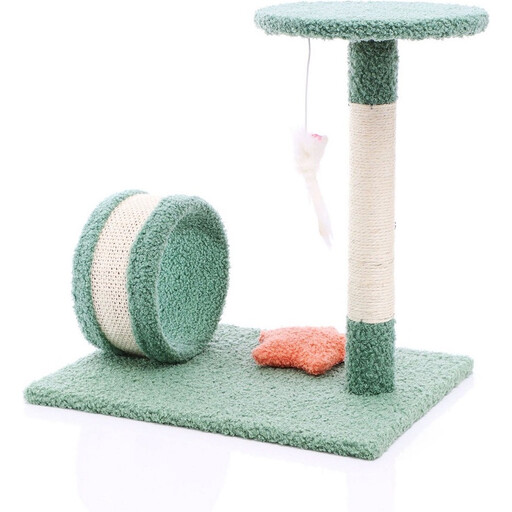
Why it suits this profile: This compact model is suitable as a kitten’s first scratching area or as an additional option in a small home. The tunnel and toys provide extra opportunities for play without taking up the space of a full-sized tall cat tree.
The product dimensions of 40 × 30 × 41 cm are clearly stated, allowing you to decide in advance whether this is a supplementary scratching post rather than expecting a large cat tree.
Compact size, sisal material, tunnel and supplied toys; according to the product information, it is mainly suitable for kittens.
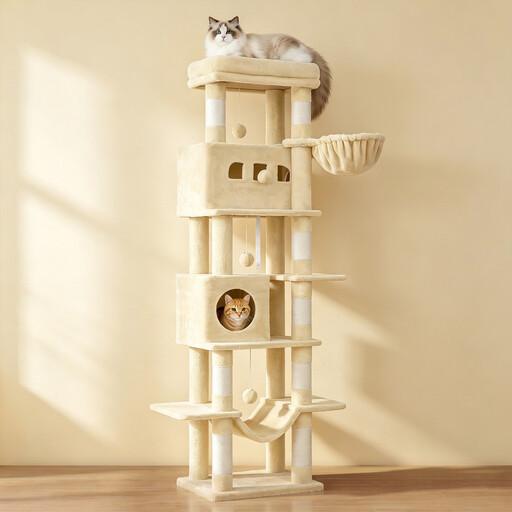
Why it suits this profile: The height of 212.5 cm, six levels and wide resting area are suitable for households looking to create an extensive space for multiple cats.
The product description mentions a double base, anti-tip locking system and eight sisal posts. Nevertheless, check the wall fixing and screws after assembly.
Six levels, two cat houses, a hammock, a 30 cm bed and a 65 × 45 cm platform.
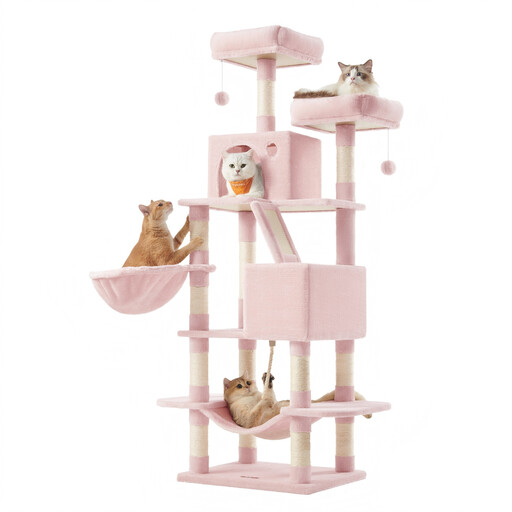
Why it suits this profile: This model is designed for active use, with five levels, two caves, a bed, hammock and several play balls. The stated maximum static load is 65 kg; always follow the usage and assembly instructions.
The specifications list 13 sisal-covered scratching posts and an anti-tip feature. This provides more distributed scratching zones than a model with just one post.
168 cm high, 13 scratching posts, two platforms, two caves, a bed and a hammock.
We’ve put together a complete, up-to-date list of products that fully meet these strict selection criteria and the applicable European safety regulations.
Place a large scratching post somewhere your cat already likes to spend time, such as by a window or near the living room. A quiet corner may be suitable for cat houses and a hammock, while an open platform often works better somewhere with a view of the room.
Use this checklist:
The lifespan depends on the weight, number of cats, intensity of scratching and maintenance. A sturdy base remains important, but sisal and plush are also wear-and-tear components.
As well as the height, consider the dimensions of the resting areas and the stability. A model measuring 168 cm or more may be suitable for cats that enjoy climbing, provided the platforms are large enough and the tree is properly secured.
That depends on the number of cats and their behaviour towards one another. Multiple cat houses, a bed, hammock and different platforms give cats more choice. If there is tension around resting areas, an additional standalone scratching post or bed may help.
Place the cat tree on a level surface, tighten all screws securely and use the supplied anti-tip feature. Check the fixings regularly, especially when multiple cats climb or jump at the same time.
