
Vandaag of morgen in huis

Kwaliteit gegarandeerd

Welkomstaanbiedingen ontgrendelen: GRATIS bezorging | Tot 80% korting | Gratis 30 dagen JoyPlus-proefperiode
Download de app
A large cat tree for cats offers more than just somewhere to sharpen their claws. For indoor cats, large cats and multi-cat households, a tall cat tree provides space to climb, play, sleep and retreat. However, an attractive model does not always prove stable or spacious in practice.
The key question is therefore not just how tall the scratching post is, but also how its construction, layout and materials suit your cat’s behaviour.
A tall scratching post takes up little floor space, but a narrow or lightweight base can move more easily when an active cat jumps upwards. Pay attention to the dimensions of the base plate, the weight of the structure and whether the post can be attached to the wall.
For models taller than around 150 cm, an anti-tip feature is advisable. Place the cat tree on a flat, non-slip surface and check after assembly that all connections are securely fastened.
A cat tree can have lots of platforms and components, while large cats still have barely enough room to stretch out. Check the dimensions of the sleeping areas, cat houses and beds. For example, a platform measuring 50 × 30 cm provides more room to move than a small round seat.
For households with several cats, multiple resting areas are important. This means cats are less likely to have to share the same hammock or highest platform.
A product may look feature-packed, yet have only one thin scratching column. Cats often scratch both horizontally and vertically. A combination of sisal posts and a sisal scratching board or ramp therefore offers more variety.
Also pay attention to the thickness of the posts. Thicker posts can be more comfortable for large cats to stretch out fully against. Check regularly whether the sisal is coming loose and replace parts when they become damaged.
A tall scratching post or cat climbing tower makes use of the vertical space in your home. This is particularly useful in flats or rooms with limited floor space. A height of 130 to over 200 cm provides different climbing levels, but also requires a suitable base.
Check the following before buying:
A stated load capacity is not a guarantee for every use scenario. Jumping cats create more dynamic load than cats that calmly settle on a platform.
A scratching post with sisal posts is practical if you want to protect your furniture from claw damage. Do not just look at the number of posts, but also at their positioning. Scratching areas at several levels may better suit everyday use.
Natural sisal fibres are often used for scratching columns. Quality depends, among other things, on how the material is attached and how intensively the post is used. An angled scratching surface is a useful addition for cats that prefer to scratch horizontally or at an angle.
A scratching post with a hammock, several platforms and a cat house combines different functions. For an indoor cat, it can become a dedicated place for rest and play. Pay attention to the distance between the levels: steps of around 20 to 30 cm are arranged at manageable intervals according to the product specifications of some models.
Very large jumps are less practical for older, young or less mobile cats. A model with intermediate platforms and wide sleeping surfaces makes the route upwards more accessible. Do not place the indoor cat furniture directly next to curtain cords, a heater, an open fire or a window where there is a risk of falling.
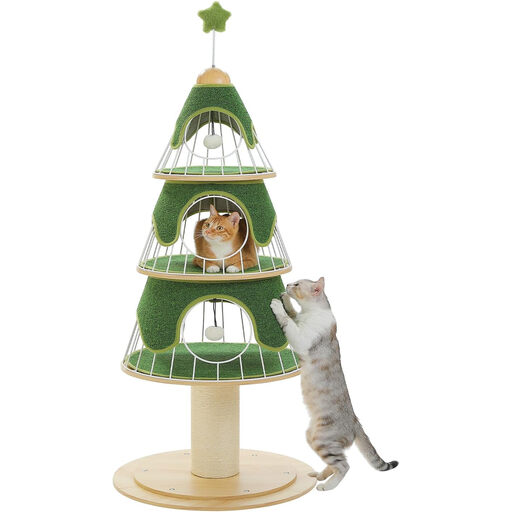
Why it suits this profile: This compact 130 cm model is suitable for smaller homes or cat owners who want to try a versatile cat tree first. Its distinctive tree shape can also serve as seasonal decoration.
According to the product specifications, the base measures 60 × 60 cm and the central post is 12.5 cm thick. This provides more support than a tall, narrow structure.
130 cm tall, three large cat houses and a sisal-covered scratching post according to the product information.
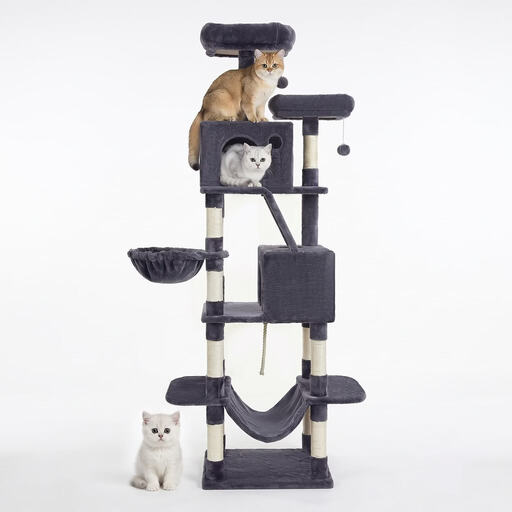
Why it suits this profile: This XXL scratching post is designed for households wanting plenty of vertical space and several separate resting areas. It is particularly suitable for active indoor cats and multi-cat households.
According to the product specifications, the model has 13 sisal posts, an angled scratching ramp and a reinforced base. The tall structure must nevertheless be anchored according to the instructions.
206 cm tall, two cat houses, two raised platforms, a hammock and a stated static load capacity of up to 70 kg.
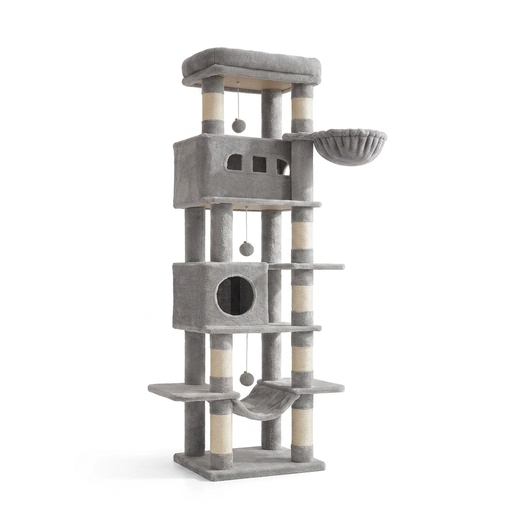
Why it suits this profile: This model is aimed at multi-cat households or cats that like to alternate between climbing, scratching and resting. The combination of six levels and various resting areas makes the layout practical for intensive everyday use.
According to the product specifications, eight of the seventeen posts are covered with natural sisal. The double reinforced base and anti-tip feature are designed to limit wobbling.
170 cm tall, six levels, two cat houses, a hammock, a 30 cm bed and two removable cushions.
We have put together a complete, up-to-date list of products that fully meet these strict selection criteria and the applicable European safety regulations.
Place the scratching post where it will be used before assembling it. Moving an assembled model can be difficult, particularly in the case of a tall cat climbing tower. Use a level surface and follow the assembly instructions step by step.
Check the following after a few days and then regularly:
Remove dust and hair with a vacuum cleaner or soft brush. Clean stains locally in accordance with the care instructions. Stop using the product if any part becomes loose, broken or unstable. Kittens, older cats and highly active climbers should preferably be supervised at first.
That depends on the available space and your cat’s behaviour. A 130 cm model may be sufficient for a smaller home. For active cats that like to sit up high, a 170 to 206 cm model offers more vertical play space. With taller models, a wide base and wall mounting are particularly important.
Its lifespan depends on the number of cats, their weight and how intensively they scratch. Sisal usually wears out sooner than the wooden load-bearing parts. By regularly tightening the screws and replacing worn parts in good time, the structure can remain usable. Always follow the manufacturer’s care and safety instructions.
Daily maintenance is usually limited to removing hair and cleaning stains locally. The main recurring check is to inspect the screws, posts and attachment points. With a scratching post used by several cats, it is advisable to do this more frequently, as the load may be higher.
