
Vandaag of morgen in huis

Kwaliteit gegarandeerd

Welkomstaanbiedingen ontgrendelen: GRATIS bezorging | Tot 80% korting | Gratis 30 dagen JoyPlus-proefperiode
Download de app
A large cat tree can combine climbing, scratching, playing and resting. But impressive height isn’t everything. A tall cat tower with a small base may wobble, while a model with lots of accessories isn’t automatically suitable for multiple cats.
So focus on the construction, layout and maintenance. This can help you avoid having to buy another one after a few months, or ending up with a cat tree that takes up space without being used properly.
An extra-tall cat tree measuring 168 or 206 cm provides plenty of vertical space, but it also needs a stable base. A narrow base or uneven floor can affect stability when a cat jumps down from a platform. So always check the base dimensions, the weight and whether an anti-tip kit is included.
A cat tree with a hammock, hideaways and baskets looks versatile. But if the sisal posts are short, thin or hard to reach, your cat may still scratch the furniture. Check the number of scratching posts, the length of the sisal-covered sections and whether there’s a ramp or another accessible scratching area.
A stated static weight capacity doesn’t guarantee that several cats can jump onto the same small platform at once. The figure mainly indicates the overall load the structure can bear. Also check the dimensions of the lounging areas and spread resting spots across different levels.
For active cats, a multi-level cat tree measuring around 160 to well over 200 cm could be a good choice. A 206 cm model is best suited to rooms with plenty of ceiling clearance. Before buying, measure the room and allow for the space needed to assemble and stand the tower upright.
A sturdy cat tree should stand on a flat, non-slip surface. Wall-fixing is strongly recommended for tall models. Always follow the assembly instructions and use the included anti-tip kit if one is provided.
A cat tree with sisal posts offers several scratching areas. Look for:
The description “13 scratching posts” doesn’t tell you whether every post is equally easy to reach. A good layout matters more than simply having the highest number of posts.
For a cat tree for multiple cats, several resting spots spread across the structure are practical. These might include platforms, cat hideaways, a basket and a hammock. That way, the cats don’t all have to share the same spot.
Many models use particleboard, plush fabric and sisal. Check that the joints can be tightened securely and that the covering can be spot-cleaned. Plush fabric can trap fur and dust, so regular vacuuming and checking for loose parts are part of keeping it in good condition.
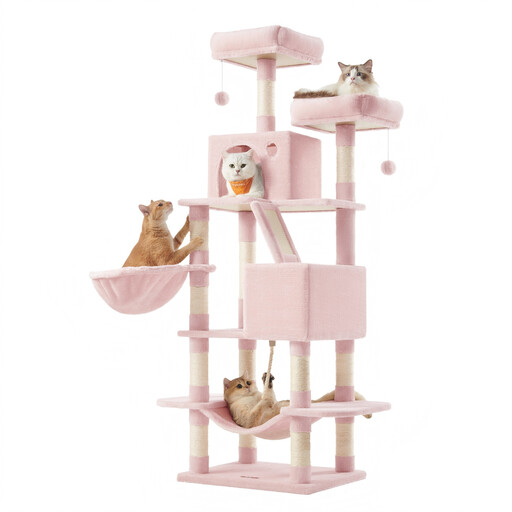
Why it suits this type of buyer: This model offers five levels and a generous mix of scratching and resting areas, without going straight for a tower over two metres tall. The pink cat tree has two hideaways, a basket and a hammock.
The specifications list 13 sisal posts and one scratching ramp. The reinforced base and included anti-tip kit make it easier to check that it’s securely assembled than with a model that provides no safety information.
168 cm tall, 13 sisal posts, two platforms, two cat hideaways, a basket and a hammock. The stated total static load capacity is 65 kg.
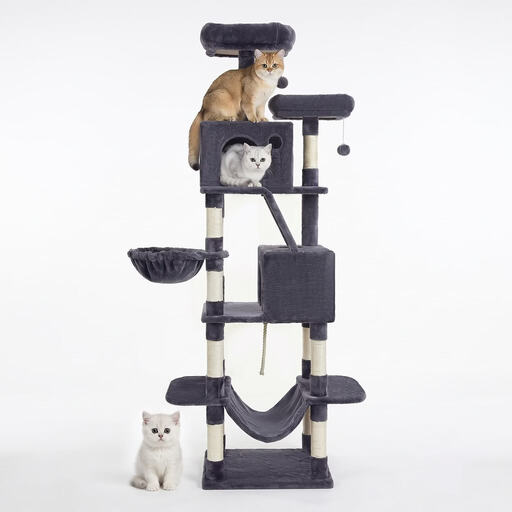
Why it suits this type of buyer: This grey cat tree is designed for households looking for plenty of vertical space and several separate areas. Its layout is well suited to active cats and multi-cat households.
The tower combines 13 sisal posts with an angled scratching ramp. The product information also mentions a reinforced base and a total static load capacity of 70 kg.
206 cm tall, two platforms, two cat hideaways, a basket, a hammock and 13 sisal posts plus a ramp.
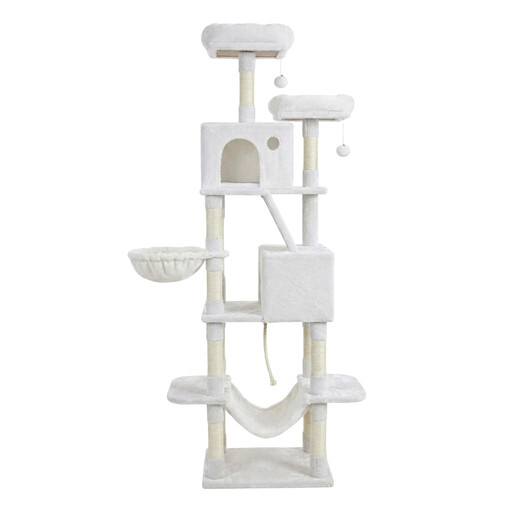
Why it suits this type of buyer: This cream-coloured cat tree is designed for intensive daily use in a multi-cat household. The tall tower, several resting spots and plenty of sisal provide different areas for cats to use.
The 13 sisal posts are spread across the structure, while two hideaways, a basket and a hammock provide separate resting spots. The stated total static load capacity is 75 kg.
206 cm tall, two platforms, two cat hideaways, a basket, a hammock and 13 sisal posts. The structure has a reinforced base.
We’ve put together a complete, up-to-date list of products that meet these strict selection criteria and the applicable European safety regulations.
Place a large cat tree on a flat surface, away from damp, heat sources and cables. Secure tall models to the wall as instructed in the manual. Give your cat time to get used to the different levels; a toy or small treat can help.
Check regularly:
Remove loose parts straight away if your cat chews them or tries to swallow them. Stop using the cat tree if a load-bearing part is damaged or has come loose.
It depends on the space available and your cat’s behaviour. A 168 cm model already offers several climbing levels. An extra-tall 206 cm cat tree needs more clearance and should ideally be fixed to the wall.
It can be, as long as there are enough separate resting and scratching areas. As well as the total weight capacity, check the dimensions of the platforms and hideaways. Several cats may still compete for the same favourite spot.
Its lifespan depends on the number of cats, how active they are, how well it’s assembled and how it’s maintained. Check the joints regularly and replace or repair worn sisal and damaged coverings. Always replace a tall cat tree as soon as the structure is no longer stable.
