
Vandaag of morgen in huis

Kwaliteit gegarandeerd

Welkomstaanbiedingen ontgrendelen: GRATIS bezorging | Tot 80% korting | Gratis 30 dagen JoyPlus-proefperiode
Download de app
A large cat tree gives your cat space to scratch, climb, play and sleep. But a tall cat tree won’t automatically suit your home or your cats. A narrow base, too little sisal or an awkward layout can make it wobble and leave it barely used.
There are three pitfalls to watch out for, especially if you have indoor cats, more than one cat or a heavier cat:
So don’t focus only on height or the number of places to lie down. The construction, dimensions and materials all determine whether a cat climbing tower really suits your cats and the space you have available.
A tall cat tree needs extra attention when it comes to stability. Check the size of the base and see whether it has an anti-tip feature. A wide, double-reinforced base is a practical choice for cats that jump around a lot or play together.
There is no universal, independent load-capacity standard for all cat trees. Any stated capacity is therefore information provided in the manufacturer’s product listing. Use it as a guide, and take into account your cats’ combined weight, how they move and the type of floor.
A large cat tree measuring 150 to 170 cm could suit active cats, but measure your ceiling height first. Place the tree on a level surface and not right next to furniture it could knock into.
Cats don’t just scratch to look after their claws. It also helps them stretch and mark a familiar spot in the home. So choose a sturdy scratching post with several vertical or horizontal scratching surfaces.
Look for:
A model with sisal scratching posts at several heights may be more practical than a tree with one short scratching post. Ideally, place the cat tree in a room your cats already like spending time in, such as the living room or by a window.
A cat tree with a hideaway is especially useful when cats want somewhere to retreat now and then. If you have several cats, a mix of open platforms, a basket, a hammock and enclosed hideaways can help give them more space.
Also check:
A cat tree with a hammock provides a separate place to rest, while a cat tree with a basket often offers more support while your cat sleeps. For larger cats, pay particular attention to the width of the resting areas and the load capacity of the upper parts.
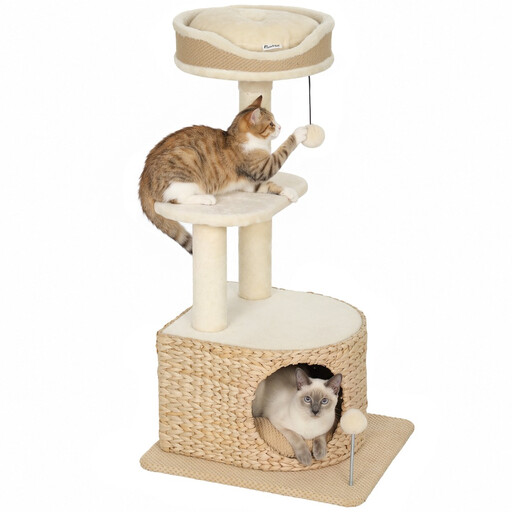
Why it suits this type of cat owner: At 87 cm tall and with four levels, this is a compact choice for a flat, a kitten or a cat that doesn’t need a very tall climbing tower.
Its lower structure reduces the leverage effect of a tall tower. The product listing mentions a jute scratching post and several levels, so scratching isn’t limited to one small area.
Four levels, a club-shaped hideaway and a hanging resting spot in a space-saving design.
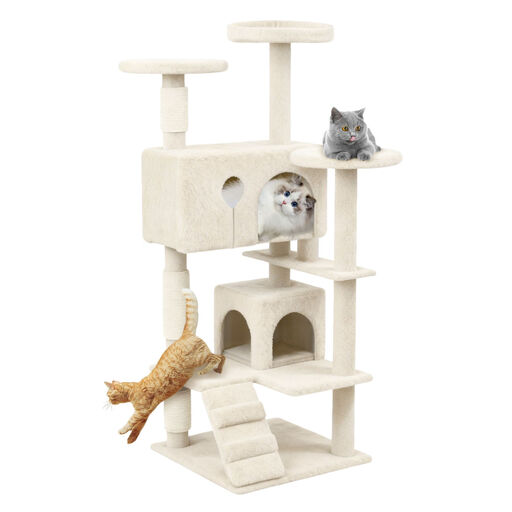
Why it suits this type of cat owner: Measuring 49 × 49 × 130 cm, it offers a compromise between height and floor space for households looking to give an adult cat extra room to rest and scratch.
The square base makes it easier to position the tree securely against a wall. Before buying, check the full product information for details about the materials, fixings and load capacity.
A medium-height cat tree with a cat bed and scratching post, ideal if you don’t have room for a 170 cm model.
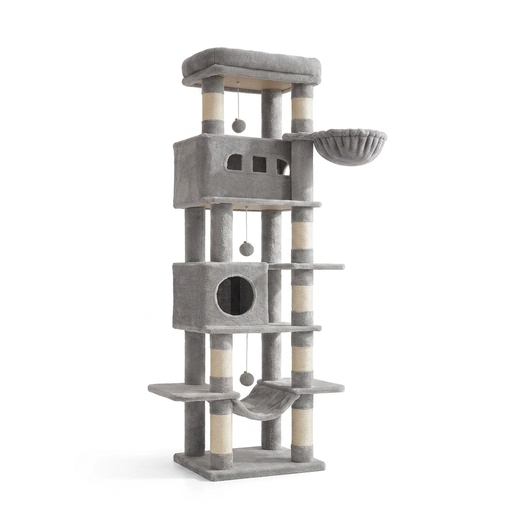
Why it suits this type of cat owner: This model is designed for multiple cats, larger cats and cats that love to climb high. The product listing describes six levels, two hideaways, a basket, a hammock and several resting spots.
According to the product listing, 8 of the 17 posts are wrapped in natural sisal, and the tree has a double-reinforced base with an anti-tip feature. The stated maximum of six cats weighing 6.8 kg each comes from the same product listing and is not an independent assessment.
170 cm tall, with a 50 × 30 cm platform, a 50 × 40 cm hideaway, two washable cushions and replaceable hanging toys.
We’ve put together a complete, up-to-date list of products that meet these strict selection criteria and the applicable European safety regulations.
Place a large cat tree on a level floor and check that all the fittings are secure after assembly. With a tall cat tree, fixing it to the wall may be a sensible extra precaution, especially if your cats are heavy or often jump down from the top level.
Clean plush surfaces regularly with a vacuum cleaner or lint roller. Check the sisal, screws, cushions and toys for wear and tear. It’s best to remove a loose ball or fraying rope straight away. Washable cushions make maintenance easier, but always follow the instructions in the product listing.
It depends on the space you have and your cat’s behaviour. A model of around 80 to 130 cm often suits smaller homes. Active climbers may prefer a cat tree of around 170 cm, as long as it has a wide enough base and stands securely.
Not necessarily. Check the number of resting spots, the width of the platforms and how the scratching areas are arranged. Several cats won’t always use the same level at the same time. A mix of hideaways, a basket, a hammock and open resting spots can help prevent competition for space.
Its lifespan depends on how it’s used, your cats’ weight and the materials. Sisal wears out more quickly when several cats scratch it every day. Tighten the screws regularly, replace damaged parts where possible, and choose a model with cushions or toys that can be removed separately.
