
Vandaag of morgen in huis

Kwaliteit gegarandeerd

Welkomstaanbiedingen ontgrendelen: GRATIS bezorging | Tot 80% korting | Gratis 30 dagen JoyPlus-proefperiode
Download de app
A large cat tree may seem straightforward to choose at first. However, many buyers are tempted by a tall model with lots of platforms without checking whether the base is sturdy enough, the resting spots are spacious enough and the scratching posts are in the right places. This can quickly lead to wobbling, wear and tear, and unused features, especially with heavier cats or multiple cats.
Look out for these common pitfalls:
For larger cats, height isn’t the only thing that matters. Check the width of the base, the size of the platforms and the space inside any cat house. A wide platform, for example 50 × 30 cm, gives a cat more room to stretch out than a small, round platform.
For households with several cats, a model with multiple resting spots is more practical. This means the cats are less likely to have to share the same spot. Also check whether the stated weight capacity applies to the whole unit or to each cat. For example, a product specification might say that a model is suitable for up to six cats weighing 6.8 kg each. Treat this as information provided by the seller, and also check the assembly, floor surface and conditions of use.
A sturdy cat tree should ideally have:
A cat scratching post is only useful if your cat likes the material and the post is tall enough for them to stretch out. Sisal is commonly used for scratching posts. Check how many posts are covered in sisal and how they’re positioned across the cat tree.
When scratching areas are spread over several levels, cats can scratch as they climb or come down. This is more practical than having just one post at the bottom. Also check that the sisal is firmly attached around the post and that worn sections can be replaced.
A cat tree with only play features may not get much use. A combination of platforms, a cat bed, a hammock and one or more enclosed cat houses offers a variety of places to rest.
Look for:
There’s no one-size-fits-all measurement for every cat. Measure your cat while they’re lying fully stretched out, then compare this with the dimensions on the product page. Also place the tree on a level surface, not directly next to a door that’s often opened.
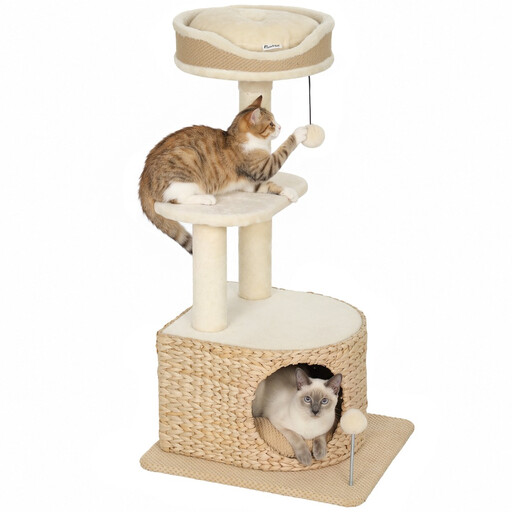
Why it suits this profile: With four levels and a height of 87 cm, this is a compact starter option for an indoor cat or a home with limited space.
Its lower height means you won’t be choosing on height alone. Do check that the dimensions suit your cat.
Four levels, a jute scratching post and a compact design for everyday climbing and resting.
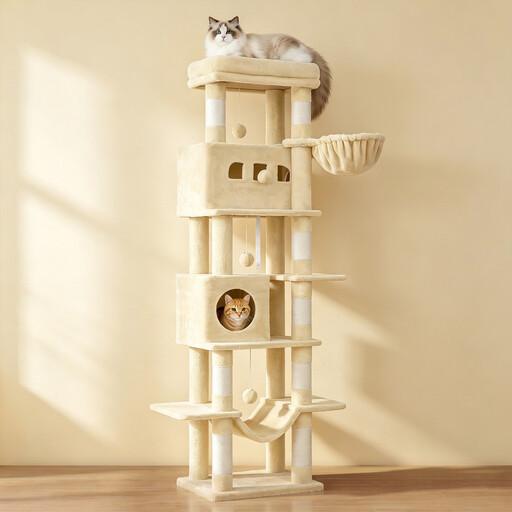
Why it suits this profile: This model is designed for households that need several places to rest and scratch, with a six-level structure standing 212,5 cm tall.
The product information lists 17 support posts, 8 sisal posts, a double base and an anti-tip lock. After assembly, check that everything is securely fastened.
Two cat houses, a hammock, a 30 cm basket, two washable cushions and eight replaceable toys.
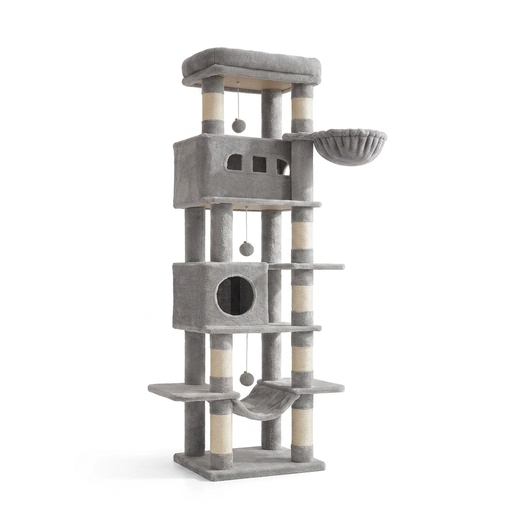
Why it suits this profile: A good choice if you’re looking for a large cat tree with platforms, two cat houses, a hammock and several scratching areas.
The stated dimensions are 170 × 50 × 40 cm and the base is double-reinforced. The seller lists an anti-tip device and 17 support posts.
Eight sisal-covered posts, a 50 × 30 cm platform, two cushions and a removable top platform.
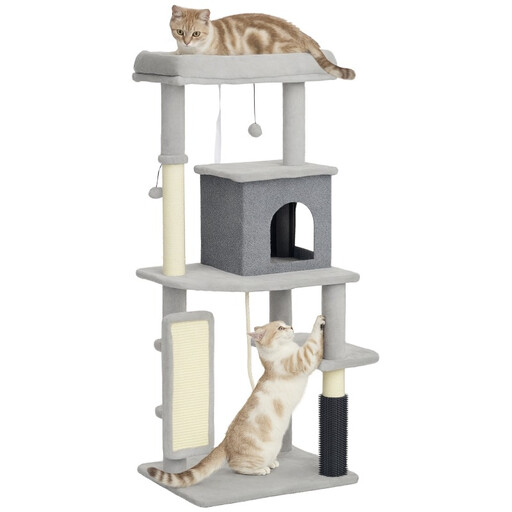
Why it suits this profile: A mid-height cat tree for indoor cats that need a combination of sleeping, climbing and scratching features.
The combination of sisal posts, an anti-tip kit and a dedicated resting spot makes its features clearer than those of a model with dangling toys alone.
132 cm tall, with sisal scratching posts, a cat bed, cat house, jumping platform and grooming brush, according to the product information.
We’ve put together a complete, up-to-date list of products that meet these strict selection criteria and the applicable European safety requirements.
Position a tall cat tree in its final spot before attaching all the cushions and toys. Tighten the connections evenly, then check again after a few days to see whether anything has come loose. For a tall model, securing it to the wall is a good idea if the instructions allow for this.
Clean soft parts regularly with a vacuum cleaner or lint roller. Washable cushions can be cleaned according to their care label. Replace damaged dangling toys and check that the sisal hasn’t come loose. This will help keep the cat tree usable and reduce the risk of loose parts.
If you have several cats, choose a tree with at least several resting spots, a spacious cat house and different scratching areas. Overall height matters less than stability and how the resting spots are arranged. Measure your heaviest cat and compare their size with the platforms and baskets.
Place the tree on a level, firm floor and choose a model with a wide base and an anti-tip device. Assemble all the posts according to the instructions and use any wall anchor provided. Check the structure again after your cats have used it for a few days.
Its lifespan depends on the number of cats, their weight, how often they scratch and the quality of the assembly. A cat tree with several sisal posts spreads the wear and tear. Regularly check the screws, fabric covering and sisal wrapping, and replace any parts that come loose or become damaged.
