
Vandaag of morgen in huis

Kwaliteit gegarandeerd

Welkomstaanbiedingen ontgrendelen: GRATIS bezorging | Tot 80% korting | Gratis 30 dagen JoyPlus-proefperiode
Download de app
A large cat tree needs to offer more than just plenty of space in a product photo. Large, active cats put considerably more strain on a platform when they jump on it than a young, lightweight cat. In a multi-cat household, there’s also the extra movement, climbing and resting at the same time.
There are a few common pitfalls, though, that can make a large cat tree less practical than you might expect.
A tall cat tree takes up relatively little floor space, but its centre of gravity is higher. A narrow base or loose connections can cause it to wobble. So check more than just the height:
For models over 150 cm tall, wall mounting is strongly recommended. Also place the cat climbing tower on a flat, non-slip surface.
An XXL cat tree may have several levels, hideaways and toys, but that doesn’t automatically mean several cats can play together comfortably. Check the size of the resting platforms and how the resting spots are arranged.
A cat hideaway offers privacy, while a basket or cat hammock provides an open place to rest. For multi-cat households, a combination of both is more practical than one large platform that all the cats have to share at once.
Plush feels soft, but cat hair quickly builds up on fabric surfaces. A model with removable or washable cushions is easier to maintain. Also check that the sisal covering is fitted to the main climbing areas. A few short strips of sisal may not be enough for cats that scratch every day.
First, measure the space available in your home. Leave enough clear space above the cat tree, and don’t place it next to windows with dangling cords, heaters or open flames.
Next, check the stated static load capacity. This is the weight the structure is said to support while stationary, according to the product information. It doesn’t automatically tell you how much force the tree can withstand when a cat jumps on it. For a cat tree for large cats, a wide base and secure fixing are therefore at least as important as the stated maximum weight.
Examples from the product information:
Use these figures for comparison, not as a guarantee for every situation. Regularly check the screws, connecting pieces, platforms and sisal.
Natural sisal is a widely used material for sisal scratching posts. Check how many posts are fully wrapped and where they’re positioned. Cats often scratch vertically, so long, sturdy posts are more practical than small horizontal surfaces.
A model with several scratching posts at different heights can help encourage your cat to scratch the tree instead. The product description may present this as a way to protect your furniture, but every cat is different. You could also place an extra scratching board next to your cat’s favourite sleeping spot.
A well-designed layout has practical distances between levels. Steps in between and wide platforms are useful for older cats or those that are less agile. Also check that the top resting spot is large enough for your cat to stretch out on.
A cat tree with a basket, enclosed hideaways, a hammock and toys offers a range of ways to play and rest. Check hanging pom-poms and balls for signs of wear, and remove any loose parts straight away.
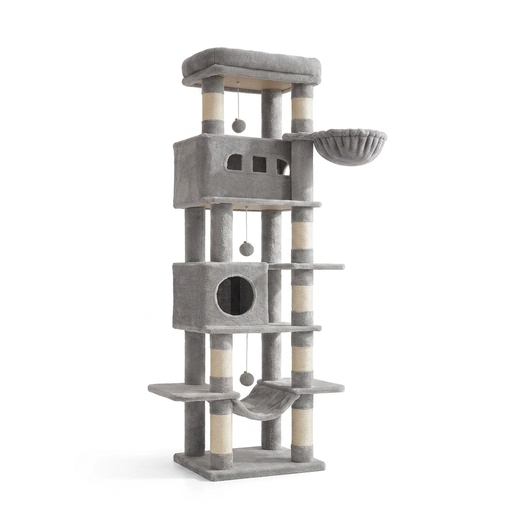
Why it suits this profile: A well-designed large cat tree with six levels for households looking for vertical play space without opting straight away for a model over two metres tall.
The description mentions a wider, double-reinforced base and an anti-tip feature. There are 17 posts, 8 of which are covered in sisal.
Six levels, two cat hideaways, a hammock, a 30 cm basket and removable cushions.
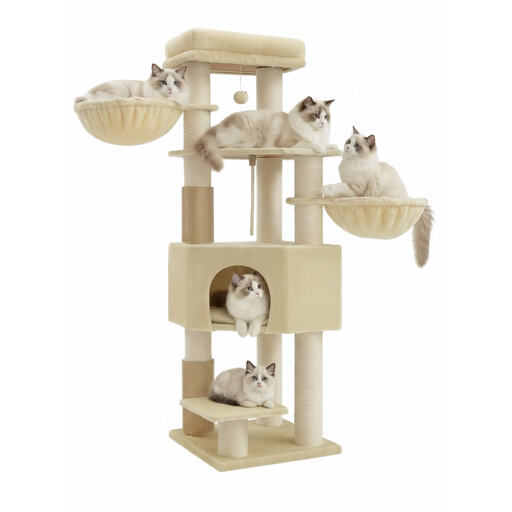
Why it suits this profile: A good choice if easy maintenance matters as much as climbing and resting space.
The product information mentions an anti-tip base, washable parts and the need to secure the tree to a load-bearing wall.
160 cm tall, 9 sisal posts, a built-in brush, a hideaway and a large resting platform.
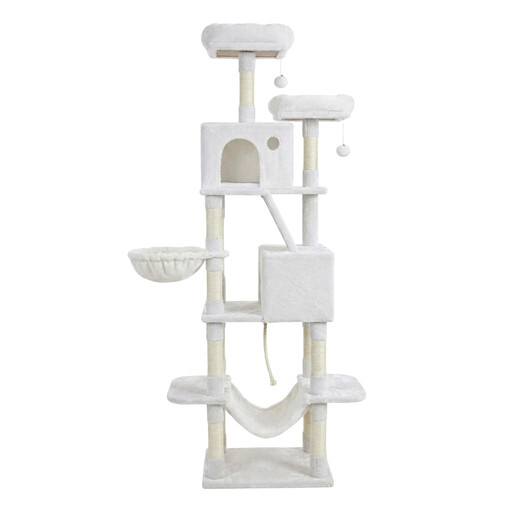
Why it suits this profile: An option for active cats or multi-cat households that make use of plenty of vertical space and different places to rest.
The tower has 13 natural sisal posts, a large base and an anti-tip kit included. Wall mounting is strongly recommended.
206 cm tall, two cat hideaways, two platforms, a basket, a hammock and a stated static load capacity of up to 75 kg.
A cat tree is no substitute for supervision. If you’d like to keep an eye on your cat remotely or interact with them, you could consider an interactive pet robot. According to the product information, the Enabot Rola PetPal has a 2.5K camera, night vision, motion detection, two-way audio, wifi and a 32GB microSD card included.
According to the specifications, the robot runs for around two hours before returning to its charging station. Place the station on a flat surface and keep the device away from water. Using a camera also comes with privacy responsibilities: make sure your account and wifi network are secure. The robot is an extra for monitoring and entertainment, not a replacement for daily care.
We’ve put together a complete, up-to-date list of products that meet these strict selection criteria and the applicable European safety regulations.
Assemble the tree on a flat, stable surface, following the instructions. Check all the screws once it’s assembled and use the anti-tip kit provided. It’s usually a good idea to secure a tall cat tree to a suitable load-bearing wall. Before you start, check that the wall and wall plugs you’ve chosen are suitable for this type of fixing.
Its lifespan depends on how many cats use it, their weight, how often they jump and the quality of the connections. Regularly inspect the sisal, fabric parts, platforms and screws. Replace or repair worn sisal posts or loose parts before using the tree again.
As well as the purchase price, maintenance and any replacement parts are the main things to consider. Washable cushions and replaceable toys can be useful. With a very tall tree, you should also factor in wall mounting and regular checks of all the connections.
