
Vandaag of morgen in huis

Kwaliteit gegarandeerd

Welkomstaanbiedingen ontgrendelen: GRATIS bezorging | Tot 80% korting | Gratis 30 dagen JoyPlus-proefperiode
Download de app
A large cat tree offers more than somewhere for your cat to sharpen its claws. For indoor cats, a tall cat tree can also provide space to climb, play and rest. The layout is particularly important in a multi-cat household: a single small platform or hammock can quickly lead to jostling and unused features.
When comparing options, look beyond the height and number of levels. These common pitfalls are worth keeping in mind.
An extra-tall cat tree is eye-catching, but a narrow or lightweight base can wobble when a cat jumps onto the highest platform. Check the base dimensions, the weight of the structure and whether the post can be secured to the wall.
A cat climbing tree over 150 cm tall should stand on a flat, stable surface. Use the supplied anti-tip device if one is included, and check the screws and joints regularly.
A product may be described as an XXL cat tree, even if it offers only a limited number of places to lie down. Look at the actual layout: are there several platforms, cubby holes, a basket or a cat tree with a hammock? For multiple cats, separate resting areas are more practical than one large lounging surface.
Soft plush covering is comfortable, but it is no substitute for well-positioned scratching surfaces. A cat tree with sisal scratching posts is more useful when the posts are long enough for your cat to stretch out against. An angled sisal ramp can also provide an extra route and scratching area.
First, measure the available space. A 168 cm model will not fit under every windowsill or in every room. Also allow for clearance from curtain cords, radiators and windows.
Next, check:
The product description for the 168 cm model states a maximum total static load of 65 kg. The two 206 cm models list maximum loads of 70 kg and 75 kg respectively. These are manufacturer specifications; use the cat tree only after assembling it correctly and checking it over.
Sisal is used for scratching areas, while plush is mainly used for resting spots and covering. Check that the sisal is wrapped securely around the posts and that no loose threads or small parts are sticking out after assembly.
According to the product information, the models listed are made from materials including particleboard, plush, sisal and metal fittings. Check all the joints after assembly. Replace or repair any parts if a post, basket, hammock or covering becomes damaged.
A multi-cat furniture unit benefits from having levels at different heights. Platforms at varying heights, two cubby holes and several scratching posts give cats more choice. However, the overall capacity depends on the size and behaviour of the cats. The statement that the 168 cm model is “suitable for up to six cats” comes from the product description; it does not guarantee that every group of cats can comfortably use all the levels at the same time.
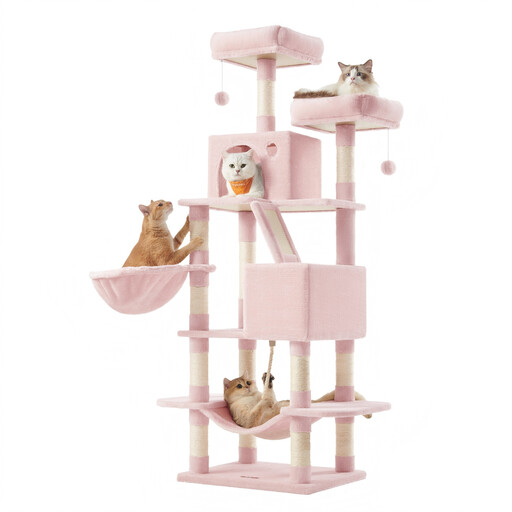
Why it suits this profile: A versatile cat tree for indoor cats that offers several features without taking up the space needed for a tower over two metres tall. According to the product description, it has five levels, two cubby holes, a basket and a hammock.
The layout combines 13 scratching posts with a ramp and several resting spots. The product description also mentions a reinforced base and an anti-tip device.
168 cm high, with 14 scratching surfaces in total and a stated static load capacity of up to 65 kg.
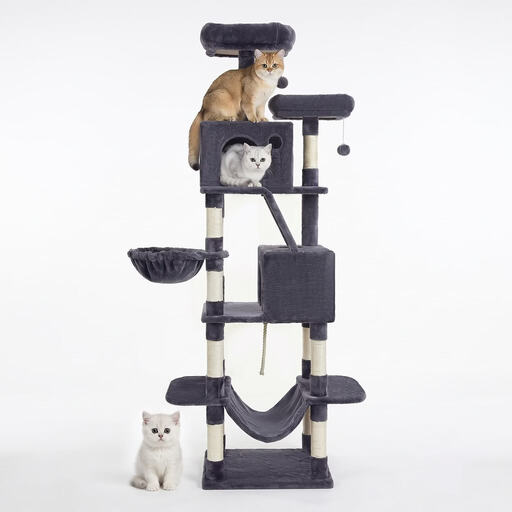
Why it suits this profile: This extra-tall cat tree is designed for active cats and households looking to make the most of vertical space. According to the product description, its grey covering complements a neutral interior.
The tower has 13 sisal posts, a scratching ramp, two cubby holes, two platforms and a hammock. The product information mentions a reinforced base and strongly recommends securing it to the wall.
206 cm high, with a stated total static load capacity of up to 70 kg according to the product description.
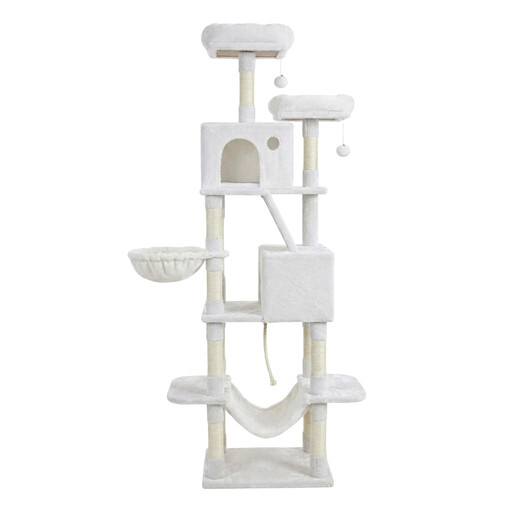
Why it suits this profile: An option for several active indoor cats that need different areas for climbing, playing and resting. The light colour complements a calm interior style, while the tall design saves floor space.
Alongside 13 sisal posts, it has two platforms, two cubby holes, a basket and a hammock. The product information mentions a reinforced base and a total static load capacity of up to 75 kg.
206 cm tall, with several resting areas and 13 sisal scratching posts according to the product description.
We’ve put together a complete, up-to-date list of products that meet these strict selection criteria and the applicable European safety regulations.
Place the cat tree on a flat, non-slip surface and keep it away from heat sources, open flames and areas where cords or window blind cords could get caught. Assemble each part according to the instructions supplied.
Give your cat time to get used to the different levels. A toy or some food can help make the platforms and scratching areas more appealing. After that, check regularly for:
It is a good idea to supervise kittens, older cats and very active climbers while they get used to the tree.
Place it on a flat surface, tighten all the joints securely and use the supplied wall fixing. Securing tall models to the wall is strongly recommended. Check the structure again after your cat has used the tree for a few days.
Its lifespan depends on the number of cats, their weight, how much they jump and how well the tree is maintained. There is no set lifespan. Regular vacuuming, tightening loose parts promptly and replacing worn sisal or covering can help keep it in good condition for longer.
It can be, provided there is enough ceiling height and a stable spot for it. A tall cat tree makes good use of vertical space, but it still needs room for its base. Measure the floor space, ceiling height and clearance before ordering.
