
Vandaag of morgen in huis

Kwaliteit gegarandeerd

Welkomstaanbiedingen ontgrendelen: GRATIS bezorging | Tot 80% korting | Gratis 30 dagen JoyPlus-proefperiode
Download de app
A large cat tree is a significant investment in your cat's well-being and the protection of your furniture. Yet, the purchase often leads to disappointment. An unstable construction, materials that wear out quickly, or a design that's completely unsuitable for an adult cat are common problems. Before you make a choice, it's important to know what to look for to avoid buying an expensive piece of furniture that your cat ignores or that falls apart after just a few months.
This guide is designed to help you see through the marketing jargon and find a model that truly fits your cat and your living situation.
Many large cat trees look impressive at first glance but fall short in practice. Watch out for these three common design flaws:
large cat tree with a base plate that's too small or light will wobble as soon as your cat jumps on it. Cats sense this immediately and will avoid an unstable tree. This is not only a waste of money but also dangerous.sturdy cat tree depends entirely on the quality of its materials—something that's hard to judge from a product photo.cat tree for large cats requires generously sized lounging areas and a robust construction.To avoid the pitfalls above, focus on a few verifiable specifications. These factors determine whether a cat scratching furniture is worth the money.
A stable cat tree is the absolute foundation. Check the following points:
tall cat tree, an included wall anchor is essential. This allows you to secure the top of the cat tree to the wall, making tipping over virtually impossible.The lifespan is determined by the materials used.
A cat climbing tree must be functional. The dimensions of the various components are crucial, especially for a cat tree for multiple cats.
Based on the criteria above, we have selected a few models that suit different needs and households.
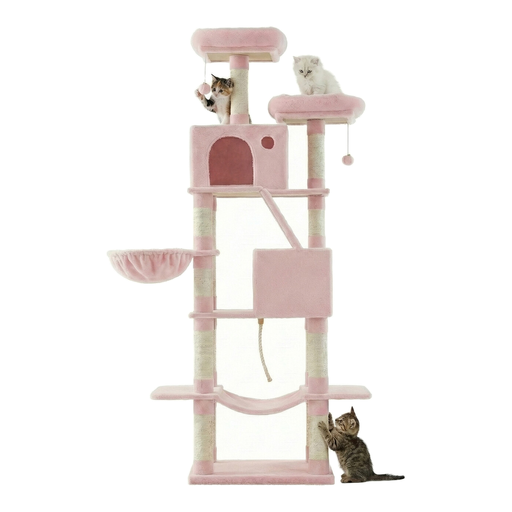
Why This Fits Their Persona: With multiple cats, personal space is essential to avoid conflicts. This model, over 2 meters tall, offers two condos, a hammock, a basket, and various platforms, providing enough individual spots for everyone.
The large, reinforced base plate and high static load capacity (up to 75 kg according to the manufacturer) tackle the stability problem that can arise with use by multiple cats. The 13 scratching posts distribute the wear and tear.
Huge vertical space and a wide variety of resting and play areas. Includes a scratching ramp for cats that prefer to scratch horizontally.
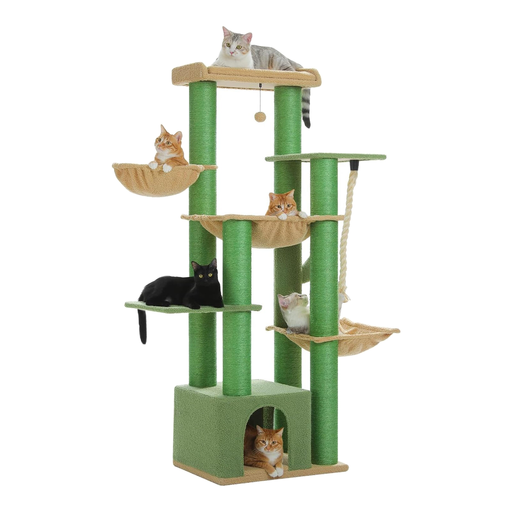
Why This Fits Their Persona: Large cats need an `XXL cat tree` that can handle their weight and strength. This model is specifically designed for cats up to 10 kg, with extra-large hammocks, platforms, and a spacious condo.
Tackles the "designed too small" problem with generously sized components. The 11 cm thick sisal posts can withstand the scratching habits of large, strong cats and provide a robust climbing structure.
Very robust construction with extra-thick posts. The removable and washable cushions and hammocks make maintenance easy.
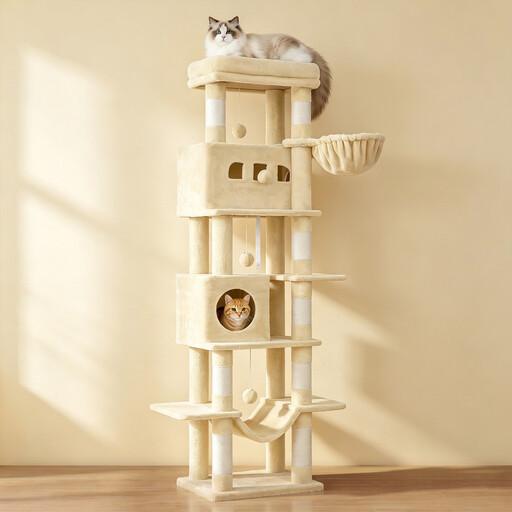
Why This Fits Their Persona: If you don't have much floor space but still want to offer your cat a `cat climbing tree`, a vertical design is the solution. This model makes optimal use of height, providing plenty of climbing, playing, and resting space on a relatively small footprint.
The double-layered, integrated base lowers the center of gravity and improves stability, which is essential for a `tall cat tree`. The built-in anti-tip hardware provides extra security.
Offers many features (dual condos, hammock, large platform) in a slim, vertical design. The staggered layout makes climbing easy for most cats.
We have compiled a complete, up-to-date list of products that fully meet these strict selection criteria and current safety regulations.
The most important step is to assemble the cat tree correctly according to the instructions. Place it on a flat, stable surface. For all models taller than 150 cm, it is strongly recommended to use the included anti-tip hardware to secure the cat tree to a solid wall. Check the screws after a few weeks of use and tighten them if necessary.
This depends heavily on the quality of the materials and the intensity of use. A well-constructed cat tree with thick sisal posts can last for several years. On many models, it's possible to replace worn-out sisal posts, which can significantly extend the lifespan.
Give your cat time to get used to it. You can make the cat tree more appealing by sprinkling some catnip on it. Place it in a strategic location, for example, near a window or next to the sofa (the very spot you want to protect). Play with your cat on and around the tree, and occasionally place a treat on one of the platforms to encourage exploration.
