
Vandaag of morgen in huis

Kwaliteit gegarandeerd

Welkomstaanbiedingen ontgrendelen: GRATIS bezorging | Tot 80% korting | Gratis 30 dagen JoyPlus-proefperiode
Download de app
A large cat tree is a significant investment. You're hoping for a sturdy playground for your cat and an end to scratched furniture. But the reality can be different: after a few weeks, the structure wobbles, the sisal is shredded, and your cat ignores it completely. As a Product Recommendation Officer at Joybuy, I see where things often go wrong. Let's review the most common pitfalls so your next purchase can be a success.
The two biggest missteps when buying a large cat tree can often be traced back to hidden flaws:
large cat or multiple cats jump on it, the entire tower becomes unstable. Cats sense this immediately and will avoid an unsafe spot.A good cat tree is more than just some plush and sisal. It's a piece of territory for your cat that must offer security, comfort, and stimulation.
To ensure you don't make a poor choice, there are a few technical specifications you should always check. These details determine whether a cat tree will still be standing after a year of use.
The stability of a tall cat tree starts at its foundation. A wide, heavy base plate is essential to keep the centre of gravity low. Pay attention to the dimensions and total weight of the cat tree. For added safety, especially with an XXL cat tree, an anti-tip device is indispensable. This is a bracket or strap that allows you to anchor the cat tree to the wall. Many manufacturers include this as standard, which is a good sign.
The scratching posts are the most important component for your cat. The quality of the sisal rope determines its longevity. Even more important is the diameter of the posts. For a cat tree for large cats, a post diameter of at least 12 cm is recommended. Thicker posts are not only sturdier but also offer more surface area and resistance, which is more satisfying for a large cat to sink its claws into.
A cat tree with a condo and hammock sounds ideal, but the dimensions are often designed for an average-sized cat. Check the specifications of the perches, dens, and baskets. Is the opening to the condo large enough? Can your 7 kg cat lie comfortably in the hammock without it sagging dangerously? A spacious and sturdy resting spot is crucial to ensure the cat tree actually gets used.
Based on the criteria above, we have selected a number of products that suit different needs and households.
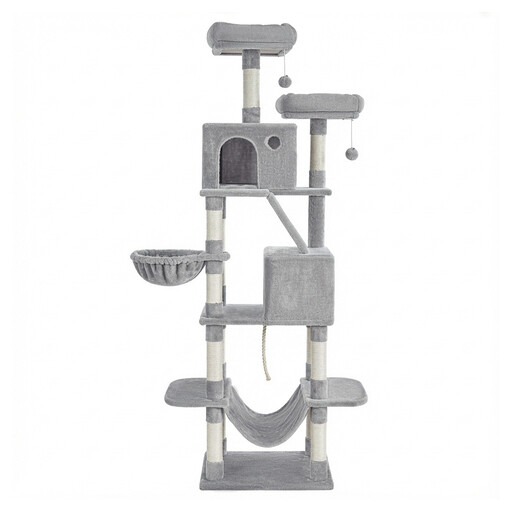
Why This Fits Their Persona: At 206 cm tall with multiple levels, condos, and a hammock, this XXL cat tree is a complete play paradise. It's ideal for households where multiple cats need to share space and want to climb high.
The wide, reinforced base and the included anti-tip device directly address the stability problem, even with the playful antics of multiple cats at once.
With 13 scratching posts, two condos, and various perches, this tall cat tree offers enough individual spots to reduce competition between cats.
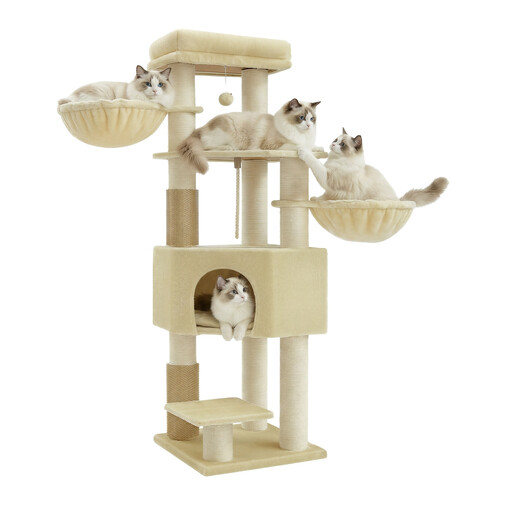
Why This Fits Their Persona: Specifically designed for heavier cats like Maine Coons. The large perch, spacious cave, and sturdy construction provide the necessary support and comfort for a large cat.
The 9 reinforced sisal posts are robust, and the entire cat tree is built on a weighted base. According to the manufacturer, the maximum static load is 105 kg, which minimises wobbling.
Includes self-grooming brushes and washable cushions, which simplifies maintenance for the owner and improves hygiene.
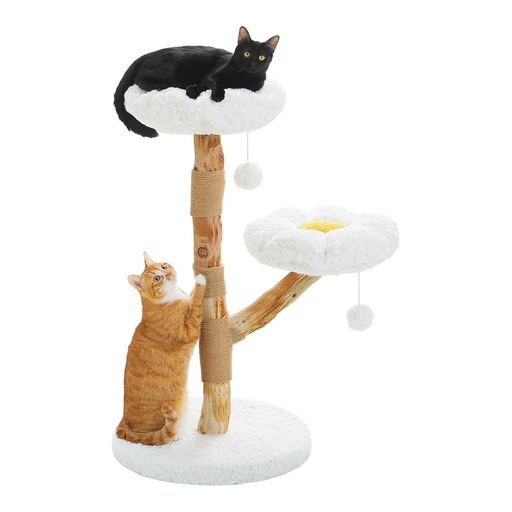
Why This Fits Their Persona: For those seeking a functional cat tree that isn't an eyesore. The modern design with natural wood and flower-shaped perches fits seamlessly into a stylish interior, avoiding the typical plush carpet look.
Although more compact, this model focuses on quality. The double-reinforced base and solid wood post offer a level of stability not found in many standard plush cat trees.
Made from natural wood and soft fleece, combining a luxurious look with durability. Suitable for cats up to 7.3 kg.
We have compiled a complete, up-to-date list of products that fully meet these strict selection criteria and safety standards.
The most important step is to use the included anti-tip device to secure the cat tree to the wall. This is especially crucial for models taller than 150 cm. Place the cat tree on a flat surface and regularly check that all screws are still tight, particularly in the first few weeks after assembly.
The lifespan heavily depends on the materials and the intensity of use. A stable cat tree with thick sisal posts and a solid construction of particleboard or wood can last for several years. The sisal rope is often the first part to wear out. On some models, you can replace the posts or the rope, which significantly extends the lifespan.
Cats are social animals that like to have an overview of their surroundings. Place the cat tree in a room where the family often gathers, such as the living room. A spot near a window is often a favourite, as it allows your cat to look outside. Avoid a tucked-away corner in a hallway or attic; there's a high chance the cat tree will be ignored there because it falls outside the cat's core territory.
