
Vandaag of morgen in huis

Kwaliteit gegarandeerd

Welkomstaanbiedingen ontgrendelen: GRATIS bezorging | Tot 80% korting | Gratis 30 dagen JoyPlus-proefperiode
Download de app
A large cat tree for large cats needs to offer more than just height. Large, active cats jump with force, while several cats may want to climb, sleep and scratch at the same time. A narrow post with a lightweight base can therefore start wobbling quickly. A model with plenty of plush but very little sisal may not offer enough practical value either.
Before buying, pay particular attention to these three common pitfalls:
The right choice therefore comes down to dimensions, load capacity, materials, and the layout of the resting and scratching areas.
With a tall cat tree, the base is at least as important as the height. Look for:
An anti-tip kit is not just a decorative extra. With some models, the top must be permanently secured to a load-bearing wall after assembly. So check beforehand whether the chosen location is suitable. Do not leave the cat tree freestanding on a slippery floor if the instructions require wall mounting.
For large cats, small platforms and narrow houses are often less practical. A platform measuring, for example, 60 × 40 cm offers more room to stretch out than a small round bed. In multi-cat households, several resting places can help reduce competition between cats.
A practical combination includes:
A cat tree with a house is particularly useful for cats that like to retreat. A cat tree with a hammock also provides an open resting place, allowing cats to choose between shelter and a view.
Sisal is intended as a scratching surface and should be firmly secured around the posts. Check both the number of posts and where they are positioned. A cat tree with sisal posts at different levels may be more appealing than a model with just one scratching column.
Also look for:
No material stays like new indefinitely. Regularly check for loose screws, fraying sisal fibres, damaged upholstery and toys. Replace components as soon as they come loose or are swallowed.
The selection below is based on verifiable specifications such as height, dimensions, number of sisal posts, resting places and mounting options. The stated capacity and features come from the relevant product descriptions.
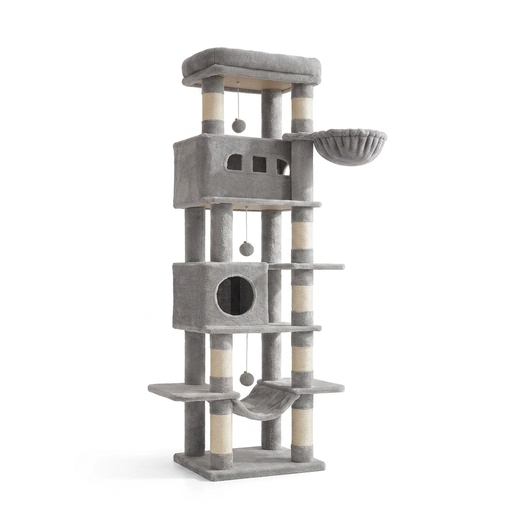
Why it suits this profile: These six levels offer a practical introduction to an XXL cat tree without requiring an extra-wide footprint. The tree has two cat houses, a hammock, a 30 cm bed and two removable cushions.
The description lists 17 support posts, 8 of which are covered in sisal, plus a double-reinforced base and anti-tip protection.
170 cm high, six levels, 8 sisal posts and a removable top platform that, according to the description, can be rinsed with water.
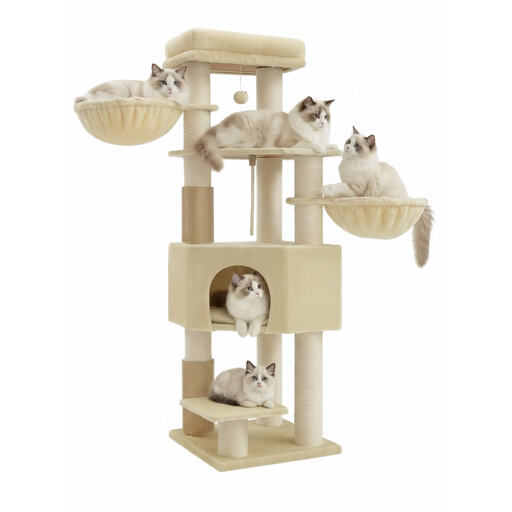
Why it suits this profile: This model combines a large resting area with a cat cave, beds, nine sisal posts and an integrated brush. It is well suited to anyone who values easy maintenance and a permanent set-up.
The product information lists an anti-tip kit and instructs you to secure the tower to a load-bearing wall after assembly.
Dimensions of 50 × 50 × 160 cm, a product weight of 22,6 kg, 9 sisal posts and a static maximum load of 105 kg according to the product information.
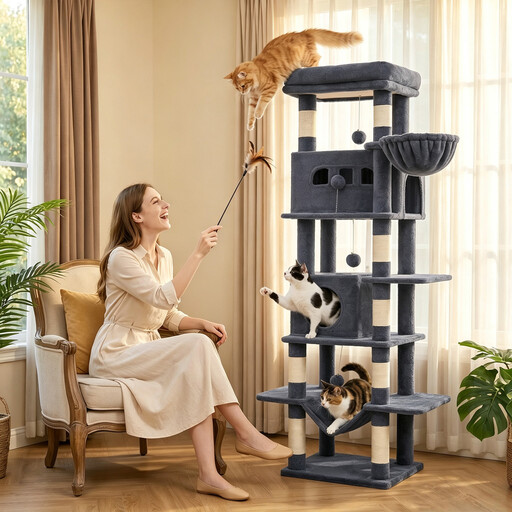
Why it suits this profile: The vertical layout makes good use of height in an apartment. Two cat caves, a spacious 60 × 40 cm platform, a hammock and a cat bed provide different areas for resting and playing.
The description mentions a widened, reinforced base and anti-tip protection. After assembly, check all connections yourself before allowing cats to use the climbing frame.
212.5 cm high, 8 sisal posts, twin cat caves and a vertical, space-saving design.
Place a multi-cat tree on a level surface with plenty of clear space around it. Take doors, radiators and walkways into account. With a tall or heavy structure, it is advisable to use the anti-tip kit properly, even when the base appears stable at first glance.
A good maintenance routine is simple:
If you have several cats, it is worth checking whether they can rest at different levels at the same time. A sturdy cat tree for several cats will not automatically prevent conflicts, but several resting places and escape options make the layout more practical.
We have put together a complete, up-to-date list of products that fully meet these strict selection criteria and the applicable European safety regulations.
Do not look only at the overall height. A spacious resting platform, sturdy support posts and a sufficient footprint are at least as important. Also measure the available floor and ceiling space. With a model more than two metres tall, you should also check whether wall mounting is required.
Its lifespan depends on the cats’ weight, the number of cats, how vigorously they jump and the quality of the connections. Regularly checking the screws and replacing worn sisal or damaged upholstery in good time will help keep the structure usable.
It can be, provided there are several resting places, accessible levels and enough scratching areas. Also check the stated maximum load and follow the assembly instructions. If in doubt, a stable cat tree with anti-tip protection and secure wall mounting is a practical choice.
