
Vandaag of morgen in huis

Kwaliteit gegarandeerd

Welkomstaanbiedingen ontgrendelen: GRATIS bezorging | Tot 80% korting | Gratis 30 dagen JoyPlus-proefperiode
Download de app
A large cat scratching post needs to offer more than an impressive appearance. Large cats, active pets and multi-cat households put more strain on a cat tree than one calm adult cat. A narrow base, thin sisal posts or a wobbly top platform can quickly lead to frustration.
Pay particular attention to these common pitfalls:
A good choice therefore starts not with colour or shape, but with weight capacity, dimensions and the way your cat uses the tree.
A 170 cm tall cat scratching post gives cats extra climbing space and a lookout point. This is particularly appealing to active cats that enjoy jumping upwards. Alongside the height, look at the footprint. A 170 cm model with a narrow base may be less stable than a slightly wider model.
Check the following points:
A stable cat tree should not noticeably move from side to side during normal use. Check all screws after assembly and repeat this regularly. No cat tree is suitable if any parts are loose or damaged.
A sisal scratching post is only practical when the scratching areas are positioned sensibly. Cats often scratch when they wake up, after sleeping or while playing. Sisal around key climbing routes makes it more likely that your cat will use the scratching post instead of the sofa.
Pay attention to:
For example, the 170 cm PAWZ Road model lists 13 sisal posts with a diameter of 11 cm. This is a verifiable product specification, but it does not in itself indicate how long the material will last in your home. That depends on the number of cats, their weight and their scratching habits.
A scratching post for multiple cats should offer more than one small basket at the top. Look at the combination of open platforms, cat houses, hammocks and resting areas. This allows several cats to keep their distance from one another, so they do not all have to use the same spot.
Also consider how the weight is distributed. A statement such as “suitable for up to six cats weighing 6.8 kg each” is a product claim based on the stated specifications. Use this information as a guideline and take your pets’ jumping behaviour into account. According to the brands’ own product information, some models are suitable for larger or multiple cats; this is not an independent guarantee for every household situation.
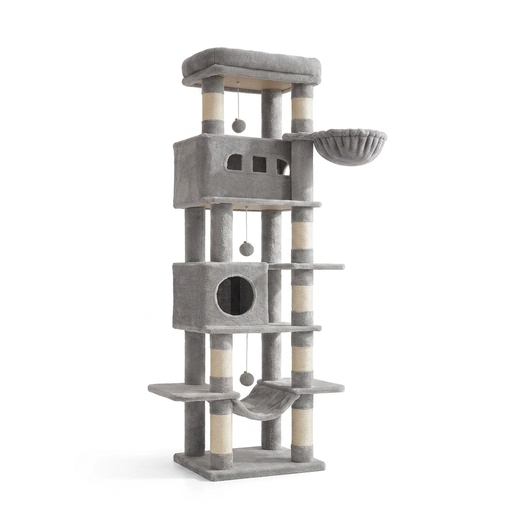
Why it suits this profile: This model combines a height of 170 cm with six levels, a cat house, hammock and several resting areas. It gives you plenty of features in one piece of cat furniture without going straight for the largest model.
The specifications list 17 support posts, eight of them covered in natural sisal, along with a double reinforced base and anti-tip feature.
170 cm tall, six levels, a 50 × 30 cm resting platform and two removable cushions.
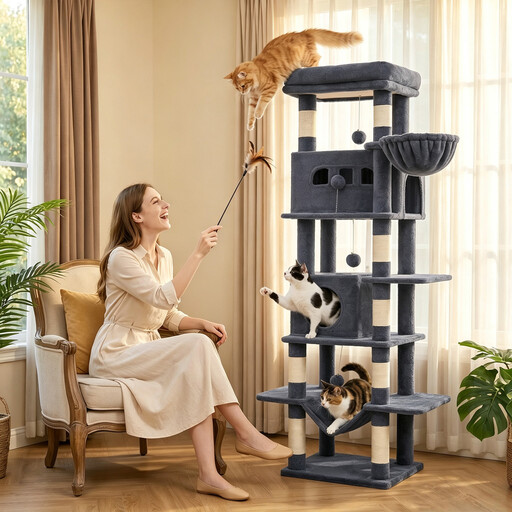
Why it suits this profile: This is a large cat tree for households looking for plenty of vertical space, multiple resting areas and a sturdy construction. Its height does require a room with enough clear space.
The product information mentions a widened, reinforced base, anti-tip features and eight sisal posts distributed across the levels.
212.5 cm tall, six levels, two cat houses, a hammock and a 60 × 40 cm platform with removable cushion.
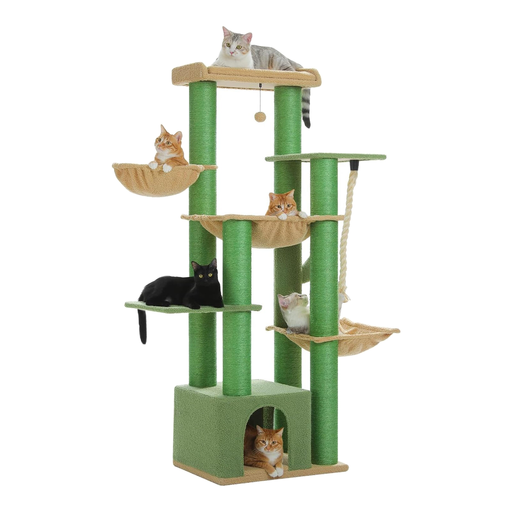
Why it suits this profile: This model is designed for large and active cats that make extensive use of scratching areas, climbing routes and separate resting areas. The stated suitability is up to 10 kg per cat.
According to the product description, the tree has 13 sisal posts measuring 11 cm thick, three hammocks and three extra-large top platforms.
Dimensions of 58 × 45 × 170 cm, product weight of 25 kg, seven levels and an extra-large cat house.
Place the cat tree somewhere your cat already likes to spend time, such as by a window or near the living room. Keep it a safe distance from fragile ornaments and make sure your cat does not have to jump from an unsafe intermediate position onto a cupboard.
Assemble the tree fully according to the instructions. Use an anti-tip strap if one is supplied and check the connections again after a few days. Cushions and hammocks should be washed according to the product information; always check the care label. Remove loose threads, damaged sisal and dangling toys as soon as you notice them.
We have compiled a complete, up-to-date list of products that fully meet these strict selection criteria and the applicable European safety regulations.
For active cats, a model measuring 170 cm or more may be a good choice. More important than height alone are a wide base, suitably sized resting areas and enough space between the levels. Measure the room height beforehand and allow for assembly and any wall fastening.
Its lifespan depends on the materials, use and maintenance. A household with several heavy cats will put more strain on the sisal, screws and platforms. Choose replaceable parts where possible, tighten the connections and inspect the tree regularly for fraying, cracks and loose components.
It can be, provided there are several resting and scratching areas and the stated weight limits suit your cats. A cat tree with multiple levels, two cat houses and a hammock distributes the space more effectively than a compact model with one resting area. Always check the product specifications and place the tree on a stable, level surface.
