Start by checking the laptop’s dimensions and making sure you can read vocabulary lists clearly on the screen. A Chromebook may suit browser-based practice if it supports the apps you need; choose Windows or macOS if your required software calls for it. The Consumers’ Association (Consumentenbond) recommends 14 inches and 8 GB RAM as a guide for basic everyday use, not as a minimum requirement for every buyer.
Who is this choice relevant to?
Reader with limited desk space
You want to view vocabulary lists on screen while leaving room for paper or a notebook. So compare the dimensions of the entire laptop and try reading the text at your preferred size. The Consumers’ Association also points out that a smaller screen can show less content at once.
User of specific practice software
You use a particular app or a programme required by your course. Check which operating system it needs. Google describes apps for ChromeOS, but that doesn’t confirm that every app you need will work on it.
Frequent typist
You enter your own translations and answers, or spend long periods in front of a screen. So check both readability and the keyboard. Arboportaal sets out specific workplace requirements for employees who work at a screen for more than two hours a day when using a laptop.
What should you look for when choosing?
| What to consider |
What should you check? |
Who is this important for? |
| Desk space |
Measure the available space and compare it with the width and depth of the exact laptop model. Also check how the text looks at your preferred reading distance. |
I want to use my laptop beside paper or a notebook without filling up my workspace. Around 29% of consumers give available desk space top priority. |
| Readable vocabulary lists |
View your own list on screen and check that the text is comfortable to read. The Consumers’ Association recommends 14 inches as a guide for basic everyday use, not as a requirement for everyone. |
If I want to read words and translations clearly, I look at the actual text size and reflections, not just the screen diagonal. Around 23% of consumers prioritise readability. |
| Compatible software |
Check whether the apps you need work on ChromeOS, Windows or macOS. For a Chromebook, also check the end-of-update date for the exact model. |
If my course or practice programme requires a particular system, my laptop needs to be compatible with it. Around 18% of consumers give the software they need the greatest consideration. |
| Supplied complete |
Check whether the exact model comes with the charger and any input devices you need. |
I want to know in advance which essentials I already have and which I still need. Around 18% of consumers prioritise having all the equipment they need. |
| Portability and charging |
Compare the weight of the exact model and check what the manufacturer says about battery life; don’t treat this figure as a guarantee of how long it will last in your use. |
If I practise in different places, weight and a suitable charging solution matter. Around 12% of consumers prioritise using their laptop on the go. |
Pitfalls to avoid when choosing
-
Focusing only on the screen diagonal
The diagonal doesn’t tell you how much space the whole laptop takes up on your desk or how large your vocabulary list will appear on screen.
Measure the available space and check the dimensions of the exact model. Also view your own vocabulary list at a text size you find comfortable.
-
Choosing a Chromebook without checking the apps
Whether you can use it for practice depends on the apps and services you need. For a Chromebook, the end-of-update date for the specific model is also relevant.
Before choosing, check the apps you need, whether your materials are available offline and the update information for that model.
-
Not checking what’s included with the laptop
What’s included in an offer can determine whether you have the charger and other essentials you need for your intended use straight away.
Check the contents of the package for the exact model, and only count accessories you actually need.
For the HP OmniBook 5 Flip 14-fp0632ndx reviewed, HP says the charger is sold separately; check whether you already have a suitable charger.
Brands and models for reference
Lenovo
The IdeaPad Slim 3 is a Windows option for anyone who needs Windows programmes as well as browser-based practice.
- Lenovo Netherlands lists an anti-glare 14-inch FHD IPS display, 16 GB RAM and a 512 GB SSD for model 82XN008RMH.
- The RAM is soldered in this model. Check the full model number; these specifications don’t automatically apply to other IdeaPad Slim 3 models.
HP
The OmniBook 5 Flip is a Windows option with a convertible screen for anyone who wants to try a different reading or input position.
- HP Netherlands lists a 14-inch touchscreen, 8 GB RAM and a 256 GB SSD for model 14-fp0632ndx.
- HP says the charger is sold separately for this model. Check what’s included with the specific product.
ASUS
The Chromebook CM14 Flip is a ChromeOS option for browser-based practice, provided the apps you need work on it.
- ASUS says the CM14 Flip series has a hinge that rotates through 360°.
- Before deciding whether it suits your needs, check the specifications and end-of-update date for the exact model.
Apple
The MacBook Air is a macOS option for anyone whose practice programmes work on macOS.
- For the 13-inch M5 configuration shown, Apple Netherlands lists a 13.6-inch display and 16 GB of memory as standard.
- Check the generation and storage configuration of the model you’re considering; models from different generations don’t have the same configuration.
Joybuy laptops for vocabulary lists
This Joybuy selection features compact Windows laptops for reading vocabulary lists and typing answers. Screen sizes and input modes vary by model.
 Image unavailable
HP OmniBook 7 AeroNGAI 13-bg1051nd NL Copilot+
Ideal if you’re looking for a 13.3-inch screen and a compact footprint for your desk.
Windows 11, Full HD IPS display, 16 GB RAM and a 512 GB SSD.
Dimensions: 29.73 × 21.12 cm.
Joybuy
 Image unavailable
HP OmniBook 5 Flip 14-fp0075nd C5VM5EA#ABH
Ideal if you want to view vocabulary lists on a touchscreen and switch between different screen positions.
14-inch OLED touchscreen with 1920 × 1200 pixels, 16 GB RAM and a 512 GB SSD.
The hinge offers laptop, tablet, tent and stand modes.
Joybuy
 Image unavailable
HP OmniBook 5 Flip 14-fp0250ndx
Ideal if you want a 14-inch screen and multiple modes for reading and typing.
Windows 11, Intel Core 5 120U, 8 GB RAM and a 512 GB SSD.
14-inch touchscreen with 1920 × 1200 pixels; charger not included.
Joybuy
 Image unavailable
HP OmniBook 3 14-hy0058ndx
Ideal if you want an anti-glare display and can fit the laptop’s dimensions on a small desk.
Windows 11, AMD Ryzen 5 7520U, 8 GB RAM and a 512 GB SSD.
14-inch anti-glare IPS display with 1920 × 1200 pixels. Dimensions: 31.45 × 22.60 cm. Charger not included.
Joybuy
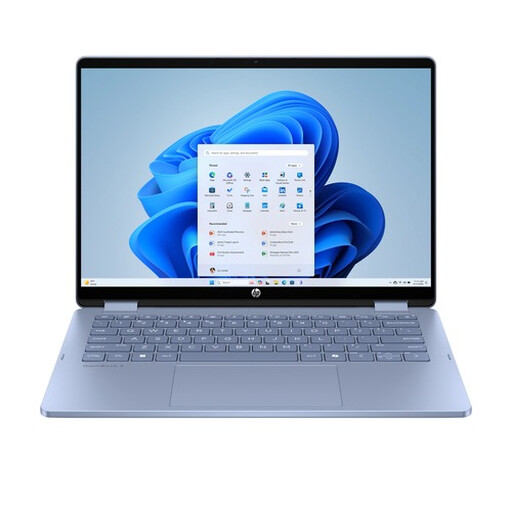 Image unavailable
HP OmniBook 5 Flip 14-fp0251ndx
Ideal if you appreciate a 14-inch touchscreen and an alternative position for reading.
Windows 11 and a 1920 × 1200 IPS touchscreen.
The hinge offers laptop, tablet, tent and stand modes.
Joybuy
Frequently asked questions
Do I need a 14-inch laptop for vocabulary lists on a small desk?
No. The Consumers’ Association recommends 14 inches as a guide for basic everyday use, not as a universal requirement. Measure the available desk space and view your own vocabulary list at a text size you find comfortable.
What should I check when choosing a Chromebook?
Check that your practice apps work on the exact Chromebook model and look up the automatic update end date for that model. Also check whether your practice materials are available offline when you need them.
How should I set up my laptop if I practise for long periods?
Position the screen and keyboard so you can work comfortably, and change your posture regularly. Arboportaal sets out rules for employees who work at a screen for more than two hours a day, which mean that a separate screen or keyboard must be available when using a laptop. These workplace rules don’t automatically apply as a purchasing requirement for every student or hobby user.
Can I return a laptop bought online if I’m not happy with it?
For a distance purchase from a business, consumers in the Netherlands have a 14-day cooling-off period, according to the Dutch government. Check the seller’s information and the applicable terms; a purchase from a private individual isn’t covered by the same distance-selling rule.
Do I always get exactly two years of statutory warranty in the Netherlands?
No. According to the Dutch government, there is no fixed statutory warranty period; what you can expect from a product depends on factors including the product itself, its price and the information provided. If a product is faulty, contact the seller. An additional warranty doesn’t replace your statutory rights.


