
Local regex learner
You want to search, edit and test regular expressions in a desktop editor. Microsoft documents search and replace features in Visual Studio Code; check that the operating system is compatible with the software you want to use.


For local regex practice, you can choose a Windows or Mac laptop. Microsoft documents Visual Studio Code for these platforms and for supported Linux systems. On a Chromebook, local development depends on the Linux environment available and any school or workplace restrictions, as Google explains. Next, choose a screen size and ports that suit your shared desk. A gaming graphics card isn’t automatically necessary for Visual Studio Code’s basic requirements.
You want to search, edit and test regular expressions in a desktop editor. Microsoft documents search and replace features in Visual Studio Code; check that the operating system is compatible with the software you want to use.
You move between workspaces and want to position and connect your screen and input devices properly each time. Arboportaal recommends setting up your workstation again whenever you use it.
You take your laptop with you and do most of your practice in a browser, but want to know whether you can use local development tools later on. Google warns that Linux may not be available on Chromebooks managed by a school or workplace.
Microsoft outlines the basic requirements for Visual Studio Code, while Google notes that Linux may be restricted on a managed Chromebook. So check your software first, then choose a screen and ports that suit your shared workspace.
| What to consider | What should you check? | Who is this important for? |
|---|---|---|
| Software and operating system | Check that your editor and any local tools work with the operating system. On ChromeOS, also check the Linux environment and management settings. | If I want to practise locally in a desktop editor, I want to know beforehand whether my software will work. Around 33% of consumers prioritise software compatibility. |
| Connecting at your desk | Compare the laptop’s ports with the monitor, and check that the keyboard, mouse and power supply will work. | When I use a shared desk, I want to be able to connect and position my screen and input devices properly each time. Around 27% of consumers prefer this workstation set-up. |
| Size and portability | Compare the dimensions, weight and screen size of the exact configuration, and consider whether there’s already a monitor at the desk. | If I move between workspaces, I want a laptop that suits the way I travel and work. Around 20% of consumers prioritise portability. |
| Essential accessories and features | Check what’s in the box, which adapters and connections you need, and the warranty terms. | I want to know in advance which items I need and what support is available, so I can use the laptop at my workstation. Around 20% of consumers focus on these features and support. |
Google says the Linux development environment may not be available on Chromebooks provided by a school or workplace. This could prevent you from using local development tools.
First decide which editor and tools you want to use, then check whether Linux is available on the device you’re considering and under its management policy.
If local tools aren’t available, you may need a different way of working or another device.
Capabilities vary by laptop and port. Apple lists different capabilities for each USB-C port on the MacBook Neo, while Lenovo documents video output for the IdeaPad Slim 3 15IRH10 range.
Compare the video output on the exact configuration with the connection and resolution of the monitor at your shared desk.
Depending on the ports available, you may need a different cable or a suitable adapter.
For the OmniBook 5 Flip 14-fp0605ndx described by HP, the recommended USB-C adapter is sold separately.
Check what’s in the box and make a note of which items you’ll actually need for your workspace.
An adapter or accessory needed for your shared workspace may be sold separately, depending on what you already have.
The Vivobook 14 M1407GA is a compact Windows option for editing and smaller desk spaces.
The IdeaPad Slim 3 15IRH10 is worth comparing if you’re looking for a larger built-in workspace and display connections.
The MacBook Neo is a compact option if you want to use macOS.
The Chromebook Plus 514 CB514-6HT-32PZ is a ChromeOS option for mainly browser-based practice.
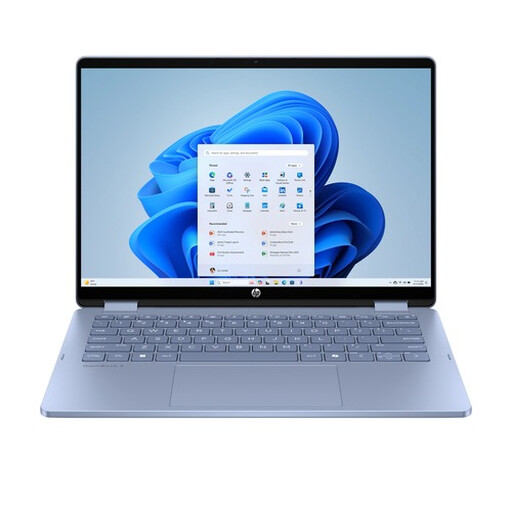
The OmniBook 5 Flip 14-fp0605ndx is a Windows option with a convertible touchscreen.
This selection focuses on laptops for local regex practice and use at a shared desk. The product list mainly features Windows models, plus one MacBook.
 No image available
A Windows laptop for local practice in a desktop editor, with connections for use at a shared workspace.
14-inch touchscreen and 16 GB of memory. The description lists HDMI and USB-C with DisplayPort.
A USB-C charger isn’t included and must be purchased separately.
 No image available
A Windows configuration for local editor practice, with connections for a shared workspace.
14-inch touchscreen, Intel Core 5 120U, 8 GB RAM and 512 GB SSD. The description lists HDMI, USB-A and USB-C.
The USB-C charger isn’t included and must be purchased separately.
 No image available
A Windows laptop with a larger built-in screen, ideal if you want to view your editor and search results side by side at your desk.
15.3-inch WQXGA OLED screen, 16 GB DDR5 and 512 GB SSD. The product name lists a GeForce RTX 5060; Visual Studio Code’s basic requirements don’t make this necessary for regex practice.
 No image available
A Windows laptop with a larger anti-glare screen for working with text at a shared desk.
15.6-inch Full HD screen, Core 3 304, 8 GB RAM, 256 GB SSD and QWERTY keyboard. The description lists a hinge that opens to 180 degrees.
 No image available
A macOS laptop for local editor practice if you want to use that operating system and need a larger screen.
15.3-inch screen, 16 GB of memory and 512 GB of storage. The description lists support for up to two external displays.
A USB-C power adapter isn’t included; according to the description, you’ll need an adapter rated at 35 W or higher.
Not according to the documented basic requirements for Visual Studio Code. Microsoft lists a processor running at 1.6 GHz or faster and recommends 1 GB of RAM, without requiring a gaming graphics card. Other software or many tasks running at once may have different requirements.
You can if the Linux development environment is available on that device. Google says this environment may not be available on a Chromebook provided by a school or workplace, so check the device and its management policy before choosing.
Set up the workstation again each time, and check whether you can use a separate keyboard and, if needed, an external screen. Arboportaal offers this as workstation guidance. The specific rules for employees apply, among other cases, when they spend more than two hours a day working with display screens; they don’t automatically apply to every student.
According to ACM ConsuWijzer, the seller is responsible for the statutory guarantee if a product doesn’t meet the standard you could reasonably expect when used normally. A manufacturer’s guarantee doesn’t replace this right, and there’s no fixed statutory guarantee period in the Netherlands that applies to every laptop.
For online consumer purchases, there’s generally a statutory 14-day cooling-off period after delivery, subject to legal exceptions. ACM ConsuWijzer recommends checking the seller’s information about cancellation and returns before you place your order.