
Student using specific layout software
Your course requires a particular desktop programme. So check the operating system and supported software version first. Adobe and Affinity each publish their own system requirements.


Start by choosing your layout software and checking that the laptop supports the version you need. Adobe InDesign and Affinity list Windows and macOS in their desktop requirements. For a photo-heavy recipe book, screen space, memory and storage are important things to compare. A smaller screen is easier to carry around, but shows less of your page at once.
Your course requires a particular desktop programme. So check the operating system and supported software version first. Adobe and Affinity each publish their own system requirements.
You’re working with lots of pages and photos in your room, and want to store files locally. The Consumentenbond recommends 512 GB or more for people who often work with large photo or video files. Lenovo Netherlands also highlights the combination of layouts and images as a consideration for creative work.
You take your laptop between your room, lectures and other places to work. So compare screen space with how easy you want the laptop to be to carry around. Apple lists 13-inch and 15-inch screen sizes for the MacBook Air.
Best for: anyone who wants to use InDesign or Affinity on a Windows computer and choose between more compact and larger screens.
Keep in mind: check the exact Windows version, processor architecture, memory and screen specification. Adobe described native InDesign support for Windows ARM in version 22.0 as a beta.
Best for: anyone who wants to work on macOS and is looking for either a portable 13-inch model or a roomier 15-inch screen.
Keep in mind: a smaller screen takes up less space, but shows less of the page and tools at once. Check the app and macOS versions you need, as well as the storage capacity of the configuration you choose.
Best for: anyone who can complete the entire layout and export process using a browser-based service.
Keep in mind: the desktop requirements we checked for InDesign and Affinity list Windows and macOS, not ChromeOS. Before buying, test that your assignment files and print exports work as required.
| What to consider | What should you check? | Who should pay extra attention? |
|---|---|---|
| Software compatibility | Check the operating system, app version and, for Windows, processor architecture. Adobe lists 8 GB RAM as the minimum for InDesign 21.3 and later, and recommends 16 GB. | If your course requires a particular desktop programme, you’ll want to make sure you can complete your assignment using it. Around 33% of consumers put software compatibility first. |
| Screen and photo files | Compare the screen size and resolution of the exact model. For lots of large photo files, the Consumentenbond recommends 512 GB or more for storage. | If you work with lots of recipe pages and photos, you’ll want to view them clearly and store your project files. Around 27% of consumers give screen space and photo work top priority. |
| Total cost | Include the software you need in your comparison. Adobe says InDesign is available via a membership; also check that any alternative can handle the required files and print exports. | If you want to know in advance what you’ll need to spend on both a laptop and the necessary software, compare the full setup. Around 20% of consumers put total cost first. |
| Portability and workspace | Balance screen size against how often you’ll carry your laptop around. Also check which connections you need and whether the right charger is included. | If you work on your book in different places, you’ll want a size you can carry without giving up more workspace than necessary. Around 20% of consumers give portability top priority. |
The desktop requirements we checked for InDesign and Affinity list Windows and macOS, not ChromeOS. A convenient browser alone doesn’t confirm that you’ll be able to complete the entire assignment.
Check which programme and file format your course or printer requires. If possible, test with a sample file to see whether you can edit it and export it correctly.
If you can’t complete the assignment on the device you choose, you may need access to another suitable computer or software.
Lenovo lists an optional OLED screen for the IdeaPad Slim 5 range, while model 83J3004VMH has an IPS screen.
Compare the screen, memory and storage using the full model or product number.
The software you need may also come with costs or conditions. Adobe says InDesign is available via a membership.
First establish which software and export format your assignment requires, then compare the laptop configurations that support them.
If you specifically need InDesign, you’ll also need to factor in the associated membership.
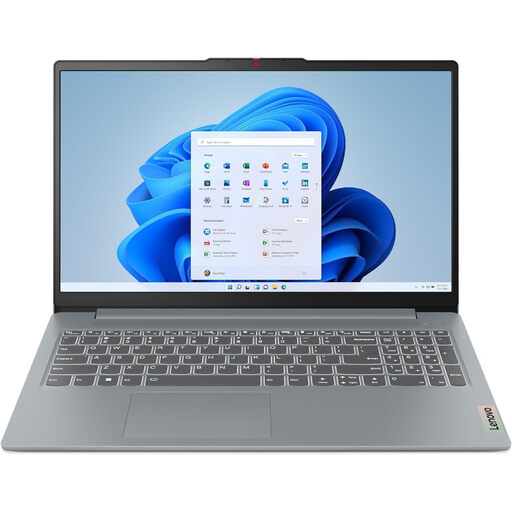
The IdeaPad Slim 5 is a Windows option to compare for page layout.
The MacBook Air offers a macOS option with different screen sizes.
According to HP, the HP OmniBook 5 range includes screen sizes such as 14 and 16 inches.
These Windows and macOS laptops are options to compare for page layout and working with local project files in a student room.
 No image available
A large built-in screen could suit you if you mainly want to view pages and photos at a fixed workspace.
The product listing specifies an 18.4-inch WUXGA IPS screen, Windows 11 Home, 16 GB of memory and a 512 GB SSD.
A suitable 45–65 W USB-C Power Delivery charger is required and not included.
 No image available
This model could suit you if you want to lay out pages on a Windows laptop and store project files locally.
The product listing specifies a 15.3-inch WUXGA IPS screen with anti-glare coating, Windows 11 Home, 16 GB of memory and a 512 GB SSD.
A compatible charger must be purchased separately.
 No image available
This 16-inch model is worth comparing if you want to work on a larger built-in screen.
The product listing specifies a 16-inch 3K OLED touchscreen with 120 Hz, Windows 11 Pro, 32 GB of memory and a 1 TB SSD.
 No image available
This model has a large screen and plenty of listed memory and storage. Compare the configuration with what your book project actually needs.
The product listing specifies a 16-inch 3K OLED touchscreen with 120 Hz, Windows 11 Pro, 128 GB of memory and a 2 TB SSD.
 No image available
A macOS option to compare if you want a larger built-in screen for page layout.
The product listing specifies a 15.3-inch screen, 16 GB of memory and a 512 GB SSD.
A USB-C power adapter is not included and must be purchased separately.
Adobe lists 8 GB RAM as the minimum for InDesign version 21.3 and later, and recommends 16 GB. Meeting the minimum doesn’t guarantee a smooth experience when working on a large recipe book full of photos.
First, ask the printer which PDF settings they require. InDesign offers settings for print-ready PDFs; Canva recommends checking margins, bleed and crop marks when designing for print. Follow the printer’s submission specifications.
Check the requirements for the app you’ve chosen before installing it. Adobe says an internet connection is needed to activate InDesign and validate your membership. The Consumentenbond recommends keeping files you use often stored locally, and saving other files externally or online too.
According to the Dutch government, you’re entitled to a product that works properly, and the seller must find a solution if there’s a problem. For distance purchases, a 14-day cooling-off period applies in many cases; whether it applies depends on the purchase and any exceptions.