
Portfolio viewer on the go
Often takes a laptop between lectures and wants to make use of short breaks to view portfolios without carrying around a bulky device.


For viewing portfolios between lectures, a compact 13- or 14-inch laptop is a sensible starting point if you’re often on the go. If you usually work at a desk and want to see details or several windows side by side, you may prefer a larger screen. When choosing, check the exact screen specification, the software you need and the charging options. Compare battery-life figures with how you actually use your laptop rather than treating them as a guarantee of a full day on campus.
Often takes a laptop between lectures and wants to make use of short breaks to view portfolios without carrying around a bulky device.
When looking at images, pays attention to the screen specification, colour reproduction and visible details, while bearing in mind that screen specifications don’t automatically mean colours will look identical on different devices.
Mainly wants to view portfolios and decide whether extra memory, storage or screen features suit the way they use their laptop.
First consider how often you’ll carry your laptop around and how much screen space you need. Then compare the exact screen specification, storage and ports with what you actually use.
A good fit if: you travel between classrooms and mainly view portfolios on your own or with one fellow student.
Bear in mind: how much room you need to view details and notes side by side.
A good fit if: you usually work at a desk and value having more visible workspace.
Bear in mind: whether the size and weight suit your bag and regular workspace.
| Factor to consider | What to look for when buying | Who is this important to? |
|---|---|---|
| Portability | Compare the screen size and weight of the exact model with your bag and usual workspace. | If I often take my laptop between lectures, I want it to be easy to carry and use in different places; around 36% of consumers say portability is their top priority. |
| Colour and detail | Check the screen variant, resolution, stated colour gamut and how much it reflects light where you work. | When discussing images, I want to judge details clearly and understand the role of colour profiles; around 29% of consumers prioritise screen assessment. |
| Right-sized specification | Decide whether you’ll only view files or also edit large ones; if so, compare the memory and storage of the exact model. | If I mainly view portfolios, I don’t want to pay for features I don’t need; around 21% of consumers say a specification that meets their basic needs is their top priority. |
| Software, ports and charging | Check software and file compatibility, the ports for an external screen and which charger is included. | If I need an external screen or specific software, I want to know in advance that everything will connect and work; around 14% of consumers prioritise compatibility and ports. |
Screen specifications and a file’s colour profile describe different aspects of colour reproduction. A stated colour gamut doesn’t prove that colours will look the same on every device.
If colour is important, check the screen specification of the exact model and the document profile.
Apple quotes different maximum battery life figures for video streaming and wireless internet use on the 13-inch MacBook Air M5. Your own usage, apps and screen settings may differ.
Check what the battery-life figures are based on and consider when you’ll be able to charge during a day on campus.
Apple states that the Mac configuration reviewed does not include a mains adapter.
Check what’s in the box and the required charging power before choosing a laptop.
You may need to buy a suitable adapter separately for that Apple configuration.
The MacBook Air M5 is worth considering if macOS and a choice between a compact model and more screen space suit the way you work.
The Yoga Slim 7 Gen 10 is a 14-inch Windows option to compare if a detailed OLED screen is important to you.
The Zenbook 14 OLED UX3405 series may be worth considering if built-in HDMI and USB-C ports are important to you.
According to Acer, the Swift Go 14 range offers a choice of screen specifications for mobile Windows use.
The OmniBook 5 range includes a variety of sizes and models, convertible options and OLED configurations.
These Joybuy products include compact laptops for taking on the go, as well as models with more screen space or a convertible design. Compare the listed specification with the features you need.
 No image available
A 14-inch Flip model to compare if you’re looking for a compact laptop for viewing portfolios between lectures.
The compatible USB-C PD charger is not included; the product information specifies a minimum of 45 W.
 No image available
A 14-inch model to take between campus sessions and use to view portfolios on an external screen.
The product name lists 8 GB RAM, a 512 GB SSD, a 1920 × 1200 screen and Windows 11 Home. The charger is not included; the product information specifies 45 W USB Power Delivery.
 No image available
A 14-inch model to compare if you want to view portfolios on a compact screen.
The product name lists 128 GB RAM, a 1 TB SSD, Windows 11 Pro and a QWERTY keyboard.
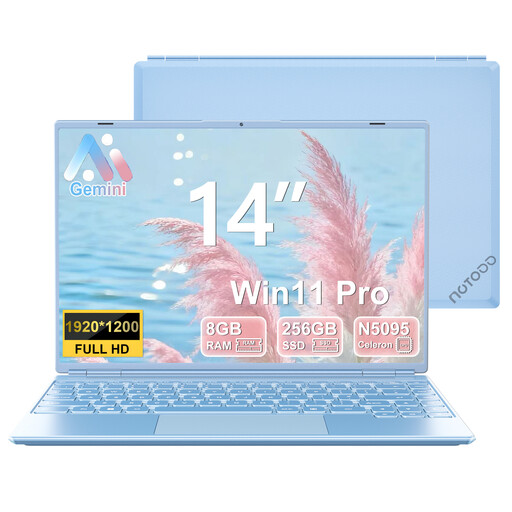 No image available
A 14-inch model to take with you if you view portfolios on a compact screen.
The product name lists 8 GB RAM, a 256 GB SSD, 1920 × 1200 resolution and a mini-HDMI port.
 No image available
The 15-inch screen is an option to compare if you want more visible space when viewing portfolios.
The product name lists an M5 chip, 16 GB of memory, 512 GB of storage and a QWERTY keyboard.
No, not for this use alone. First decide whether you’ll only be viewing portfolios or also editing photos and videos yourself. Only compare extra memory and storage if you’ll be doing those additional tasks.
Colour profiles play a part in ensuring consistent display across devices. Adobe describes colour management as part of image reproduction. For colour-critical work, check the document profile and screen settings. A stated wide colour gamut doesn’t, on its own, measure whether colours will look the same.
Not without checking the requirements: compare the charger’s power output and compatibility with the exact laptop. For the 13-inch MacBook Air M5 reviewed, Apple specifies a minimum of 30 W; that doesn’t mean another laptop has the same requirement.
For distance purchases, you generally have 14 days to change your mind, according to the Dutch government. The seller must also provide a solution if a product is faulty. The Dutch government states that the Netherlands does not have one fixed statutory guarantee period for all products.