
Photographers who check print colours
You want to assess how your edits will look on paper under consistent lighting conditions. Adobe describes calibration, ambient lighting and colour management as parts of a controlled print workflow.


Choose a laptop based on your complete print workflow: a screen you can calibrate, controlled ambient lighting and a suitable profile for your printer, ink and paper combination. Adobe describes these as important parts of colour management. Also check that the exact laptop configuration supports your external monitor, and that its memory and storage suit your photo files.
You want to assess how your edits will look on paper under consistent lighting conditions. Adobe describes calibration, ambient lighting and colour management as parts of a controlled print workflow.
You might want to view the photo on one screen and your library or tools on the other. Adobe explains how Lightroom Classic can display the library on a connected second monitor; check that your laptop and monitor are compatible.
You work with large photos or catalogues and want to balance memory and storage against portability. Adobe identifies memory and processing power as factors that can affect Lightroom Classic performance.
Start with your colour workflow and the connection for your external monitor. Then compare memory, storage, portability and the cost of your complete workstation. Here, two screens means the laptop screen plus one external monitor. If you want two external monitors as well as the laptop screen, check support for the exact configuration separately.
| What to consider | What should you look for? | Who is this important for? |
|---|---|---|
| Colour checking for prints | Check the screen specifications for the exact model and allow for calibration, consistent lighting and a suitable profile for your printer, ink and paper. | If colour accuracy is critical to my work, I want to assess my edits under consistent conditions. Around 25% of consumers put reliable print colour at the top of their buying priorities. |
| A useful second screen | Check the video output and external display support of the exact laptop, and make sure the cable or adapter is compatible with your monitor. | If I want to see photos and tools side by side, the main thing is whether my monitor connects to my laptop. Around 25% of consumers give their screen setup top priority. |
| Memory and storage | Compare the memory, SSD capacity and upgrade options with your files, catalogues and software. | If you work with large photo files or several applications, you’ll want enough space and processing power. Around 20% of consumers put this need first. |
| Portability | Compare the size and weight of the exact model, and decide where you’ll make your final colour checks. | If I work on the go regularly, I consider what I can easily carry and where I’ll make my final colour decisions. Around 15% of consumers put portability first. |
| Total cost and aftercare | Factor in the monitor, connections and any calibration equipment as well as the laptop. Check the terms of any additional service separately from your statutory rights. | If you want to keep your entire workstation within budget, look beyond the laptop alone. Around 15% of consumers make total cost their top buying priority. |
A screen specification is no substitute for calibration, controlled ambient lighting or a suitable profile for the printer, ink and paper combination you use. Adobe describes these as separate parts of colour management.
Assess your complete print workflow, not just the screen’s colour gamut.
Remember to allow for any calibration equipment or test prints you may need.
A connection or charging function alone doesn’t confirm that the laptop supports the video output you need. The number of external screens supported can also vary by configuration.
Check the video output on the exact model and compare it with your monitor’s input and cable.
You may need a suitable cable, adapter or dock for the connection you choose.
For checking colours on an external screen, your workstation may also need a monitor, connections and calibration equipment. So the laptop alone won’t determine how complete your print setup is.
List all the components you need for your workflow before choosing a model.
Apple describes MacBook Pro models with an M5 chip as a macOS option for working on the go, with either the built-in screen or an external display.
ASUS describes the Dutch ProArt P16 H7606GP model as a laptop for creative work, with a 16-inch OLED screen, 32 GB of memory and a 1 TB SSD.
Lenovo lists 64 GB of soldered memory, a 2 TB SSD and a 16-inch screen for the Yoga Pro 9i Gen 10, code 83L0003UMH.
HP describes the ZBook X G1i range as mobile workstation models for tasks including conceptual design and video editing.
These Joybuy products offer laptop options for photo work, from models suited to an external monitor setup to those with a stated OLED screen. Check which screens and connections your workflow supports on the exact model.
 No image available
A 16-inch model to consider if you want to work with the laptop screen and one external monitor; check that it supports your particular screen setup.
The IPS screen has a stated resolution of 1920 × 1200 and a 16:10 aspect ratio. The product description lists HDMI 2.1 and USB-C with DisplayPort Alt Mode.
AMD Ryzen 5 7520U, 8 GB of memory and a 512 GB SSD. The stated weight is around 1.64 kg.
 No image available
A 14-inch model to consider if you’re looking for a laptop to take on the go and want to connect one external monitor as well; check that this configuration supports the monitor features you need.
The IPS screen has a stated resolution of 1920 × 1200 and a 16:10 aspect ratio. The product description lists an anti-glare screen, HDMI 2.1 and USB-C with DisplayPort.
AMD Ryzen 5 7520U, 8 GB of memory and a 512 GB SSD. The stated weight is around 1.42 kg.
 No image available
A 16-inch model with an OLED screen to consider if you want to view photos on the built-in display. An OLED screen alone doesn’t confirm a calibrated print workflow.
The product name lists a WUXGA OLED screen, a Snapdragon X processor, 16 GB of LPDDR5X memory and a 512 GB SSD.
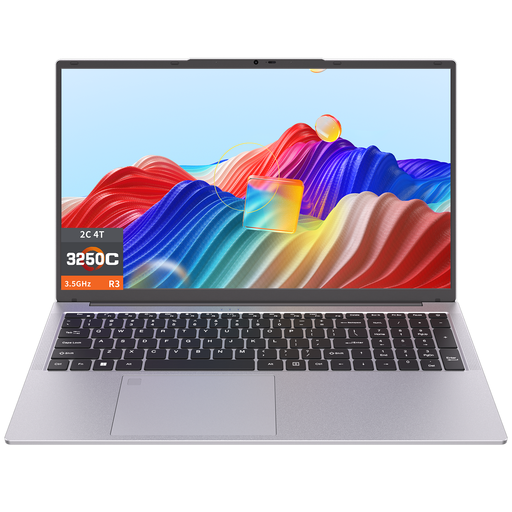 No image available
A 17.3-inch laptop to consider if you’re looking for a large built-in screen for photo work and files. Check the exact model’s monitor support before you buy.
The product name lists a 3250C processor, 8 GB of DDR4 memory and a 512 GB SSD. The product description mentions USB-C and an HDTV connection.
 No image available
This model is worth considering if you want a built-in OLED screen and plenty of memory. Its stated screen coverage and factory calibration don’t independently confirm print accuracy.
The product description lists a 16-inch OLED screen with stated 100% DCI-P3 coverage, factory calibration, 64 GB of memory and a 1 TB SSD.
The description lists HDMI 2.1 and USB4 with DisplayPort. Check that the connections support the monitor setup you need.
For a Photoshop-managed print, use a profile for the specific printer, ink and paper combination if one is available. Adobe also describes a printer-managed workflow; check which approach suits your printing process.
First, check the calibration and lighting conditions of the screen you use to make your final colour decisions. Adobe advises against changing brightness, contrast and colour settings without realising it after calibration. Recalibrate if you do change them.
No. The presence of a USB-C port doesn’t confirm that it supports video. The European Commission states that the common charging rules have also applied to laptops since 28 April 2026; those rules don’t confirm whether a specific laptop can send video to your monitor. Check the video output on the exact model.
Not as a replacement for your statutory rights if a product is faulty. According to the Dutch government, there’s no fixed statutory warranty period in the Netherlands; the seller must provide a solution if a product is faulty. Compare extended warranties by the terms and rights they actually add.
For an eligible distance purchase from a business, the Dutch government says you’ll generally have 14 days to change your mind. Check the circumstances of your purchase; these distance-selling rules don’t apply to purchases from a private individual.