
Slide creator with a fixed workspace
You spend extended periods working with text and images and want plenty of screen space, perhaps alongside a separate monitor.


Start with the presentation software and work files you need to use, then choose a screen size and ports to suit your workspace. A larger built-in screen gives you more room for slides and reference material, while a more compact model is easier to carry around. The Consumers’ Association recommends 16 GB of memory as a guide if you use several programmes at once.
You spend extended periods working with text and images and want plenty of screen space, perhaps alongside a separate monitor.
You need to open files using the required software and want to check in advance that the laptop, screen and projector will connect to your workspace.
You create slides at home but take your laptop with you too. Size and ports matter, as well as having enough room to work comfortably.
First, check the software and files you need. Then compare screen space, ports and how many programmes and media files you use at once.
| What to consider | What should you check? | Who is this important for? |
|---|---|---|
| Presentation software and files | Check that the required programme and files work with the operating system you choose. Also check which version or licence you need. | If I need to use work files or software from my organisation, I want to know in advance whether they’ll work on my laptop. Around 25% of consumers put software compatibility at the top of their list. |
| Screen space at your desk | Compare screen size and resolution. If you use a separate monitor, check the video output too. | If I want to view slides, notes and reference material side by side, screen space is a major consideration. Around 25% of consumers give screen space top priority. |
| Connecting to a monitor or projector | Compare the input on your screen or projector with the ports on the exact laptop configuration; check which adapter you need, if any. | If I want to use my existing monitor or projector, I want to know whether the cable will plug straight in. Around 19% of consumers put ports first. |
| Memory and storage | Choose the amount of memory based on how many programmes you have open at once, and storage based on how many large media files you keep locally. | If I use several apps alongside my slides or keep lots of photos and videos locally, I want enough space for them. Around 19% of consumers give multitasking and media files top priority. |
| Accessories, software and service | Check what’s in the box, which software you need and whether you’ll need an adapter. Look at any additional service cover alongside the rights you already have. | If I want to avoid extra costs for software, connections or service, I check these details in advance. Around 12% of consumers put total cost at the top of their list. |
You may need a specific charger, software licence or video adapter depending on the configuration you choose and your workspace. For the HP ProBook configuration D4TM6EA#ABH, HP states that the charger is sold separately.
Before you buy, check what’s in the box, which software you need and how your screen or projector connects.
A separate charger, licence or adapter may cost extra; what you need depends on your configuration and workspace.
A USB-C port isn’t the same as an HDMI port. The MacBook Air reviewed supports video through Thunderbolt 4/USB-C ports, while the HP configuration mentioned has HDMI.
Compare the ports on the exact laptop configuration with the input on your monitor or projector, and check whether you need an adapter.
You may need a suitable cable or adapter to connect to your existing workspace.
Screen, memory and ports can vary between configurations. So the range name alone doesn’t tell you which configuration you’re buying.
Check the full product number and the specifications for that configuration before comparing.
A commercial warranty or service plan is separate from your statutory rights. ACM ConsuWijzer explains that if a product doesn’t meet what you could reasonably expect from it, you can ask the seller to put things right.
Read what additional cover a service plan provides and compare it with the rights you already have.
An optional service plan may cost extra, so first consider what additional cover it actually provides.
The ProBook 4 G1i D4TM6EA#ABH is a specific example of a Windows work laptop with a 16-inch screen and HDMI.
According to Apple, the MacBook Air with M5 comes in 13-inch and 15-inch configurations for those who want to use macOS.
The Zenbook 14 OLED (UX3405) range is worth considering if you’re looking for a compact Windows laptop with a video output.
The ThinkPad E14 Gen 7 (Intel) is a business 14-inch range worth comparing if you use an external monitor at your workspace.
These Joybuy picks are Windows laptops for creating slides in a home office, with a range of screen sizes and ports to suit your workspace.
 No image available
A 14-inch screen and HDMI are useful if you create slides on your laptop and want to connect it to an HDMI screen.
Windows 11 Home; 16 GB memory; 512 GB SSD; 14-inch screen with 1920 × 1200 resolution and a 16:10 aspect ratio; HDMI; weighs approx. 1.62 kg.
The charger isn’t included; the product description says you’ll need a compatible USB-C charger of at least 45 W.
 No image available
The 16-inch touchscreen gives you a larger built-in display for viewing and editing slides.
Windows 11 Home; 16 GB memory; 512 GB SSD; 16-inch touchscreen with a 16:10 aspect ratio; Thunderbolt 4 with DisplayPort video support.
The 360° hinge supports laptop, tablet, tent and stand modes.
 No image available
The 14-inch configuration has HDMI 2.1, making it suitable for a workspace with a compatible HDMI connection.
Windows 11 Home; AMD Ryzen 5 7520U; 8 GB memory; 512 GB SSD; 14-inch anti-glare IPS screen with 1920 × 1200 resolution; HDMI 2.1; weighs approx. 1.42 kg.
The charger isn’t included; the product description says you’ll need a 45 W USB-C Power Delivery charger.
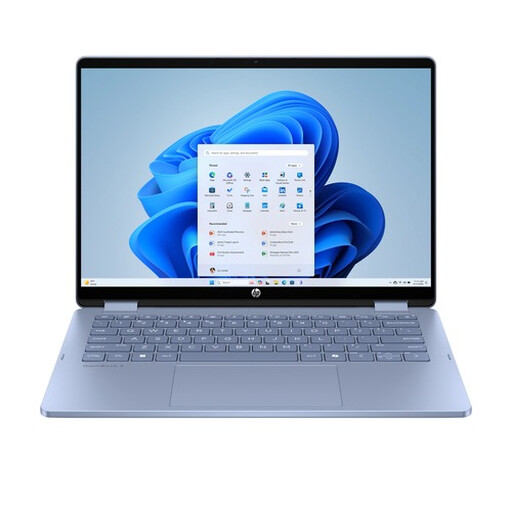 No image available
The touchscreen and different modes are useful if you want to use the laptop in more than just laptop mode.
Windows 11 Home; Intel Core 5 120U; 8 GB RAM; 512 GB SSD; 14-inch IPS touchscreen with 1920 × 1200 resolution and a 16:10 aspect ratio; HDMI 2.1; weighs approx. 1.60 kg.
The USB-C charger and stylus aren’t included.
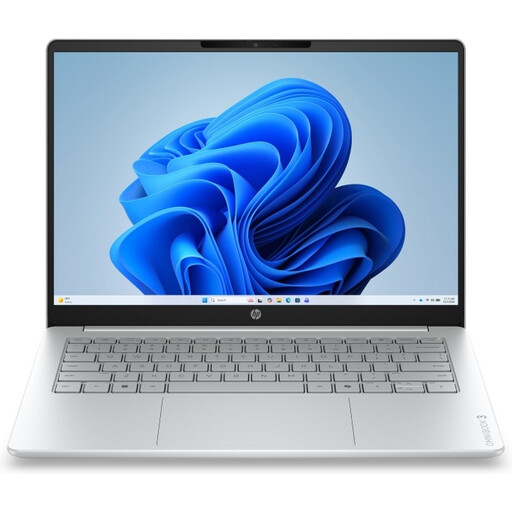 No image available
The 17.3-inch screen gives you more built-in space if you want to view slides and documents on one screen.
Windows 11 Home; AMD Ryzen 5; 8 GB memory; 512 GB SSD; 17.3-inch Full HD anti-glare IPS screen; HDMI; weighs approx. 2.01 kg.
The product description states that the charger isn’t included.
Not always: Microsoft also offers a free web version of PowerPoint. Check which version and features your work requires, and whether your organisation already provides access. Don’t assume a software licence is included with the laptop.
Yes, if the laptop’s video output works with the projector’s input, possibly with a suitable adapter. Apple specifies video output through Thunderbolt 4/USB-C ports for the MacBook Air mentioned here; check the connections on both devices in advance.
For basic office software, the Consumers’ Association recommends 8 GB RAM as a guide; if you run several programmes at once, it recommends 16 GB where possible. Choose based on what else you’ll have open alongside your presentation.
A linked video may be missing if the file link no longer works. Microsoft distinguishes between a linked video and an embedded video, which makes the presentation file larger; test your presentation on the device you’ll use to present.
For online consumer purchases, you generally have a statutory 14-day cooling-off period after delivery, although exceptions may apply. You also have statutory warranty rights if a product doesn’t meet what you could reasonably expect from it. ACM ConsuWijzer explains that if there’s a fault, you can ask the seller to put things right.