
Home-based editor who writes for long periods
Writes longer pieces at a dedicated desk and wants to read text and source material clearly. How the workspace is set up matters too, not just the built-in screen.


Start by considering the writing software you need and how you handle interview material. A Chromebook suits a web-based workflow, while Windows or macOS may be more appropriate if you need specific desktop software. Then compare the screen, ports and your home working setup. A larger laptop screen does not automatically make for a suitable workspace.
Writes longer pieces at a dedicated desk and wants to read text and source material clearly. How the workspace is set up matters too, not just the built-in screen.
Needs to work with files or features specified by an editorial team, so checks first which software runs on the operating system they are considering.
Works mainly in browser-based documents and wants a straightforward workflow, but checks that web apps support all the necessary editing tasks.
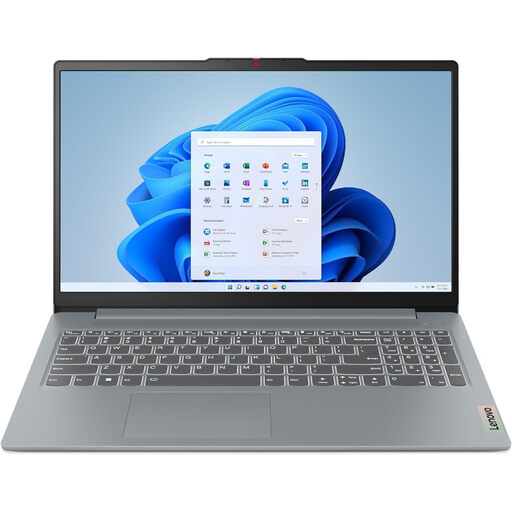
A good fit if: your required editorial programme runs as Windows desktop software, or you want to view text and sources on a larger built-in screen. Lenovo lists an anti-glare 15.6-inch Full HD IPS screen for the IdeaPad Slim 3 15, model 82XQ00SHMH.
Bear in mind: the memory in this configuration is soldered, and Lenovo lists an English (Euro) keyboard. Check the layout and configuration of the exact model.
A good fit if: you create documents mainly in a browser and the interview and editorial tools you need are available as web apps.
Bear in mind: Microsoft Support says the Windows and Mac desktop versions of Office cannot be installed on a Chromebook. Check that the web features meet your needs.
A good fit if: you use macOS software or want to pair a compact laptop with a dedicated home working setup. Apple lists 16 GB of memory, a 512 GB SSD and two Thunderbolt 4 ports for the 13-inch MacBook Air with M5.
Bear in mind: check whether your peripherals need an adapter or dock, and what is included with the specific configuration.
| What to consider | What should you check? | Who is this important for? |
|---|---|---|
| A comfortable workspace | Compare screen size and reflections; check the ports for a separate screen or keyboard. | If I write for long periods, I want to read text and sources clearly and set up my workspace to suit me. That is why around 25% of consumers put workspace comfort first. |
| Software compatibility | Check that any required writing, transcription and file management programmes work on the operating system. | If my editorial team requires specific software, I want to be able to use the necessary features from the outset. Around 25% of consumers give compatibility top priority. |
| Interview files | Decide which files need to be stored locally and which storage service you use. | If I handle recordings and notes, I want to know where files are stored and how I can work with them. File management comes first for around 19% of consumers. |
| Required configuration | Choose memory and storage to suit your programmes and files; also check which accessories you need. | I want to choose features that suit my writing work without paying for capacity I will not use. Around 19% of consumers prioritise finding the right configuration. |
| Taking it out or working from home | Compare the screen size with how you use the laptop at your desk, and check the ports and charging setup. | If I sometimes take my laptop with me, I want a size that works both on the go and in my home workspace. Around 12% of consumers give portability top priority. |
The web app and desktop version do not necessarily offer the same features. Being able to open a document does not automatically mean that all the editing tools you need will be available.
Before choosing, test a representative editorial document and the applications you need to use.
A permanent workspace may also call for a separate keyboard, screen or port adapter. What you need depends on your setup and what comes with the laptop.
Check what is included in the specific offer and make a list of the equipment your workspace needs.
Depending on your setup, you may need a separate keyboard, external screen, port adapter or mains adapter.
The Lenovo IdeaPad Slim 3 15, model 82XQ00SHMH, and the IdeaPad Slim 3 14AHP10 have different model numbers. Sharing a series name does not prove that their configurations are the same.
Compare the full model number, configuration and keyboard layout.
The IdeaPad Slim 3 15, model 82XQ00SHMH, is a specific Windows configuration to compare if screen space and running several programmes at once matter to you.
The Chromebook Plus 514, model NX.JKAEH.001, is a ChromeOS configuration to consider for a web-based workflow.
The 13-inch MacBook Air with M5 is a macOS configuration for anyone looking for that operating system and a compact built-in screen.
These laptop options suit writing at home, handling interview material and working with a larger built-in screen.
 No image available
An option to consider if local file storage matters for your writing work.
The listed configuration includes an i3 1000NG4 processor, 16 GB DDR4 memory, a 1 TB SSD and fingerprint unlocking.
 No image available
This configuration is worth comparing if you write and also store files locally.
The listed configuration includes 16 GB DDR4 memory, a 512 GB SSD, a 3050E processor, fingerprint unlocking and a backlit keyboard.
 No image available
An option to compare if you want a larger built-in screen for your draft and source material.
The product name lists a Snapdragon X Elite processor, 16 GB of memory and 512 GB of storage.
 No image available
A Windows configuration to compare if you want to view documents and sources on a spacious built-in screen.
The listed configuration has a 15.3-inch WUXGA screen, Windows 11 Home, 16 GB DDR5 memory, a 512 GB SSD and a QWERTY keyboard.
 No image available
This Windows configuration is worth comparing if you need a larger screen and connectivity options for a permanent workspace.
The listed configuration includes a 16-inch WUXGA IPS screen, Windows 11 Pro, 16 GB DDR5 memory, a 512 GB SSD and a QWERTY keyboard.
Yes. Microsoft offers Word and other Microsoft 365 apps on a Chromebook through the web. The Windows and Mac desktop versions cannot be installed, and features may differ between Word for the web and the desktop version. Check which features your editorial team needs.
Make sure you can position the screen and input devices appropriately. According to the Dutch Working Conditions Portal (Arboportaal), for employees who work at a screen for more than 2 hours a day, the screen and keyboard must not be attached to each other. Check whether you can use your laptop with a separate screen or keyboard, and discuss your home workspace with your employer if necessary.
Not automatically. According to the Dutch Data Protection Authority (Autoriteit Persoonsgegevens), consent is one possible legal basis under the GDPR for processing personal data, but it is not the only one. Personal data must not be kept for longer than necessary. The applicable legal basis and retention period depend on the specific interview situation and are separate from your choice of laptop.
When consumers buy from a business online, they generally have a 14-day cooling-off period, according to the Dutch Government (Rijksoverheid). The rules mentioned for distance selling do not apply in the same way to purchases from a private seller.
If a product is faulty, consumers in the Netherlands can pursue the seller; a manufacturer's warranty is separate from statutory rights. The Dutch Government says the Netherlands has no fixed statutory warranty period: what you can expect depends, among other things, on the product and the information provided at the time of purchase. Different rules may apply to business purchases.