
Catalogue designers
If you lay out pages with photos, text and tool panels, having the right amount of screen space is useful, along with checking your print preparation separately. Adobe sets out the system requirements for InDesign.


Start with the software you use and the kind of image work you do for the catalogue. Intensive photo editing calls for attention to memory and available SSD space, while a larger built-in screen can give you more room for pages and tool panels. If you often change where you work, a more compact laptop paired with a suitable external monitor or separate input devices may be a better fit. A wide colour gamut alone does not guarantee an accurate print proof.
If you lay out pages with photos, text and tool panels, having the right amount of screen space is useful, along with checking your print preparation separately. Adobe sets out the system requirements for InDesign.
If you edit a lot of catalogue photos, you can take into account your software’s memory requirements, available SSD space and colour management. Adobe publishes separate system requirements for Photoshop.
If you work in different locations, consider how the laptop works with an adjustable desk, external input devices or an external monitor.
| What to consider | What should you check? | Who is it for? |
|---|---|---|
| Screen space for page layouts | Compare screen size, resolution and scaling settings. Also check whether you can connect the external monitor you have in mind. | If I want to view spreads, photos and tool panels at the same time, I prioritise screen space. Around 33% of consumers put on-screen page layout first. |
| Memory and working space for photo editing | Check the requirements for your software version and how much SSD space will be left for working files. Adobe recommends 16 GB of memory for the versions of InDesign and Photoshop consulted. | When editing large image files, I focus on memory and available storage. Around 25% of consumers prioritise intensive photo editing. |
| A flexible workspace | Check that the laptop has the connections you need for your monitor and input devices. Arboportaal states that employees who work at a screen for more than two hours a day must have a separate monitor or keyboard available when using a laptop. | If I move my laptop between workspaces, I want to know whether my desk setup will work with separate input devices or an external monitor. Around 25% of consumers prioritise a flexible workspace. |
| Colour assessment and print preparation | Ask the printer which output profile and proofing process they require. Treat colour coverage as a screen specification, not proof of print accuracy. | For catalogue images that will be printed, I want to know in advance how colour management and print proofing will be handled. Around 17% of consumers prioritise colour and print checks. |
A screen specification does not tell you which colour conversion or output settings will be used for printing the catalogue.
Before making screen coverage a decisive buying criterion, ask the printer which colour profiles and proofing process apply to your project.
The space taken up by your software and working files determines how much storage will be left for your projects after installation.
Check your software’s requirements and leave room for source images and edited files.
For employees who work at a screen for more than two hours a day, Arboportaal says that laptop users must have the option of using a separate monitor or keyboard.
Factor in connections and input devices, and check whether these workplace rules apply to your situation.
The MacBook Air M5 and MacBook Pro M5 come in different macOS configurations. The Air is a more compact option if you can use an external monitor.
The Yoga Pro 9i Gen 11, variant 83SF003UMH, is a Windows laptop with a built-in 16-inch screen for those who mainly work on their laptop display.
The ProArt P16 H7606 is a Windows creator range for those who may also do more demanding image work alongside catalogue layout.
These Joybuy laptops have a built-in 15.3- or 16-inch screen and are suited to layout, image selection or other creative work. Check each configuration to make sure its software, connections and included accessories suit your workspace.
 No image available
Suits those who want to view catalogue pages on the built-in screen and also work with images. A wide colour gamut alone does not guarantee an accurate print proof.
16-inch OLED screen, 2560 × 1600, 16 GB memory and 1 TB SSD.
The product information lists a weight of 1.85 kg and HDMI 2.1 and Thunderbolt 4 ports.
 No image available
Suits those looking for a spacious built-in screen and generous memory configuration for design and media production work. Check the requirements of your software.
16-inch OLED screen with 4K resolution, 128 GB RAM and 1 TB SSD.
The product description states that the charger is not included. Specified colour coverage is not proof of an accurate print proof.
 No image available
Suits those who want to review pages and images on a built-in screen and use several creative applications.
Intel Core Ultra X7 358H, 32 GB memory and 1 TB SSD.
16-inch 2.8K OLED screen with 120 Hz; the product information lists a weight of around 1.5 kg and two Thunderbolt 4 ports.
 No image available
Suits those who move between workspaces and want to view catalogue pages on the built-in screen.
15.3-inch IPS screen with 1920 × 1200 resolution, Ryzen 5 7535HS, 16 GB memory and 512 GB SSD.
The product information states that the power adapter is not included.
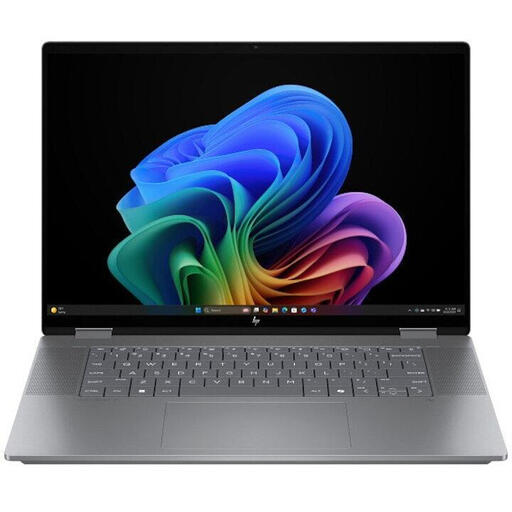 No image available
Suits those who want to view catalogue pages and photos on a spacious built-in screen and use several applications at once.
16-inch 3K OLED touchscreen, 24 GB memory and 1 TB SSD.
The product information lists a weight of 1,890 g and USB-C and USB4 ports with DisplayPort functionality.
For the software versions consulted, Adobe lists 8 GB as the minimum and 16 GB as the recommended amount for both InDesign and Photoshop. Also check the requirements for your own versions and plug-ins; Photoshop also specifies available internal SSD space.
No. The specified screen colour space alone does not prove that the printed output will be accurate. Agree with the printer on the profiles and proofing process required, then set up your colour management accordingly.
For employees who work at a screen for more than two hours a day, Arboportaal states that laptop users must have a separate monitor or keyboard available. Whether this workplace rule applies to your situation depends on the circumstances.
ACM ConsuWijzer says that consumers who buy online generally have a statutory 14-day cooling-off period from delivery, subject to exceptions that you should check. If a laptop develops a fault too soon under normal use or does not meet what you could reasonably expect, the seller is responsible for providing an appropriate solution under the statutory guarantee. There is no simple fixed two-year period that applies to every laptop.