
Student with local model files
You want to open downloaded course materials. Check which file format and software your course uses, and whether you’ll open the model locally or in a browser.


Start with the file format and software specified by your course: downloading a file doesn’t automatically mean you can open it offline in an online viewer. If you mainly want to view models while on the move, a portable laptop may be enough, provided the software and file are compatible. If you also need to edit or render large models, compare the requirements of the specific software with the configuration of the exact laptop.
You want to open downloaded course materials. Check which file format and software your course uses, and whether you’ll open the model locally or in a browser.
You view models during lectures or while out and about, and need to balance a compact size with the screen space you need.
You want to do more than view models: you also want to edit or render them. The software requirements and laptop configuration are therefore important factors in your choice.
A good fit if: you can work online and the viewer you choose supports your file. Autodesk Viewer lists formats including DWG, RVT and STEP, and requires a browser with WebGL, according to Autodesk.
Bear in mind: downloading a file doesn’t automatically mean you can open it offline. SketchUp for Web is browser-based, according to SketchUp.
A good fit if: you take your laptop with you often and your course uses compatible desktop software. If you’re considering macOS, check in advance that it supports the software your course requires.
Bear in mind: a smaller screen leaves less room to view the model and software panels at the same time. Apple lists 16 GB of memory and a 512 GB SSD for the MacBook Air M5 base models mentioned here; this doesn’t confirm that every course app or file will work with them.
A good fit if: you want more screen space or plan to edit or render large models as well as view them. Compare the requirements of the specific software with the full laptop configuration.
Bear in mind: a larger screen or a configuration described as more powerful isn’t necessarily needed just to inspect models. Blender, for example, distinguishes between minimum and recommended requirements; Lenovo product ranges can vary by configuration.
| What to consider | What should you check? | Who is this important for? |
|---|---|---|
| File and software compatibility | Check the file extension and the software specified by your course; find out whether you need to work online or locally. | If I need to open a downloaded model for my course, I want to know first whether my file and software work together. Around 33% of consumers give compatibility top priority. |
| Portability | Compare the weight and screen size of the exact configuration; also check the conditions used to calculate the stated battery life. | If I take my laptop with me every day, I weigh ease of carrying against the space the model takes up on screen. For around 27% of consumers, portability comes first. |
| Local storage | Check the SSD capacity of the exact configuration and separately confirm whether the storage can be upgraded later. | If I want to keep models and related files locally, I focus on the available SSD space. Around 20% of consumers put local file storage first. |
| Screen space | Compare screen size and resolution; consider whether you can use an external monitor at a permanent workstation. | If I want to see the model and software panels clearly at the same time, a larger workspace may matter more than travelling as light as possible. Around 20% of consumers prioritise having enough room to view their models. |
A file may require particular software or a specific workflow. Using an online viewer doesn’t guarantee that you can open the model without an internet connection.
Before buying, ask which sample file, file format and software your course uses, and check how you can work with them offline.
Memory, screen, operating system and upgrade options can vary by configuration. The specifications for one model don’t prove that every configuration meets the same requirements.
Compare the full model number and configuration with your course requirements.
The Joybuy pages consulted for the MacBook Air configurations mentioned here state that a charger isn’t included.
Before buying, check what’s in the box and which power adapter and connections you need for the exact configuration.
The 13-inch and 15-inch MacBook Air M5 are useful reference points when weighing portability against screen space.
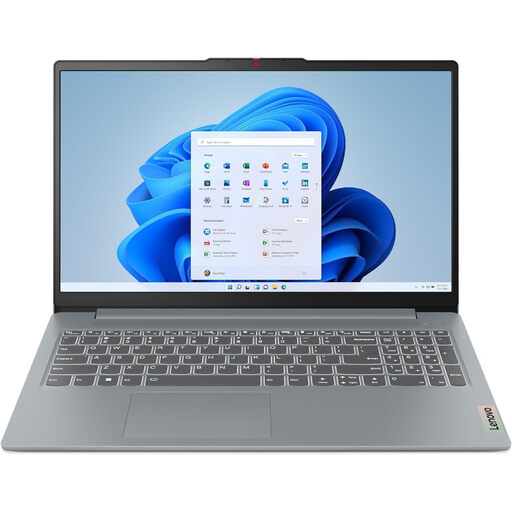
The IdeaPad Slim 3 15AHP10 is a Windows option with a 15.3-inch screen; compare configurations individually.
The Pavilion Plus 14-ew0000 range is an example of a more compact Windows laptop where the configuration makes all the difference.
These product picks are aimed at storing course files locally and viewing models on a spacious screen. The selection focuses mainly on larger Windows laptops and also includes a 15-inch MacBook Air.
 No image available
An option for storing course files locally and viewing models on a larger screen.
15.3-inch WUXGA screen, Ryzen 7 8840HS, 16 GB DDR5, 512 GB SSD, Radeon 780M graphics and Windows 11 Home.
The charger must be purchased separately.
 No image available
A 16-inch Windows laptop for viewing models and software panels on a larger screen.
16-inch WUXGA screen, Intel Core Ultra 5 135H, Intel Arc graphics, 16 GB DDR5, 512 GB SSD and Windows 11 Pro.
 No image available
An option if you want plenty of local storage and a large built-in screen for course materials.
16-inch 3K OLED touchscreen with 120 Hz, 64 GB RAM, 2 TB SSD and Windows 11 Pro.
 No image available
A MacBook Air option for viewing local files on a larger screen; check in advance that your course software works on macOS.
M5 chip, 16 GB memory, 512 GB SSD and a 15.3-inch Liquid Retina display.
A power adapter isn’t included; a USB-C adapter of at least 35 W is required.
 No image available
An option for anyone who values a large screen and doesn’t need to carry their laptop around often.
18.4-inch WUXGA screen, Ryzen 7 260, 16 GB memory and 512 GB SSD.
A power adapter isn’t included; a compatible 45–65 W USB-C PD charger is required.
Don’t assume you can. Autodesk Viewer is an online viewer for the file formats listed and requires a browser with WebGL. For offline use, check whether your course provides suitable local software and the files you need.
Not for every situation where you’re only viewing models. For editing, complex models or rendering, the requirements of the specific software are what matter. SketchUp and Blender publish different minimum and recommended graphics requirements, so consider what you’ll be doing and the exact laptop configuration, rather than relying on a label such as ‘design laptop’.
Keep a separate copy of important downloaded files. SketchUp states that the list of recent files in SketchUp for Web may be empty after you clear your browser cache or use a different browser or device. Check which storage method suits the way you work.
According to ACM ConsuWijzer, online purchases come with a statutory cooling-off period that ends 14 days after delivery, with some exceptions. The statutory guarantee is separate from any manufacturer’s warranty: if a product breaks too soon during normal use, the seller must offer an appropriate remedy free of charge, according to ACM ConsuWijzer.
No, access to the Autodesk Education plan is subject to certain conditions. Autodesk lists a minimum age and enrolment at a qualifying educational institution among its requirements. Check whether you’re eligible and which software your course specifies; buying a laptop doesn’t entitle you to a licence.