If you need both the interviewer and interviewee to come through clearly in the recording, Speaking History recommends using two microphones. At a fixed table, wired lapel microphones can be practical if the cables and inputs are suitable. A wireless set gives you more freedom to move, but you’ll need to check the power, recording and applicable frequency requirements.
Who is this choice relevant to?
Interviewer recording both voices
You’re recording both questions and answers for a local history archive. Decide in advance how to connect two microphones to your recorder or phone. Speaking History recommends using two microphones when both people need to be clearly audible.
Volunteer using a phone
You want to use the phone you already have, so you’ll need a microphone that works with its connection. Check that you have enough storage, too, and make a test recording to confirm that the external microphone is actually being used.
Recording long conversations
If a conversation would be difficult to record again, make sure you consider power, audio monitoring and keeping the original recording file. Speaking History recommends making a test recording and listening back to it before the interview begins.
What should you look for when buying?
Start by deciding whether you need just the interviewee or both the interviewer and interviewee to be clearly audible. Speaking History recommends using two microphones if both voices matter. Then check how the recording device receives both audio signals.
| What to consider |
What should you check? |
Who should pay particular attention? |
| Recording both voices |
Check how many microphones or transmitters are included and how the recording device receives both audio signals. |
If I want to keep both my questions and the answers clear, I look for a separate microphone position for each person. Around 33% of consumers prioritise capturing both voices. |
| Connecting to your equipment |
Check the input on your phone, camera or recorder, any adapters you may need, and the recording app by making a test recording. |
If I’m using my existing phone or recorder, I want to know before the interview whether the microphone will work with the connection available. Around 27% of consumers prioritise device compatibility. |
| Long or difficult-to-repeat recordings |
Check the power, available storage and whether you can listen back to a test recording during or after recording. |
If I can’t easily record a long conversation again, I want to be able to check the recording and original file in advance. Around 20% of consumers prioritise recording security. |
| Setting up around a shared table |
Test the setup from the actual seats, and watch out for clothing noise and unsafe cable routing. |
If everyone is staying seated at the table, I want to position the microphones and cables so they don’t get in the way of the conversation. Around 20% of consumers prioritise a tidy table setup. |
Common buying mistakes
-
Assuming ‘dual’ in a product description means two complete microphone channels
A microphone on one person won’t automatically pick up the interviewer just as clearly. Check whether the set includes two microphones or transmitters, and how both signals reach the recording device.
Check exactly what’s included and make a test recording with both speakers before the interview.
Depending on your setup, you may need a second microphone or a suitable input.
-
Assuming a compatible plug guarantees that it will work with your phone
The adapter supplied with the Audio-Technica ATR3350xiS is designed for devices with a 3.5mm headset socket. This doesn’t confirm that the microphone will work directly with every phone.
Check your phone’s port and listen back to a test recording before the interview starts.
-
Choosing wireless without testing the table setup and clothing
Going wireless doesn’t automatically prevent clothing, paper or other noises from spoiling the recording. A poorly routed cable can also get in the way.
Test the setup with the speakers in their actual seats. Speaking History recommends attaching a lapel microphone around 15 cm below the mouth and avoiding contact with rustling clothing.
Brands to consider
BOYA
The wired BY-M1 is an option for one speaker, provided your camera, phone or recorder has a suitable connection.
- According to BOYA, the BY-M1 has a 6 m cable, an LR44 battery and a switchable camera and smartphone mode.
- Check the connection and version: other BY-M1 variants may use a different power supply.
Audio-Technica
The wired ATR3350xiS is designed for a camera or recorder with a suitable 3.5mm input.
- Audio-Technica lists a 3 m cable, an adapter for devices with a 3.5mm headset socket, a clothing clip, windscreen, LR44 battery and on/off switch.
- The adapter doesn’t confirm that the microphone will work with phones without a 3.5mm headset socket.
Deity
The wired V.Lav is worth considering if you switch between recording devices with a suitable 3.5mm microphone input.
- According to Deity, the cable is 5 m long and the connector can adapt to many 3.5mm microphone inputs.
- The manufacturer doesn’t list every input as compatible. The specification states that it uses two LR41 batteries; check your device’s connection.
RØDE
The Wireless ME Dual and Wireless PRO are different wireless sets, each with two transmitters.
- According to RØDE, the Wireless PRO includes two Lavalier II microphones and each transmitter has onboard recording.
- The Wireless ME is also available as a set with one transmitter. Check which version and receiver you’re choosing; product specifications don’t guarantee that a recording will never drop out.
Wireless microphones with two transmitters
These Joybuy product picks focus on wireless microphone sets for interviews where each person may need their own microphone. Check the number of transmitters included with each version, and make sure the receiver is compatible with your recording device.
 No image available
DJI Mic Mini 2S (2 TX + 1 RX + Charging Case)
With two transmitters and one receiver, this version is worth considering when both people need their own transmitter.
Configuration: 2 TX + 1 RX; charging case.
View on Joybuy
 No image available
Lark M2 wireless USB-C microphone
This USB-C version is worth considering if your recording device has a suitable USB-C connection.
Connection: USB-C.
View on Joybuy
 No image available
RØDE Wireless Micro, Camera Kit, USB-C, Black
The set with two microphones is worth considering if you want to mic up both people separately.
Components listed in the product name: two microphones, camera receiver, smartphone receiver and charging case. Connection: USB-C.
View on Joybuy
 No image available
Moman M1CXT wireless lavalier microphone, USB-C, 2TX+1RX
The two-transmitter configuration is worth considering if the interviewer and interviewee each need their own transmitter.
Configuration: 2TX+1RX; connection: USB-C. The recording device must have a suitable USB-C connection.
View on Joybuy
 No image available
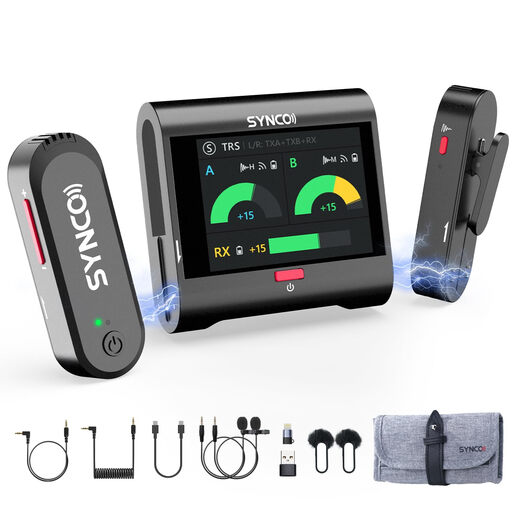
SYNCO G3PRO Wireless Lavalier Microphone System, 2.4GHz Dual Lapel Mics
With two lapel microphones, this version is worth considering when both people need to be miked up separately.
Product name lists: 2.4GHz and two lapel microphones.
View on Joybuy
Frequently asked questions
How do you attach a lapel microphone for a table interview?
Speaking History recommends attaching the microphone around 15 cm below the interviewee’s mouth. Avoid contact with clothing, and make a short test recording before the conversation so you can listen back to it.
Will my phone automatically use the external microphone?
Don’t assume it will without testing. Check that the connection or adapter is suitable and make a test recording. Speaking History recommends checking that the external microphone is actually being used.
Do I need a licence to use a wireless microphone in the Netherlands?
According to the Dutch Authority for Digital Infrastructure, a licence is usually not required for wireless microphones, but you must use the correct frequency band. With UHF systems, the available frequencies can vary by location, so check the requirements for your specific system and recording location.
Is the interviewee’s consent always legally required to record or publish an interview?
There isn’t a single yes-or-no answer: it depends on who makes the recording and what happens to it. The Dutch Data Protection Authority explains that processing under the GDPR must have a lawful basis, and that an exception applies to use solely for personal or household purposes. Consent isn’t automatically the only possible lawful basis. Publishing personal data online involves additional considerations. The Dutch Data Protection Authority’s information was updated in September 2026. Speaking History covers storage and different forms of reuse separately in its oral history consent form.


