What should you look for when choosing?
Direct wired connection
A good fit if: you stay in one spot and your recording device supports the specific USB-C or 3.5mm microphone connection.
Bear in mind: the cable limits your set-up; TRS and TRRS aren’t interchangeable.
Body recorder
A good fit if: you want to read without a cable connecting you to a phone or computer, then transfer the file later. The Zoom F2 is a recorder supplied with a lavalier mic.
Bear in mind: you’ll need to start the recorder and sort out storage, transfer and, if necessary, synchronisation afterwards.
Wireless system
A good fit if: you want to move around while reading, or place a receiver by a camera or another recording device.
Bear in mind: the transmitter, receiver and power supply; also check the system’s frequency requirements. The Dutch Authority for Digital Infrastructure lists frequency bands with different conditions.
For a reading in a small booth, the connection, capsule placement and file workflow you need are the main things to consider. The connection and recording examples below are based on product specifications from Sennheiser, Shure, RØDE and Zoom.
| What to consider |
What to look for |
Who it matters most to |
| Connection |
Check your device’s input, the difference between TRS, TRRS and USB-C, and whether the recording app receives the external signal. |
I want to know in advance whether my microphone will actually work with my recording device; around 40% of consumers prioritise a compatible connection. |
| Clothing and booth noise |
Check whether a suitable clip and windscreen are included; make a test recording while moving your head and speaking softly and emphatically. |
If I want to minimise clothing rustle and distracting room noise, I test the mic’s position before recording my reading. Around 30% of consumers prioritise a clean voice recording. |
| Freedom of movement |
Decide where you’ll stand or move, whether you need a receiver, and how you’ll access the file afterwards. |
I want to move around while reading without being tethered to the recording device by a cable; around 20% of consumers prioritise that freedom of movement. |
| Separate recording file |
Check whether the specific model records internally, what file it saves, and whether recording has started before you begin reading. |
If you want to keep a separate file, where the recording is made and how it’s transferred afterwards are key. Around 10% of consumers prioritise this independent recording workflow. |
Joybuy products for recording poetry
This selection includes wired lapel microphones and wireless clip-on models for reading in a small booth. Before buying, check that the connection and recording chain are right for your device.
 No image available
Moman MA6 6 m Lavalier Microphone
Could suit a fixed reading position if your device supports the specified 3.5mm microphone connection.
The product title lists a 6 m cable, an omnidirectional clip-on microphone and compatibility with smartphones.
Joybuy
 No image available
SYNCO S8 Lavalier Microphone
Could suit a direct recording set-up with a compatible device and 3.5mm connection.
The product information lists 3.5mm connectivity, an omnidirectional pickup pattern and a windscreen. The title mentions smartphones, PCs, laptops and cameras.
Joybuy
 No image available
Verbex ST5 dual-mic Type-C
Could suit you if you’re looking for a wireless clip-on set-up with a Type-C interface.
The product title lists a dual-mic version and a Type-C interface.
Joybuy
 No image available
Verbex K9-Black Wireless Mini Microphone
Could suit a wireless recording set-up if your device and the microphone connection are compatible.
The product title lists a Type-C interface and describes the model as a wireless lavalier microphone for recording.
Joybuy
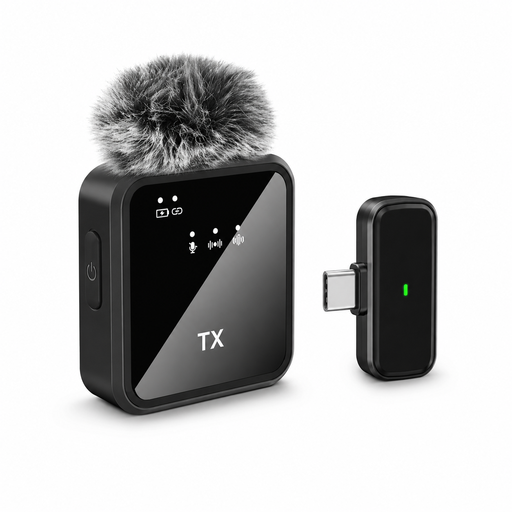 No image available
Verbex ST5 single-mic
Could suit you if you’re looking for a wireless lapel microphone for a reading and its interface matches your recording device.
The product title lists a single-mic version and a universal interface.
Joybuy
Frequently asked questions
Can I plug a 3.5mm lapel microphone straight into my phone?
Only if the connection or a suitable adapter supports that microphone signal. The Shure MVL uses 3.5mm TRRS; Shure recommends a CTIA-compatible adapter for devices without a suitable port. The RØDE Lavalier GO uses 3.5mm TRS. Make a short test recording to check that your device selects the external microphone.
How should I test the mic’s position for a poem with quiet and loud lines?
Clip the capsule somewhere your clothing won’t rub against it, then record a few lines while making your usual head movements and changes in volume. Listen back to assess what the mic’s position and the booth acoustics capture.
What should I do with a body recorder after a reading?
According to Zoom, the Zoom F2 writes WAV files to a compatible microSD card; you can transfer files to a computer via USB. Before you start reading, check that storage and power are available and that recording is active.
What are my rights when buying online in the Netherlands?
According to the Government of the Netherlands, distance purchases are often covered by a 14-day cooling-off period, although exceptions depend on the agreement. You’re also covered by the statutory guarantee: if a product is faulty, the retailer is your point of contact, even if a manufacturer’s guarantee is mentioned.
Can I use any wireless microphone in the Netherlands without a licence?
No, not every wireless microphone can be used without a licence. The Dutch Authority for Digital Infrastructure lists frequency ranges in which wireless microphones can be used licence-free under certain conditions; some other frequency bands require a licence. Check the frequency and conditions for the specific system. This frequency licensing question doesn’t apply to wired microphones.


