First, choose a lapel microphone with a connection that your phone, computer or recorder actually supports. In a small booth, compatibility matters more than wireless range. RØDE recommends positioning the microphone on your chest, around 20–30 cm from your mouth, and keeping it clear of clothing that might rub against it. Listen back to a test recording, and check which file format your phone system accepts before exporting. For example, 3CX describes converting prompts to WAV, but this is not a universal requirement for every system.
Who is this guide for?
Recording with a phone
You want to record a single greeting on a smartphone, so your main priority is checking that the microphone, input and any adapter work together. RØDE Support and Shure outline the connection requirements for specific mobile microphones.
Recording with a laptop
You record while seated in the booth and need a suitable connection and enough cable length for your speaking position. Sennheiser lists a 2 m cable for the XS Lav USB-C; also check that your computer and recording app support the microphone.
Phone system administrator
You want to use your recorded greeting in your own phone system. Choosing a microphone does not automatically determine which file formats that system accepts; for example, 3CX describes a conversion process for prompts.
What should you look for when buying?
For a short greeting recorded in a small booth, your choice comes down to a compatible input, clear speech, a usable audio file and a setup that suits your speaking position.
Wired via USB-C
Choose this if: your recording device supports this microphone via USB-C and you can stay within cable reach.
Bear in mind: USB-C alone does not guarantee compatibility with every phone or recording app. According to the manufacturer, the Sennheiser XS Lav USB-C has a 2 m cable.
Wired via 3.5 mm TRRS
Choose this if: your device has a compatible headset microphone input, or you have confirmed that you have a suitable adapter for microphone input.
Bear in mind: check the connection. The IK Multimedia iRig Mic Lav uses CTIA/AHJ wiring, and Shure specifies that some devices need a suitable CTIA adapter.
Wired via 3.5 mm TRS
Choose this if: your recorder or transmitter has a suitable TRS microphone input; the RØDE Lavalier GO is designed for this type of input.
Bear in mind: RØDE lists a TRS-to-TRRS adapter for use with a smartphone headset input. A phone without a 3.5 mm port may also need a suitable port adapter.
Wireless clip-on set
Choose this if: you want to move freely while recording or would rather avoid a cable.
Bear in mind: check the receiver output and choose the right version. BOYA warns that the mini 2’s strong noise cancellation can make voices sound slightly less natural.
| What to consider |
What to check before buying |
Who should pay particular attention? |
| Connection |
Check the exact input on your device, whether it supports microphone input and, if needed, which adapter is suitable. A plug that fits physically is not necessarily electrically compatible. |
I want to know before buying whether my phone or computer supports this microphone input; around 31% of consumers prioritise connecting to their recording device. |
| Clear speech |
Check whether a clip and, if needed, a windscreen or pop filter are included. Make a test recording in the clothes and speaking position you’ll actually use. |
If I want to record a single clear greeting, I want to avoid clothing noise and listen back to the recording; around 31% of consumers prioritise speech clarity. |
| File format |
Check the import and format requirements for your phone system, then test the final file after uploading it. |
I want to use the file in my phone system without running into export problems later; around 23% of consumers prioritise receiving a usable file. |
| Using it in the booth |
Measure the distance between the microphone and recording device, and consider whether you’ll actually change position while recording. |
If I want to adjust my posture, I need to know whether a cable will restrict me and what the wireless set-up involves; around 15% of consumers prioritise ease of use. |
Common buying mistakes
-
Assuming TRS and TRRS are interchangeable
A TRS microphone such as the RØDE Lavalier GO needs a suitable TRS-to-TRRS adapter for direct use with a smartphone headset input.
Check the electrical connection required by your device, not just whether the plug fits physically.
-
Assuming noise cancellation means you can skip a test recording
BOYA says that the mini 2’s strong noise cancellation can affect how natural the voice sounds.
Compare a short recording with and without processing on the device callers will use to hear the greeting.
-
Assuming a good recording is ready to upload
Phone systems can have different file format or import requirements.
Check your system’s documentation before recording the final greeting, and test the file after exporting or converting it.
Brands to compare
The features listed below apply to the specific product ranges mentioned; they are not a general recommendation for every product from these brands.
Sennheiser
The XS Lav USB-C is a wired USB-C option for recording speech on supported mobile devices and computers.
- Sennheiser lists a 2 m cable, a clip and a windscreen as included with this model.
- Check that your device and recording app support the microphone; USB-C alone doesn’t confirm compatibility.
Shure
The MVL is designed for a compatible 3.5 mm TRRS input on a mobile device.
- Shure lists a clip and windscreen.
- Shure says some devices need a suitable CTIA adapter; check the connection on your device.
RØDE
The Lavalier GO is a TRS option for a suitable recorder or transmitter, while the smartLav+ is a separate TRRS option for a compatible smartphone input.
- The two models offer different connection options.
- RØDE Support specifies a TRS-to-TRRS adapter for using the Lavalier GO with a smartphone. A phone without a 3.5 mm port may also need a suitable port adapter.
BOYA
The wired BY-M1 and wireless mini 2 are designed for different set-ups.
- BOYA says the BY-M1 uses an LR44 button cell.
- Don’t confuse the BY-M1 with the separate BY-M1S. BOYA warns that the mini 2’s strong noise cancellation can make voices sound slightly less natural.
IK Multimedia
The iRig Mic Lav is a wired mobile lapel microphone with a CTIA/AHJ TRRS connection.
- According to the manufacturer, the model has an additional connection for headphone monitoring or a second iRig Mic Lav.
- If your device doesn’t have a compatible headset input, you’ll need to check which adapter supports microphone input.
Joybuy products
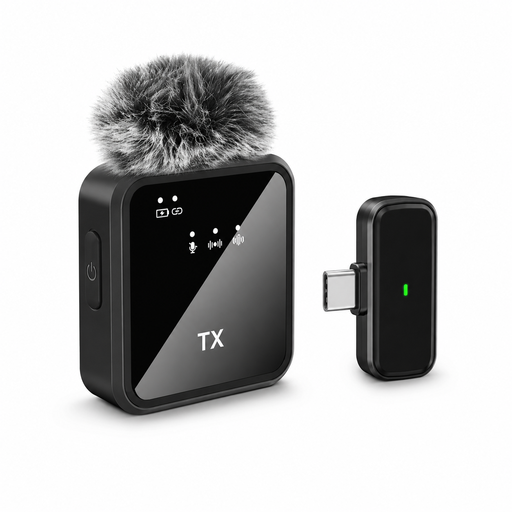
The Joybuy selection below consists of wireless clip-on microphones. Before recording your greeting, check that the connection, receiver and recording app work with your device for each model.
 No image available
SYNCO P2XT wireless USB-C microphone, 2TX+1RX
A wireless option if you don’t want a cable while recording. Check that your device supports USB-C microphone input.
The product title lists two transmitters and one receiver.
View at Joybuy
 No image available
Moman M1CXT wireless lavalier microphone, USB-C, 2TX+1RX
A potential choice if you want to record wirelessly. First check that your recording device supports the stated USB-C connection for microphone input.
The product title lists two transmitters, one receiver and a stated range of 150 m.
View at Joybuy
 No image available
Verbex K9-Black wireless mini microphone, Type-C
A wireless clip-on option for a short recording. Check that the Type-C interface works with your device and recording app.
The product title lists a Type-C interface.
View at Joybuy
 No image available
Verbex ST5 wireless lapel microphone, dual mic, Type-C
This version may suit you if you’re looking for a wireless set with two microphones; check that the interface is compatible with your recording device.
The product title lists two microphones and a Type-C interface.
View at Joybuy
 No image available
Verbex ST5 wireless lapel microphone, single mic, universal interface
This version may suit you if you’re looking for a single wireless microphone. Check what ‘universal interface’ means for your specific recording device.
The product title lists one microphone and a universal interface.
View at Joybuy
Frequently asked questions
How should you position a lapel microphone for a short greeting?
As a starting point, RØDE recommends positioning the microphone on your chest, around 20–30 cm from your mouth, and avoiding contact with clothing that might rub against it. Listen back to your test recording, as this distance is not guaranteed to work for every voice or booth.
Does the recording need to be in the right format for my phone system straight away?
Not until you’ve checked your phone system’s requirements. For example, 3CX describes converting prompts to WAV; other systems may have different import or format requirements.
What are the rules in the Netherlands for online purchases and faulty products?
When buying at a distance, consumers usually have a cooling-off period of up to 14 days after the product is delivered, subject to exceptions. The Netherlands Authority for Consumers and Markets explains this cooling-off period. There is also a statutory guarantee, with no fixed guarantee period in the Netherlands. If a product is faulty, the seller is your point of contact, according to the Dutch government. Check separately which rules apply if you’re buying as a business.
Do you need to tell callers when you record a greeting?
Recording a greeting is different from recording calls with callers. If an organisation also records calls, separate privacy requirements apply; the Dutch Data Protection Authority covers, among other things, informing employees when their calls are recorded.


