What should you look for when buying?
Start with the recording location and how you’ll perform the monologue. Then check that the microphone and recording device are compatible.
Wired omnidirectional lapel microphone
Choose this if: you’ll mainly perform in one spot and a simple connection matters more than freedom to move. RØDE says that positioning the mic close to your voice helps improve the signal-to-noise ratio.
Bear in mind: the capsule isn’t specifically designed to reject sound coming from outside the direction of your speech; cable and clothing rustle may also be audible.
Directional lapel microphone
Choose this if: the main source of noise is outside the direction of your voice and you can position the microphone carefully. Sennheiser describes the cardioid ME 4 as designed for speech in noisy environments.
Bear in mind: performance depends on direction and placement; a directional microphone won’t guarantee that neighbours’ noise or echo will disappear.
Wireless system
Choose this if: a cable to the recorder would restrict your movement as you perform. Recording in the transmitter can provide an extra option for important takes; RØDE lists this feature for the Wireless PRO.
Bear in mind: you’ll also need to manage the transmitter, receiver and radio connection. The Dutch Authority for Digital Infrastructure warns that licence-free use doesn’t guarantee interference-free reception.
| Consideration |
What should you check? |
Who is this important for? |
| Speech clarity with background noise |
Record a test take where you’ll perform and check the positioning and direction of your speech. |
If I’m performing in a flat with audible ventilation or traffic, I want my words to be easy to understand. Around 33% of consumers put speech clarity in noisy conditions first. |
| Freedom of movement |
Perform the whole scene and listen for cable and clothing noise. |
When my performance involves moving around the room, I don’t want to be restricted by a cable. Around 27% of consumers give freedom to perform their top priority. |
| Connection to the recording device |
Check the exact input, connector type and whether you need an adapter. |
If I’m recording straight to my phone, camera or recorder, I want to be sure it recognises the microphone. Around 20% of consumers prioritise a connection that’s compatible with their device. |
| Keeping an important take |
Check whether the system records locally, and test playback and saving files. |
If I have a take I can’t easily record again, I want to know whether there’s a local backup recording. Around 20% of consumers prioritise keeping their take. |
Wireless microphones at Joybuy
This Joybuy selection features wireless clip-on microphone systems for anyone who wants more freedom to move during a monologue. Check that each model’s connection is compatible with your recording device.
 No image available
DJI Mic Mini 2S (2 TX + 1 RX + charging case)
A wireless set for a monologue where freedom of movement and two transmitters are useful; check that the receiver is compatible with your recording device.
Configuration: 2 TX + 1 RX and charging case.
View at Joybuy
 No image available
SYNCO P2XT USB-C wireless microphone
A wireless option for a USB-C recording setup; check in advance that the receiver works with your specific phone or recorder.
Connection in the product name: USB-C.
View at Joybuy
 No image available
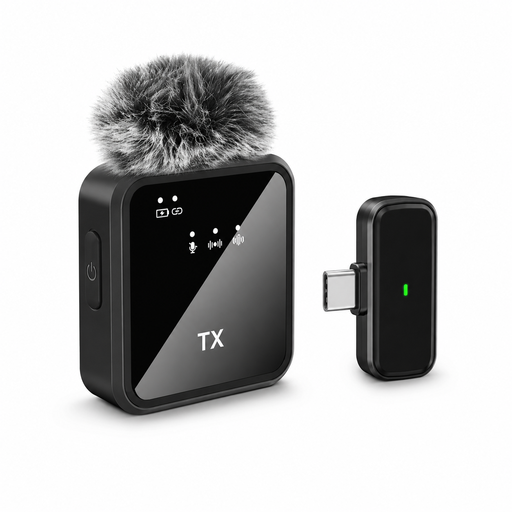
Verbex K9-Black wireless mini microphone, Type-C interface
A wireless clip-on microphone for a Type-C recording setup; check that the connection is suitable for your recording device.
Interface in the product name: Type-C.
View at Joybuy
 No image available
Verbex ST5 dual mic, Type-C interface
A wireless version with two microphones for a Type-C setup; check that the receiver is compatible with your recording device.
Configuration: dual mic with Type-C interface.
View at Joybuy
 No image available
Verbex ST5 single mic, universal interface
A wireless version with one microphone; check which connection the universal interface offers for your recording device.
Configuration: single mic with universal interface.
View at Joybuy
Frequently asked questions
Can noise reduction remove unexpected neighbours’ noises from your monologue?
Don’t count on it. RØDE says that the Wireless Micro’s noise reduction mainly tackles continuous background noise and isn’t designed to instantly silence sudden sounds such as a door slamming. This explanation applies to that product; test the features of the system you’re considering with your own voice and the sounds in your flat.
Where should you attach the microphone while performing?
Try positioning it on your upper chest and listen back to the recording while moving around. Shure also mentions positioning it near the ear or hairline for theatre, and warns that clothing rubbing against the capsule or cable can cause handling noise.
Do you need a licence for a wireless microphone in the Netherlands?
It depends on the frequency used. The Dutch Authority for Digital Infrastructure says that wireless microphones generally don’t need a licence, but some frequency bands do require one, and available UHF frequencies vary by location. Before buying and using a system, check the frequency and location against the RDI’s latest information.
Who should you contact about a fault after buying in the Netherlands?
According to the Dutch government, your statutory right to a product that works as it should is with the seller; any manufacturer’s guarantee is in addition to this. Read the terms of any extended guarantee before paying for it.


