Who is this choice relevant to?

Speaker dealing with household noise

You record spoken news bulletins while sounds such as ventilation or traffic are audible. RØDE and Shure highlight background noise and microphone positioning as important considerations, so assess the result with a test recording in your own room.

Recorder using a phone or camera

You want to record directly on a device you already own. RØDE and Shure describe different connections for their microphones, so check the exact device, input and whether you need an adapter.

Presenter who moves while recording

You want to present without a cable and monitor the sound during an important recording. DJI describes monitoring through the Mic 2 receiver, but check that the kit and connections you choose are suitable for your recording device.

What should you look for?

What to consider What should you check? Who is this important for?
Speech clarity with background noise Make a test recording with the sounds you hear at home, then listen to both your voice and any noise that remains. If I’m speaking in a room with, for example, ventilation or traffic noise, I want to be able to assess my voice clearly; around 33% of consumers prioritise speech clarity despite background noise.
Connection to your device Check the input on your phone, camera or recorder, and whether you need a specific adapter. If I want to record on a device I already own, I want to know in advance whether the microphone and input will work together; around 27% of consumers give this connection the highest priority.
Freedom of movement Compare a wired microphone for a fixed position with a wireless kit whose receiver can connect to your recorder. If I want to move around while presenting, I don’t want to be tethered to a cable, and I’ll check which components are included in the kit; around 20% of consumers prioritise freedom of movement.
Monitoring your recording Make a test recording in advance and check whether your chosen kit offers monitoring or internal recording if you need these features. If I’m recording an important bulletin, I want to spot a connection problem or clothing rustle before publishing; around 20% of consumers prioritise monitoring and testing.

Buying pitfalls

  • Assuming noise reduction means a silent room

    RØDE describes the Wireless Micro’s noise reduction as targeting continuous background noise, rather than removing sudden sounds as they happen.

    Record with the sounds you actually hear at home and compare how clear the speech is with and without processing.

    If the bulletin is difficult to understand afterwards, you may need to record it again or do extra audio editing.

  • Assuming a matching plug means it is compatible

    TRRS, TRS and TA4F are used with different recording devices and transmitters. A plug that physically fits does not prove that the microphone will work with your device.

    Check the exact model, input and whether you need an adapter before ordering.

    Depending on the combination, you may need a suitable adapter or a different microphone.

  • Assuming a separate transmitter or microphone is a complete kit

    A wireless system can comprise several components; a lavalier such as the Shure CVL is designed to be used with a compatible bodypack.

    Check what is included in the exact version and whether it can connect to your recorder.

    If a required transmitter, receiver or connection is missing, you may need to buy an additional component.

Brands to consider

RØDE

RØDE offers wired lapel microphones with different connections, as well as a wireless option designed for smartphones.

  • RØDE describes the adjustable noise reduction on the Wireless Micro as intended for continuous background noise.
  • The smartLav+ uses TRRS, while the Lavalier GO uses TRS; check the input on your recording device or whether you need an adapter.

DJI

The DJI Mic 2 is a wireless system for anyone who wants to move while recording or monitor the sound through a receiver.

  • DJI lists monitoring through the receiver and internal 32-bit float recording as features of the Mic 2.
  • These are manufacturer specifications, not an independent comparison of speech clarity in a noisy home. Check the contents and connections of the exact kit.

BOYA

The BOYA BY-M1 is a wired lavalier with a camera setting and a smartphone setting for a suitable connection.

  • BOYA specifies a 6 m cable and an LR44 battery for the BY-M1.
  • Check the switch setting and connection before recording; these specifications alone do not prove that it will reduce noise in a noisy room.

Shure

The Shure MVL is a TRRS lavalier for compatible mobile devices; the CVL is designed for compatible Shure bodypacks.

  • Shure specifies a TA4F connection and a cardioid polar pattern for the CVL.
  • The CVL is not a standalone plug-and-play microphone for a phone. The CVL and MVL have different connections and pickup patterns.

Sennheiser

The ME 2 is worth considering if you already use a compatible Sennheiser bodypack transmitter.

  • Sennheiser lists compatible transmitter families for the ME 2.
  • A 3.5mm specification alone does not prove direct compatibility with a phone; check the exact transmitter and connection.

Joybuy products for this recording setup

This selection includes lapel microphones and wireless microphone kits for spoken recordings. For each model, check that the connection and included components are suitable for your recording device.

DJI Mic Mini 2S (2 TX + 1 RX + Charging Case)

DJI Mic Mini 2S (2 TX + 1 RX + Charging Case)

The version named in the product title includes two transmitters, one receiver and a charging case; check that the receiver can connect to your recording device.

View at Joybuy

SYNCO P2XT USB-C Wireless Microphone

SYNCO P2XT USB-C Wireless Microphone

The product name specifies USB-C; check that the connection and operation are suitable for your recording device before you record.

View at Joybuy

SYNCO S8 Lavalier Microphone for Smartphone and PC, Laptop and Camera

SYNCO S8 Lavalier Microphone

The product name lists use with a smartphone, PC, laptop and camera; check which connection your device requires.

View at Joybuy

DJI Mic 3 (1 TX + 1 RX) Wireless Microphone

DJI Mic 3 (1 TX + 1 RX)

The product name specifies one transmitter and one receiver, and lists use with iPhone, camera and Android; check that the connection you choose is suitable for your device.

View at Joybuy
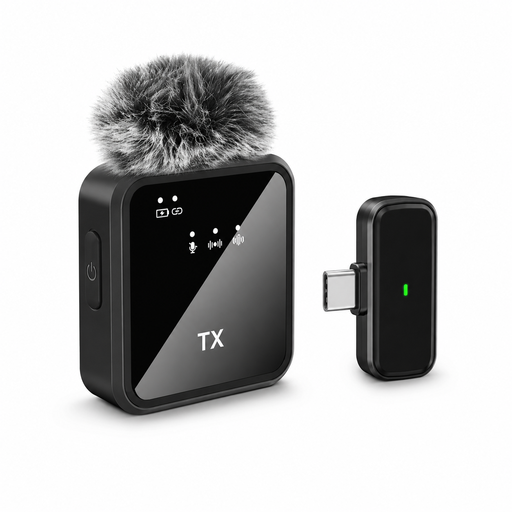
Verbex ST5 single-microphone universal-interface wireless lapel microphone

Verbex ST5 single-mic wireless lapel microphone

The product name describes a wireless lapel microphone with one microphone and a universal interface; check that the interface works with your recording device.

View at Joybuy

Frequently asked questions

Does noise reduction help with all the sounds in your flat?

No. RØDE describes the Wireless Micro’s noise reduction as intended for continuous background noise, not sudden sounds such as a door slamming. So listen to a test recording made in your own room.

Where should you attach a lapel microphone, and how can you prevent rustling?

For the Shure MVL, Shure recommends positioning it 15–25 cm from your mouth. Keep the capsule and cable away from rubbing clothing and make a short test recording beforehand; the BOYA BY-M1 manual recommends a test recording before an important recording.

Can you connect a microphone with a 3.5mm plug directly to any phone?

No. The RØDE smartLav+ and Shure MVL use TRRS; the RØDE Lavalier GO uses TRS. Check your device’s input and whether you need an adapter separately, even if the plug appears to fit.

Which components or additional services should you check in advance?

Check that the version you choose includes the receiver, transmitter, battery or adapter you need. According to the ACM, distance purchases made by consumers in the Netherlands generally come with a statutory 14-day cooling-off period after delivery, with some exceptions; check which terms apply to your purchase.

Do you need a licence for a wireless microphone in the Netherlands?

It depends on the frequency and the specific equipment, not just on whether it is described as wireless. The Dutch Authority for Digital Infrastructure states that certain frequency use is permitted without a licence or registration, provided the conditions are met; licence-exempt use is not guaranteed to be free from interference. Check the frequency and documentation for your kit.
