
Solo pronunciation practice
If you practise while sitting down and want to listen back to your own words and sounds, good placement and a compatible wired connection are important considerations.


If you mainly record one voice while sitting down, choose a wired lapel microphone that’s confirmed to work with your phone or computer. A wireless set is worth considering if you move around or want to record two speakers separately. Check the receiver, the number of transmitters and the charging requirements. Either way, make a test recording to check how clear the speech sounds and whether there’s any clothing noise.
If you practise while sitting down and want to listen back to your own words and sounds, good placement and a compatible wired connection are important considerations.
If you walk around while speaking or act out conversations, consider how freely you can move and check that the receiver works with your recording device.
If you’re recording a dialogue between two people, check that the set you choose actually includes two transmitters, so both speakers can have their own microphone.
Choose this if: you only record in one place using a device that supports the microphone via USB-C.
Trade-off: you won’t need a wireless connection or charging case, but the cable limits how far you can move.
Choose this if: your recording device has a compatible microphone input; a longer cable can be useful if the recorder is further away.
Trade-off: a 3.5 mm connection alone doesn’t guarantee compatibility; check the plug type, input and whether you need an adapter.
Choose this if: you want to move around during practice or record two speakers separately.
Trade-off: check the receiver and what’s included in the set; you’ll need to charge it, and wireless connections can suffer interference.
| What to consider | What should you look for? | Who is this important for? |
|---|---|---|
| Clear speech | Make a test recording with different sentences and listen for clothing noise. Shure recommends positioning the MVL 15–25 cm from your mouth. | If I want to hear words and sounds clearly when I listen back, I pay attention to placement and background noise. Around 36% of consumers put clear speech first. |
| Connection | Compare your device’s port, the microphone plug and the recording app. For 3.5 mm, check that the input is suitable for a microphone. | If I want to use my existing phone or computer, the connection needs to be right before I can record. Around 29% of consumers make device compatibility their top priority. |
| Freedom of movement | Decide whether you’ll actually walk around while practising. Test a wireless set where you plan to record, or compare the cable length with the distance to the recorder. | If I want to move around during practice, I don’t want to be tethered to the recorder by a cable. Around 21% of consumers give freedom of movement top priority. |
| Two speakers | Check how many transmitters are included in the set you’re considering and whether the receiver supports two transmitters at once. | If I’m recording a dialogue, I want each speaker to have their own microphone. Around 14% of consumers make recording two separate voices their top priority. |
The Shure MVL uses TRRS. You’ll need a compatible input or a suitable CTIA adapter; the size of the connection alone doesn’t tell you whether your device will recognise the microphone.
Check the plug, your device’s input and the selected microphone input in your recording app.
Wireless equipment uses shared frequency bands, where interference can occur. The Dutch Authority for Digital Infrastructure (Rijksinspectie Digitale Infrastructuur) explains that licence-exempt use is subject to conditions; a product name alone doesn’t prove that a particular version meets them.
Test the connection where you plan to record. If you don’t need to move around, you could also consider a wired option.
Shure says that friction between clothing, the microphone capsule and the cable can cause audible noise. Noise cancellation is no substitute for good placement.
Reposition and secure the microphone, then compare short test recordings before relying on audio editing.
The fact that a receiver can pair with two transmitters doesn’t mean both transmitters are included in every set.
Check exactly what’s included and how the receiver connects before choosing a set for two speakers.
The MVL is a wired lapel microphone with a 3.5 mm TRRS connection for mobile voice recordings.
The XS Lav is available in separate USB-C and 3.5 mm TRRS versions.
The V.Lav is a wired option with a 5 m cable, useful when the recorder is further away from the speaker.
The Wireless Micro is a wireless set designed for smartphones, with separate USB-C and Lightning receivers.
The Mic Mini is a wireless option for moving around or recording a conversation between two speakers, depending on the set you choose.
These Joybuy products are wireless microphone sets for voice recording. For each model, check the receiver connection and the number of transmitters included in the set you choose.
 No image available
This configuration is suitable for a practice dialogue if both speakers need a transmitter.
The product name lists 2 TX and 1 RX with a Charging Case. The product description mentions two levels of AI noise cancellation and three voice settings.
 No image available
This wireless microphone set is an option if you’re looking for a USB-C receiver for voice recording.
For Android phones with USB-C, the product description says OTG must be enabled. It also mentions noise cancellation and audio monitoring via the receiver.
 No image available
This set could suit a practice dialogue if you want to use two transmitters with a USB-C-compatible device.
The product name lists USB-C, 2TX and 1RX. The product description says it can be used with USB-C-compatible devices.
 No image available
With two transmitters, this configuration is designed for voice recording with two people.
The product name lists 2 TX, 1 RX and a Charging Case. The product description mentions interviews and recordings with two speakers as possible uses.
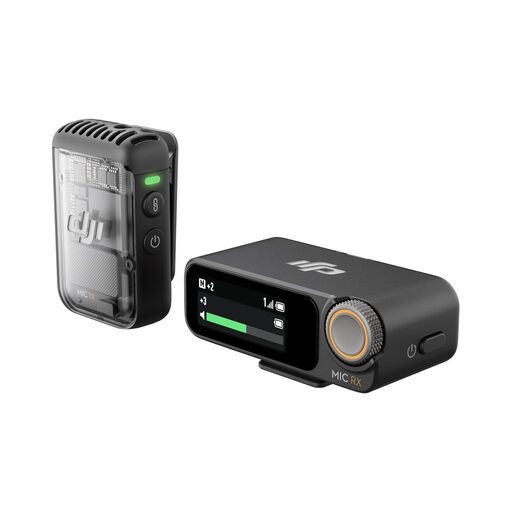 No image available
This configuration is designed for solo recording with one transmitter; check which adapter your recording device needs.
The product name lists 1 TX and 1 RX. The product description mentions internal recording by the transmitter and adapters for phones, cameras and laptops.
Attach the microphone so that clothing doesn’t rub against the capsule or cable, and make a short test recording first. For the Shure MVL, Shure specifically recommends a distance of 15–25 cm from your mouth; this isn’t a general guideline for every model.
No, a 3.5 mm connection doesn’t guarantee that a microphone will work with your phone. The Shure MVL uses TRRS, and Shure specifies a compatible TRRS input or a suitable CTIA adapter. Also check that the microphone is selected as the input in your recording app.
According to ACM ConsuWijzer, you’re entitled to a legal guarantee in the Netherlands if the product doesn’t do what you could reasonably expect. If a fault is covered, the seller must put it right free of charge, for example by repairing or replacing the product. The manufacturer’s warranty period alone doesn’t determine how long your legal rights apply.
For processing carried out solely for personal or household purposes, the Dutch Data Protection Authority says there is an exemption from the GDPR. If you publish information that identifies other people outside a limited private circle, or process it professionally, the GDPR may apply and you’ll need to assess the relevant legal basis; consent is one possible basis.
No, not all frequency use requires a licence. The Dutch Authority for Digital Infrastructure (Rijksinspectie Digitale Infrastructuur) describes licence-exempt applications, but refers to the current regulations for the exact conditions. Don’t assume that a particular version meets those conditions based only on its product name or the word ‘wireless’.