
Solo presenter in an echoey room
You’re recording your own intro and want a microphone that can sit close to your mouth. RØDE gives around 20–30 cm from the mouth as a general guideline for chest placement.


Start with a microphone close to each speaker and make a short test recording: noise reduction won’t automatically fix room echo. For one voice, a suitable wired microphone may be enough; for an interviewer and guest, you’ll need two transmitters and a receiver that connects to your recording device. If you can’t easily record the intro again, local recording can be a useful extra, but it’s no substitute for good microphone placement.
You’re recording your own intro and want a microphone that can sit close to your mouth. RØDE gives around 20–30 cm from the mouth as a general guideline for chest placement.
You and your guest both speak in the intro. Check that your chosen set supports two transmitters at once and includes the right receiver.
As well as the wireless audio track, you may want to save a local file on the transmitter. Check whether this feature is included with each set and how to manage the files afterwards.
Suitable if: you’re recording your own intro, staying in one place and have a compatible 3.5mm TRRS input or suitable adapter.
Bear in mind: you’ll need to position the cable carefully. The Shure MVL is designed for compatible mobile connections, not necessarily every camera.
Suitable if: the interviewer and guest speak at the same time, or you need more freedom to move around.
Bear in mind: check that the set includes two transmitters and that the supplied receiver connects to your phone or camera.
Suitable if: you want a separate audio file as a backup because the intro would be difficult to record again.
Bear in mind: files on the transmitters need checking afterwards and may need to be synchronised. Local recording won’t fix clothing rustle or poor microphone placement.
| What to consider | What to look for | Who should consider this? |
|---|---|---|
| Speech clarity | Check how the microphone attaches, then make a test recording in the clothes you’ll be wearing and from the position you plan to use. | If I’m recording in an echoey room, I want to position the microphone close to my mouth and hear how my voice sounds beforehand. Around 36% of consumers say clear speech is their top priority. |
| Recording two voices | Check that the set supports two transmitters at once and that the version you choose includes both. | If both the interviewer and guest are on camera or need to be heard, I want to give each of them their own microphone. Around 29% of consumers prioritise recording both voices. |
| Connection | Compare the input on your phone or camera with the exact receiver, and check whether you’ll need an adapter. | If I want to use the microphone with a specific phone, camera or changing setup, I want to know in advance which receiver and adapter will work. Around 21% of consumers put device compatibility first. |
| Backup recording | Check whether both transmitters can record locally. Don’t assume this feature is included with every wireless set. | If an intro would be difficult to record again, I want to save a local file as well as the wireless audio track. Around 14% of consumers make recording security their top priority. |
Speech clarity also depends on how far the microphone is from your mouth and where it’s positioned. A noise reduction setting won’t solve these issues.
Choose a fastening that lets you position the microphone close to each speaker, then listen to a test recording in the room where you’ll be recording.
A 3.5mm TRRS connection, USB-C receiver and camera receiver aren’t automatically interchangeable. Some combinations need a suitable adapter or a different receiver.
Compare your device’s input with the connections and receivers included in the exact set.
If the connection doesn’t match, you may need to buy a suitable adapter or receiver as well.
A receiver’s ability to support two transmitters doesn’t necessarily mean that the version you’ve chosen includes two.
Check the full version name and what’s included if the interviewer and guest will be speaking at the same time.
The MVL is a wired lavalier for speech recordings with compatible mobile devices that have a 3.5mm TRRS connection.
The Wireless Micro Camera Kit is designed for camera or USB-C phone setups, with two clip-on transmitters. The Wireless PRO offers local recording on the transmitters.
The Mic Mini is a range of wireless clip-on microphones whose receiver can connect to two transmitters at once.
The LARK M2 is a range of compact wireless lavaliers for anyone looking for a small clip-on transmitter.
The Profile Wireless 2-Channel Set combines two clip-on microphones with a receiver and charging bar for camera and mobile setups.
These Joybuy picks focus on wireless clip-on microphones for interview intros, with options for one or two speakers and a range of connections.
 No image available
A set for recording with a camera or USB-C phone. This version is designed for two voices.
Includes two transmitters and camera and USB-C receivers. According to the product information, a different version is needed for older iPhones with Lightning.
 No image available
This version, with one transmitter, suits an intro with one speaker. You’ll need a second transmitter for two people to speak at once.
The product information lists internal 32-bit float recording. Check which connections are compatible with your phone or camera.
 No image available
The version with two transmitters is designed for an intro with an interviewer and guest.
The product name lists two transmitters, one receiver and a charging case. Check that the receiver connection is compatible with your recording device.
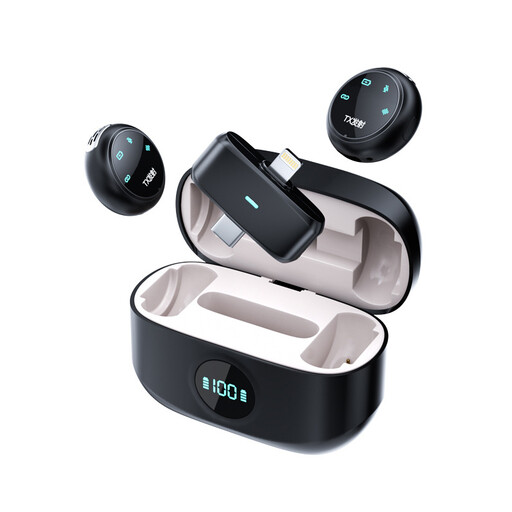 No image available
A version with two wireless microphones for an intro with two voices.
The product name lists a magnetic clip-on design and compatibility with iOS and Type-C interfaces. Check your device’s connection.
 No image available
A wireless lavalier microphone for an intro with one speaker.
The product name lists a Type-C interface. Check that it connects to the device you want to record with.
Attach the microphone to your clothing, close to your mouth. RØDE gives around 20–30 cm as a general positioning guideline. Make sure the fabric doesn’t touch the capsule, and listen to a short test recording beforehand.
No, not for every frequency. The Dutch Authority for Digital Infrastructure publishes the frequencies and power levels at which wireless microphones can be used without a licence; some other frequency bands do require a licence. Check the frequency and conditions for the specific set.
Don’t assume you can. The Dutch Data Protection Authority states that publishing other people’s personal data online generally requires their consent, and that processing must have a legal basis under the GDPR. The assessment depends on the recording, what can be used to identify someone and the purpose of publication. Agree the details with the interviewee beforehand.
According to ACM ConsuWijzer, you have a statutory warranty as well as any manufacturer’s warranty. If a product doesn’t meet what you could reasonably expect, the seller must repair, replace or refund it free of charge, subject to the applicable conditions. In the Netherlands, there is no fixed general two-year period for this.