
Vandaag of morgen in huis

Kwaliteit gegarandeerd

Welkomstaanbiedingen ontgrendelen: GRATIS bezorging | Tot 80% korting | Gratis 30 dagen JoyPlus-proefperiode
Download de app
The right lighting does more than create the atmosphere in your home – it also affects how comfortable a room is to use. A living room needs different lighting from a workspace, hallway or balcony. Yet when buying lights, many people focus mainly on appearance. This can lead to problems such as insufficient light, awkward controls or a lamp that is unsuitable for its intended location.
This buying guide helps you compare lamps and lighting based on measurable features. You’ll learn about colour temperature, lumens, energy consumption, dimming and protection ratings. Afterwards, you’ll find some popular choices for different uses.
Wattage indicates how much energy a lamp uses, not how much light it produces. To assess brightness, look at lumens (lm). A modern LED lamp can provide plenty of light while using relatively few watts.
As a guide:
Colour temperature is measured in Kelvin (K). A lower value produces warmer, more yellow-toned light. A higher value looks whiter and more functional.
Also check the product description. A lamp with an RGB function may also have a fixed warm-white setting, but the exact controls vary by model.
For outdoor lighting and lighting in damp areas, the IP rating is important. IP44 means protection against splashing water, but not against immersion or prolonged exposure to heavy rain. An IP20 lamp is intended for dry indoor areas.
Always check:
With an E27 lamp or G9 pendant light, you often buy a fitting without a light source. With the Aigostar pendant light, the E27 bulb is not included. This means you can choose the colour temperature, brightness and, if required, dimming capability yourself. Do check that your chosen E27 bulb does not exceed the fitting’s maximum wattage.
With integrated LED lamps, the light source is built in. This makes the design compact, but replacement is usually not possible. For example, the Brilliant Katrina desk lamp has an integrated 8.5 W LED, with a stated output of 650 lumens and a colour temperature of 2700 K.
A dimmable lamp is useful when one light source needs to serve several purposes. Look out for the difference between:
A night light with a light sensor can switch on automatically when it gets dark. This is practical in a hallway or child’s bedroom, but check whether the brightness can be adjusted and exactly what the sensor responds to.
Measure the space around the light point before buying. With a pendant light, the diameter and overall height are particularly important. The Aigostar Pendant Lamp has a diameter of 250 mm and a height of 1100 mm, including a 1.1-metre cord. Above a dining table, the lamp should hang low enough to distribute the light comfortably, without getting in the way.
Wall panels, such as hexagon gaming lights, require a flat, clean and dust-free wall. Self-adhesive tape may not stick as well to a rough or damp surface.
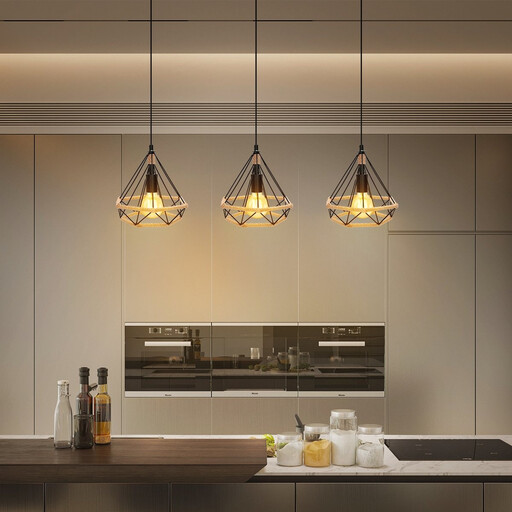
Why it suits this profile: A stylish pendant light for anyone looking for a striking fitting and wanting to choose a suitable E27 bulb for the living room, hallway or dining area.
The E27 fitting means the light source can be replaced. Please note that the bulb is not included and that installation is suitable for indoor use only.
Steel fitting, black finish, E27 fitting and a 1.1-metre cord.
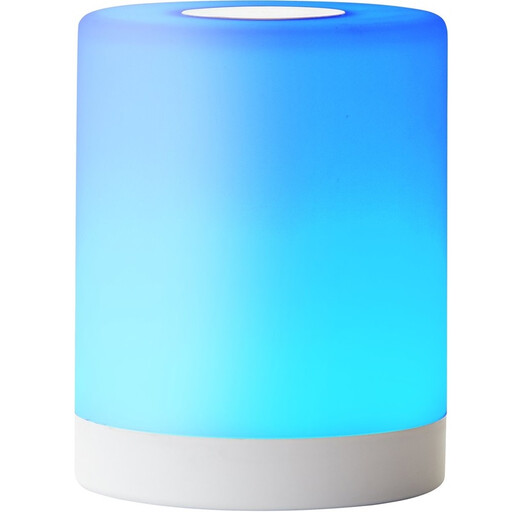
Why it suits this profile: A flexible portable lamp for the balcony, patio, garden or indoors, when you want to move your lighting around without permanent installation.
The IP44 rating allows outdoor use in splash-prone areas, but the lamp must not be immersed or exposed to severe weather.
1 W integrated LED, 140 lumens, 3000 K, RGB function, touch dimmer and USB charging.
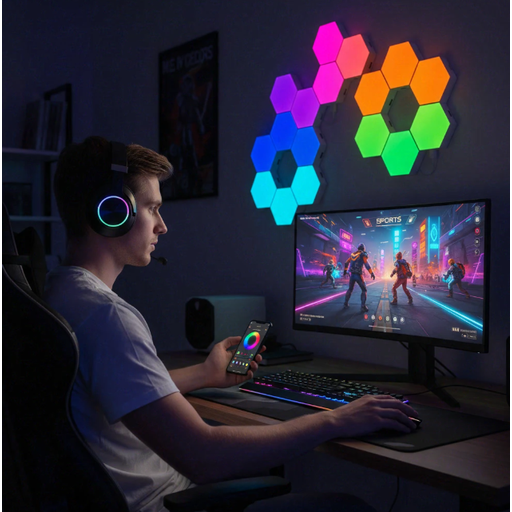
Why it suits this profile: Designed for gaming rooms, TV walls and creative wall décor where colour, patterns and music synchronisation take centre stage.
The eight panels can be connected individually and operate via USB. Only install them on a dry, flat and clean surface, and do not use more panels than recommended.
Eight RGB panels measuring 11.5 × 10 × 2.6 cm, remote control, music synchronisation and various mounting patterns.
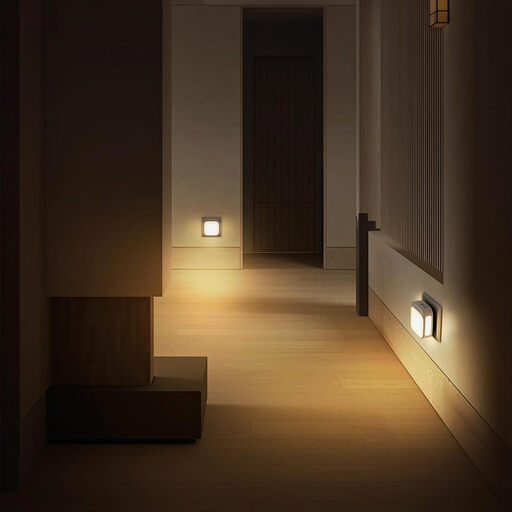
Why it suits this profile: Handy for hallways, bedrooms and other places where you want a small light to come on automatically without having to operate a switch.
The automatic sensor switches the light on at up to 20 lux and off in daylight. This prevents it from being left on unnecessarily.
Power consumption of 0.3 W, warm white light of 2800–3000 K, continuously dimmable from 10% to 100% and supplied as a set of two.
With a pendant light featuring a G9 fitting, check in advance whether the required G9 bulbs are included. For products with limited technical information, such as some chandeliers, it is wise to check the fitting, dimensions, maximum light source and installation instructions before buying.
We’ve put together a complete, up-to-date list of products that fully meet these strict selection criteria and the applicable European safety regulations.
That depends on the room, its size and the number of light sources. A small table lamp may need just 400 to 800 lumens, while a living room often needs several lamps for even light distribution. As well as lumens, consider the lampshade, positioning and how light reflects off walls and furniture.
LED lamps generally use fewer watts to produce their light. The actual cost depends on the wattage, number of hours used and energy price. Compare the stated consumption, for example per 1000 hours. An integrated LED lamp can be energy-efficient, but check whether the light source can be replaced.
No. A lamp must be explicitly described as dimmable, and the light source, dimmer and fitting must be compatible with one another. A touch dimmer or built-in dimming function works differently from a wall dimmer. Always check the instructions before modifying an existing installation.
