
Workshops with small batteries
You want to add short ownership codes to batteries with little clear space on the casing. Tape width and legibility are key to your choice.


First, measure the flat, clear space on the camera battery. Then choose a printer and tape that leave enough room for a short, legible code. A keyboard model is ideal for entering codes at the workbench without a phone. An app-based printer suits a team that designs codes on a compatible shared mobile device, but depends on that device and the app. Keep the contacts clear and check that the label does not interfere with fitting the battery into the camera or charger. Brother describes TZe tape as durable, but this manufacturer’s claim does not prove that the tape will stick to every battery.
You want to add short ownership codes to batteries with little clear space on the casing. Tape width and legibility are key to your choice.
Batteries are often passed from person to person. Compare tape designed for durability with standard tape, without assuming that any particular tape will stay in place on your battery.
If several people create or reprint labels, choosing between entering text on the printer and designing labels on a shared mobile device will shape your workflow.
Choose this when: different users need to enter short codes straight at the workbench, without a phone.
Consider: check which cassette range and widths are compatible with each model. The printer specifications do not prove that a label will fit every battery.
Choose this when: your team wants to design labels using a compatible shared mobile device.
Consider: printing depends on the device and the app. This workflow does not offer the standalone input of a printer with a keyboard.
Choose this when: your workshop already has a DYMO LetraTag and you want to try a short code with the tape designed for it.
Consider: the LetraTag plastic tape mentioned here is 12 mm wide. Check that it will fit the available space.
| What to consider | What to look for when buying | Who is this important for? |
|---|---|---|
| Fit and legibility | Measure the flat space and print a full-size test label. Brother lists 6 and 9 mm TZe tape for the PT-H110; DYMO specifies 6, 9 and 12 mm D1 tape for the LabelManager 280. | If I’m labelling a small casing, I want to know in advance whether the text will fit and remain legible; around 36% of consumers prioritise fit and legibility. |
| Legibility with frequent handling | Brother describes laminated TZe tape as durable. Test its adhesion and legibility on a suitable spot on your own battery. | For batteries that are often passed around, I want the code to remain legible without assuming that every tape will stick to every surface; around 29% of consumers give durability top priority. |
| Creating and reprinting codes | Brother lists a built-in keyboard for the PT-H110 and Bluetooth app control for the PT-P300BT. Decide whether users need to be able to enter codes without a mobile device. | When several colleagues create codes, I want a workflow that suits the shared device; around 21% of consumers prioritise how codes are entered and reprinted. |
| Ease of use and compatible tape | Check the cassette code for the exact model. DYMO distinguishes D1 for LabelManager from LT for LetraTag; Brother uses TZe for P-touch printers. | I want to replace cassettes easily without mixing up different tape ranges; around 14% of consumers give ease of use and compatible replacement tape top priority. |
The printer and cassette ranges mentioned support different widths, but width alone does not prove that a label will fit a particular battery.
Measure the flat area and make a test label with the actual code. Keep the contacts clear and check that the battery still fits properly in the camera and charger.
DYMO specifies D1 for LabelManager and LT for LetraTag; Brother uses TZe for P-touch. A cassette from one range is therefore not automatically designed for a printer from another.
Before buying, check both the exact printer model and the cassette code.
According to Brother, the PT-P300BT is controlled via Bluetooth and a mobile app, while the PT-H110 has its own keyboard.
Agree in advance who will make the labels and which compatible mobile device will be available.
Epson Netherlands marks the LabelWorks LW-600P as discontinued and no longer available.
Consider this model only if your workshop already has one, and check that the cassette you need is available.
The PT-H110 lets you enter text using a keyboard; the PT-P300BT works with a mobile app. Brother uses TZe tape for P-touch printers.
The LabelManager 280 uses D1 tape; LetraTag printers use a different tape range.
LabelWorks is relevant here for workshops that already have an LW-600P and are looking for compatible tape.
These Joybuy products include app-based label printers and a USB-connected model. For each printer, check the tape range and how much space the labels will take up on the battery.
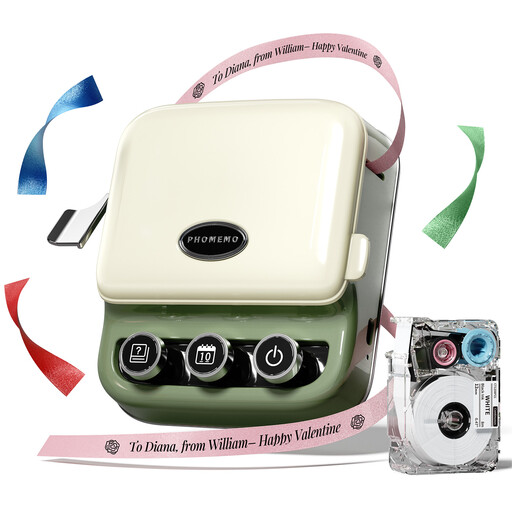 Image unavailable
An option if you want to design labels on a mobile device and print ribbons too.
Connects via Bluetooth to the Print Master app; a compatible mobile device is required. One roll of label tape is listed as included.
 Image unavailable
Suited to a team that wants to design labels on a mobile device and uses LetraTag tape.
Supports tape up to 12 mm wide and works with the LetraTag Connect app for iOS and Android. Runs on four AA batteries, which are not included. The product name lists one roll of white paper labels.
 Image unavailable
An app-based option if your team wants to design labels using a compatible mobile device.
Connects via Bluetooth to the P-touch Design&Print app and uses TZe tape. The product description lists tape widths of 3.5, 6, 9 and 12 mm; check which width suits the clear space on the battery.
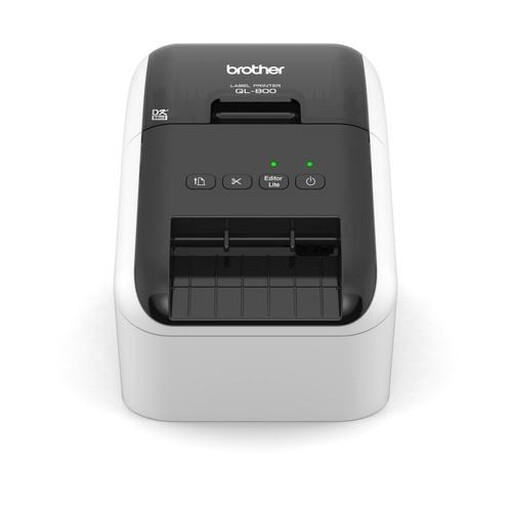 Image unavailable
Consider this model only if the available label space is large enough for the wide DK labels it supports.
The product description lists a maximum label width of 62 mm, a USB connection and DK tape. Measure the available space before choosing a label.
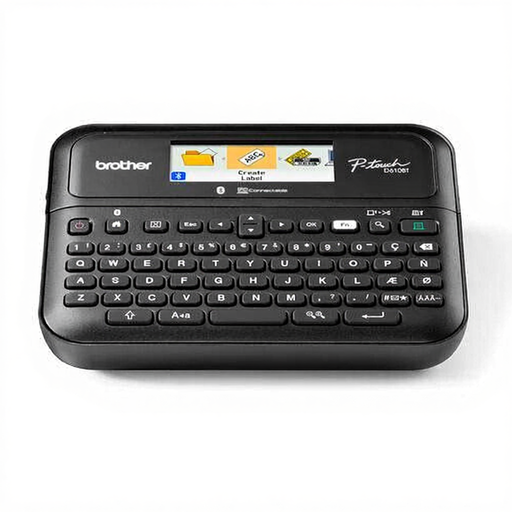 Image unavailable
An option if labels are designed on a smartphone or PC and your team wants to use TZe tape.
The product description lists Bluetooth and a cable connection. Check which tape is compatible and what width will fit on the battery.
Keep the electrical contacts clear and test whether the battery, with a sample label attached, still fits into the camera and charger without obstruction. The Fire Service identifies short circuits and damage as fire risks for batteries, so check for yourself where there is a suitable clear area on your battery type. This is a safety consideration, not a specific legal requirement for labelling.
Choose tape that is compatible with your printer and test its adhesion on a suitable spot on your own battery casing. Brother describes laminated TZe tape as durable, but this general manufacturer claim does not guarantee that it will stick to every battery surface.
Check whether tape is included with your chosen model and which cassette you need. TZe, D1 and LetraTag are different tape ranges; the LetraTag plastic tape mentioned is 12 mm wide and designed for LetraTag printers.
According to the Dutch Government, used batteries must not be put in general waste; camera batteries can be taken to battery collection points. For electrical appliances, the government lists collection by local authorities and, for private buyers, the option of returning an old appliance when buying a similar new one, subject to certain conditions. This scheme does not apply to businesses.