
Photographer with small batteries
Wants to tell similar-looking batteries apart and first checks how much clear space each battery model has for a legible label. Measure the area and keep the contacts clear.


First, choose a label that fits on a flat, clear area of your battery without covering the contacts or markings, or interfering with how it fits in your camera or charger. Then choose between a printer with a keyboard, a Bluetooth model or pre-cut labels. These systems use different consumables, and Brother TZe tape’s resistance to wear does not prove that every label is suitable for a battery.
Wants to tell similar-looking batteries apart and first checks how much clear space each battery model has for a legible label. Measure the area and keep the contacts clear.
Wants to change a code or date easily and compares a printer with a built-in keyboard with one controlled through a phone app.
Also wants to label storage items, so checks cassette compatibility and the cost of suitable refills.
Best for: typing short codes or dates without a phone; the Brother PT-H110 has a built-in keyboard.
Bear in mind: you’ll need compatible TZe cassettes and should check that the tape fits on the battery.
Best for: designing labels on a phone; the Brother PT-P300BT and DYMO LetraTag 200B use different cassette families.
Bear in mind: check app compatibility, suitable refills and exactly what’s included in the box.
Best for: labelling small items around your hobby room too; Phomemo lists 12 × 40 mm labels for the D30.
Bear in mind: check the label length, as it may be too large for a camera battery.
Measure the available space on your own battery before choosing a printer or refill. Then compare the label material and how the printer is operated. If possible, print a test label to check that it fits.
| What to consider | What should you check? | Who is this relevant to? |
|---|---|---|
| Size and placement | Measure the clear area and compare both the width and length of the specific tape or labels. Keep the contacts and important markings clear. | If I want to avoid a label sticking out or stopping the battery from fitting properly, I’ll measure the available space first. Around 33% of consumers prioritise fit and placement. |
| Readability | Check the material, contrast and font size; test how easy a sample label is to read in the chosen position. | If I handle batteries often, I want to be able to read the code later too. Around 27% of consumers prioritise readability with repeated use. |
| How it works | Choose between a built-in keyboard and Bluetooth control; if you’re using an app, check that it works with your phone. | If I regularly change codes or dates, I want controls that suit the way I work. Around 20% of consumers mainly want to make labels quickly. |
| Refills and pack contents | Check the cassette code, material type, label dimensions and included items for the exact model. | If I use the printer regularly, I want to know in advance which refills it takes and what’s in the box. Around 20% of consumers mainly consider recurring consumables. |
A label may be too long or cover an area that needs to remain clear, even if the width seems right.
Measure the flat area on your battery model and check that the battery still fits properly in your camera and charger with a test label on it.
These printers use different cassette and label systems, so refills aren’t automatically interchangeable.
Make a note of the full printer model and check the compatible cassette code and dimensions before buying refills.
Brother describes laminated TZe labels as resistant to wear; that claim doesn’t tell you how another type of label will hold up on your battery.
Check the exact material and test a label in the intended position.
The amount of starter tape or the number of labels included can vary between offers, even for the same model.
Check the contents of the specific pack and find out which compatible refills or power supply you’ll need as well.
If a pack contains very little starter material, you may need to buy extra compatible tape or labels sooner.
The PT-H110 has a built-in keyboard, while the PT-P300BT is designed for creating labels over Bluetooth. Both use TZe tape in a compatible width.
The LetraTag 100H has a keyboard, while the LetraTag 200B works with a phone app. Both use the LT cassette system.
The D30 is a compact printer for, among other things, small labels used for hobbies and organising.
These Joybuy products are designed for Bluetooth labels, tape printers and labels for organising your hobby room. For each model, check whether the label material and dimensions are suitable for the clear area on your camera battery.
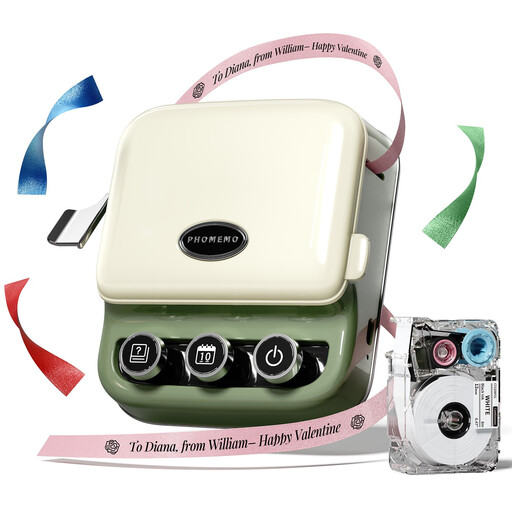 Image unavailable
May suit projects where you want to create labels over Bluetooth. First check that the available label material and size are suitable for your battery.
The product name lists one label tape unit. Ribbon for gift decoration is available separately.
 Image unavailable
May suit anyone who wants to design labels over Bluetooth; check the label length carefully before sticking one on a battery.
The product name lists a label width of 0.59 inch. Phomemo lists 12 × 40 mm labels for the D30; they may be too long for a battery.
Design labels using the app on a phone or tablet connected via Bluetooth.
 Image unavailable
May suit anyone who wants to design labels using a phone app; check that an LT label in the right size will fit on the battery.
DYMO lists compatibility with 12 mm LT tapes. The pack described contains one roll of white paper labels; other LT materials are available separately.
The printer uses four AA batteries, which aren’t included.
 Image unavailable
May suit anyone who wants to design labels on a smartphone or tablet; check the cassette width and label dimensions before using it on a battery.
Brother lists TZe tape up to 12 mm for this model.
The product name lists direct thermal printing, 180 × 180 DPI and a print speed of 20 mm/sec.
Image unavailable
May suit anyone looking for a TZe label printer with Bluetooth or a wired connection; check the cassette width and the available space on the battery.
The product name lists TZe, Bluetooth, wired and wireless connectivity, 180 × 360 DPI and 30 mm/s.
Choose a clear area where the label won’t interfere with how the battery fits in your camera or charger. Keep the contacts clear: Sony notes that dirt on battery contacts can cause charging problems. Follow the instructions for your battery model to find the exact position.
No. These models use different consumables: the Brother PT-P300BT uses TZe tape, the DYMO LetraTag 200B uses LT cassettes, and the Phomemo D30 uses compatible thermal labels. Check the cassette code and dimensions before buying; don’t assume they’re interchangeable.
In the Netherlands, you have statutory consumer rights in addition to any manufacturer’s warranty. If a product doesn’t deliver what you could reasonably expect during normal use, the seller must provide an appropriate solution free of charge, according to ACM ConsuWijzer. There isn’t one fixed statutory warranty period that automatically applies to every printer.
The Netherlands Food and Consumer Product Safety Authority states that an electrical device with Bluetooth falls under the Radio Equipment Directive (RED) 2014/53/EU. This doesn’t establish whether a specific offer meets the applicable requirements; check the information for the exact model and pack.
According to the Dutch Government, you can take batteries from still and video cameras to battery collection points. When you buy a new, similar household appliance, the shop must take back your old appliance under the take-back scheme.