
Person responsible for shared items
Wants to keep materials and storage boxes easy to identify when used by different groups. Pay particular attention to readability, adhesive and the surface the label will be applied to.


Choose a portable printer with the right tape if you want to label individual items and boxes as you move around the community centre. If you mainly print long runs of labels in one place, compare a desktop printer that uses label rolls. In either case, check compatibility, adhesive and suitability for the surface.
Wants to keep materials and storage boxes easy to identify when used by different groups. Pay particular attention to readability, adhesive and the surface the label will be applied to.
Moves between rooms and storage areas, and wants to make short labels without having to go back to a printer in one fixed location. A keyboard and power supply are practical considerations.
Prepares lots of name or inventory labels from a fixed workstation. A roll printer and a suitable computer connection may fit this way of working better than a handheld printer.
First decide where you’ll make the labels and which type of tape or roll suits your materials. Then consider the ongoing cost of consumables and the power supply.
| What to consider | What should you check? | Who is this important for? |
|---|---|---|
| Readability and adhesive | Check which tape or roll is compatible, the adhesive and the surface; test a label first on a similar item. | I want labels to stay readable on items that are handled frequently; around 36% of consumers say label durability is their main concern. |
| Labelling on the spot | Compare the keyboard and screen, the battery type or rechargeable battery, and whether an adapter is included or optional. | When I’m working between rooms, I want to make short labels where the items are; around 29% of consumers give mobile labelling their highest priority. |
| Printing labels in batches | Check whether the printer works with your computer or phone, and whether the roll size suits your boxes, folders or materials. | When I want to prepare a batch of inventory labels in advance, having a fixed workstation matters; around 21% of consumers say batch printing is their main concern. |
| Consumables | Make a note of the exact cassette or roll code, width, length and pack contents. Only compare products with the same label dimensions. | I want to be able to estimate the ongoing cost of tape or rolls; around 14% of consumers put consumable costs first. |
P-touch printers use TZe tape, while QL printers use DK rolls. These are different consumables. Properties Brother attributes to TZe tape don’t automatically apply to DK rolls or other tapes. DYMO also lists properties for specific D1 labels.
Check the printer model, cassette or roll code, surface and claims for the exact label material you’ve chosen.
If the material isn’t suitable for the way it will be used or cleaned, you may need to replace the labels.
You’ll need compatible tape or rolls after buying the printer. Comparing printers alone doesn’t take the ongoing cost of these consumables into account.
Check the code, length, width and pack size of the compatible tape or roll, and see what’s included with the printer.
Remember to allow for replacing tape or rolls, as well as the power supply you’ll need.
A name can make a child identifiable. The Dutch Data Protection Authority points out that an organisation needs a purpose and an applicable legal basis for processing personal data.
Where it’s sufficient for managing items, use an item or group code instead, and discuss within your organisation how any children’s data will be used.
P-touch printers use TZe tape for labelling individual items, while QL printers use DK rolls. These are different systems with different consumables.
The LabelManager 280 is a portable printer for D1 tape, while the LabelWriter 550 is a direct thermal label printer.
MediaMarkt’s Dutch product listing describes the D110M as a label printer with Bluetooth and a rechargeable battery.
This selection includes portable printers for TZe tape and Brother printers for DK roll labels, suitable for labelling on the spot or preparing batches from a fixed workstation.
 No image available
Suitable if you want to use TZe tape in a portable printer to label individual items.
Bluetooth; TZe tape; direct thermal; 180 × 180 DPI; 20 mm/sec. Check cassette compatibility when buying replacement tape.
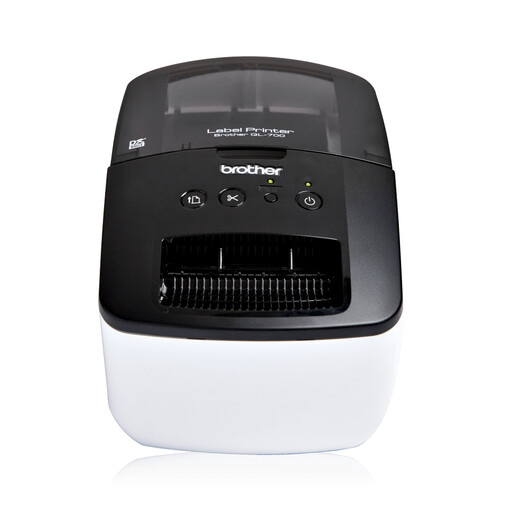 No image available
Suitable if you want to prepare roll labels at a fixed workstation, for example for boxes or folders.
DK label material; direct thermal; 300 × 300 DPI; 150 mm/sec. Check which roll size suits the labels you need.
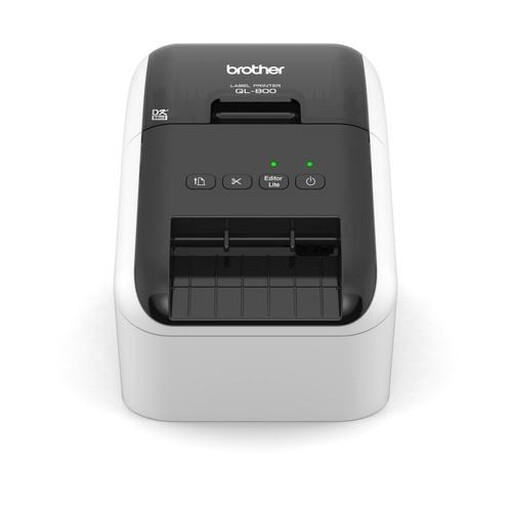 No image available
Suitable for preparing inventory or storage labels on a roll at a fixed workstation.
DK label material; wired; direct thermal; 300 × 600 DPI; 148 mm/sec. Check that a wired connection suits your workstation.
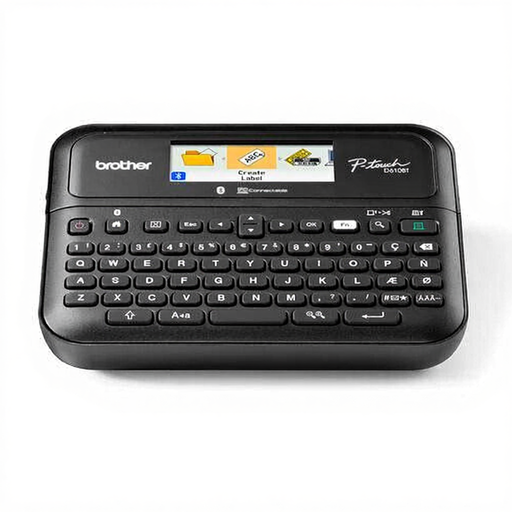 No image available
Suitable if you’re looking for a portable TZe printer and want to print labels from a smartphone or PC.
Thermal transfer; TZe tape; Bluetooth; wired and wireless connectivity; 180 × 360 DPI; 30 mm/s. Check cassette compatibility when buying replacement tape.
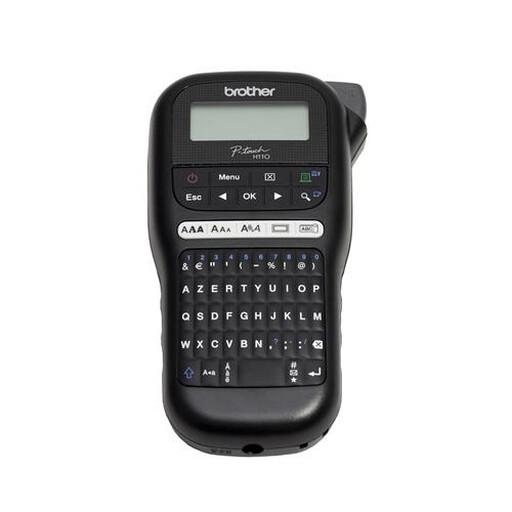 No image available
Suitable if you’re looking for a handy printer for making labels on the spot.
Handheld model. Before buying, check the exact version and which cassette it takes.
Check the properties of the exact tape or roll and the surface. Brother claims that TZe tape is water- and abrasion-resistant; DYMO says its D1 Durable Labels resist moisture and household cleaning products, among other things. Test your chosen combination on a similar item first.
For a short label, you can use the built-in keyboards on the Brother PT-H110 and DYMO LabelManager 280. DYMO also says the LabelManager 280 can be used with a computer. The Brother QL-820NWB offers different connection options and can print previously saved labels on its own.
Check the exact consumable code, the length or quantity in each pack, what’s included and the power supply. Brother lists AAA batteries or an optional adapter for the PT-H110; for the TZe-231, Brother specifies a width of 12 mm and a length of 8 m. When you buy, also check the terms and conditions that apply to your order.
A name is personal data. According to the Dutch Data Protection Authority, an organisation must consider its purpose and the applicable legal basis when processing personal data. An item or cupboard code may be an alternative if it’s sufficient for managing items; this doesn’t mean that every name label is automatically forbidden or permitted.
No. According to Business.gov.nl, CE is not a quality mark; it’s a marking through which the manufacturer declares that the product complies with applicable EU rules. A CE marking doesn’t tell you whether a particular label will stick to a specific school item.