
Shared folder administrator
You want everyone to be able to find the same files easily. Brother Netherlands and DYMO Netherlands describe label printers for making labels for folders and small offices, among other things.


First, choose a label that fits the spine or tab of the folder and is easy for everyone to read. Then choose a printer that supports that material. A standalone tape printer is handy for labelling individual folders in different locations, while a computer-connected printer using label rolls may be better suited to printing batches of matching labels. Before you buy, check the exact cassette or roll code and the adhesion you need.
You want everyone to be able to find the same files easily. Brother Netherlands and DYMO Netherlands describe label printers for making labels for folders and small offices, among other things.
If folders are handled often, it’s important to choose a label that’s suitable for the surface and can be removed as required. DYMO describes different D1 tapes for a range of applications.
You regularly create batches of labels and want to reuse designs or prepare them on a computer. Brother mentions saved designs for the PT-D610BTVP and computer control for the QL-800.
First measure the space available on the folder and decide how you’ll create the labels. Then choose consumables that suit the surface and how the folders will be used.
| What to consider | What to look for | Who is this important for? |
|---|---|---|
| Readability and size | Measure the available width on the spine or tab and check which tape widths the printer supports. | I want everyone to be able to read folder names quickly, and the label to fit the folder; around 36% of consumers prioritise readability and size. |
| Adhesion and use | Check the tape type, the folder surface and whether the label needs to be removable later. | For folders that are handled often, I want a label that suits the surface and provides the right level of adhesion; around 29% of consumers give this top priority. |
| Batch labelling | Decide whether you’ll create labels at each folder or prepare them on one central computer. | If I regularly need the same layout, I want to be able to reuse designs or print labels one after another; around 21% of consumers choose mainly based on batch printing. |
| Refills | Make a note of the exact cassette or roll code and check which starter refill is included with the model. | I want to choose refills that fit the printer and avoid unnecessary waste; around 14% of consumers focus mainly on the refill system. |
P-touch, QL and LabelManager models use different material ranges. A cassette or roll for one system won’t necessarily fit another model.
Check the exact printer model against the cassette or roll code before ordering refills.
The wrong refill may be unusable, meaning you’ll need to buy the correct material as well.
A printer’s maximum width doesn’t tell you how much space is available on the folder spine or tab. A label that doesn’t fit could obscure text or make it harder to see neighbouring folders.
Measure a sample folder and, if necessary, print a test label with a long, typical folder name.
A label that doesn’t fit can result in wasted tape or labels.
Brady lists a rechargeable battery with the M210-KIT EU; don’t assume the standalone M210 includes one too.
Check the full product code and the contents of the pack you’ve chosen before ordering.
Depending on the version you choose, you may need to buy a power supply or another kit component separately.
The P-touch models mentioned use tape for individual labels, while the QL-800 uses a separate system with DK label rolls.
The LabelManager 210D+ is a standalone option for labelling folders and files, using D1 tape as its consumable.
The M210 is worth considering if you also need the same printer for other identification tasks around the workplace, as well as for file folders.
This selection includes portable label makers for folder labels, as well as a label-roll printer for archive folders and batches of labels.
 No image available
Could be a good fit if you want to make folder labels on the go and create labels in batches too. Check that the roll width and material are suitable for your folder spines or tabs.
 No image available
Could be a good fit if you want to label files with a portable label maker and create labels using a mobile device. The product name specifies a label width of 0.59 inch; check that this size will fit your folder spine or tab.
 No image available
Could be a good fit if you want to make labels in different locations using a phone or tablet. According to the product information, this version runs on four AA batteries, which aren’t included. Check that the label material is suitable for the folder surface.
 No image available
Could be a good fit if you want to make folder labels in different locations using Bluetooth. The product name specifies thermal printing and TZe; check which tape type and width are suitable for your folder.
 No image available
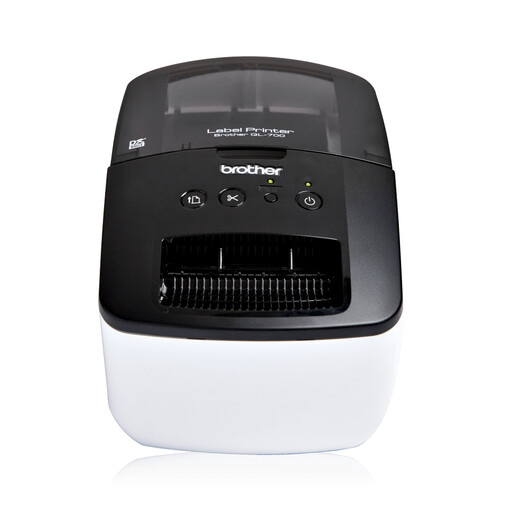
Could be a good fit if you design archive-folder labels on a computer and print them in batches. The product name specifies DK, 300 x 300 DPI and 150 mm/sec; the product information lists USB and an automatic cutter. Check that a roll suits your preferred label size and folder surface.
No. First measure the usable space on the folder, then choose a suitable tape and printer. Brother Netherlands lists support for widths up to 12 mm for the PT-D210VP and up to 24 mm for the PT-D610BTVP; a wider maximum size doesn’t mean the label will fit every folder.
Choose label material to suit the surface and the adhesion and removability you need. DYMO describes standard D1 tape as suitable for clean, flat surfaces and also offers permanent tape. If you’re unsure, test the adhesion on a similar folder.
No. Check the exact printer and material code. The Brother P-touch models mentioned use TZe tape, the Brother QL-800 uses DK rolls and the DYMO LabelManager 210D+ uses D1 tape.
Not necessarily: Ondernemersplein distinguishes between private purchases and purchases made by businesses. Different warranty rules apply to business purchases, and there’s no statutory cooling-off period for consumers; for a consumer purchase made at a distance, the Dutch government generally states a 14-day cooling-off period. Check who the contractual buyer is.