
Staff member labelling folder spines one at a time
Wants to make individual labels by the filing cabinet and checks that the tape width will fit the folder spine.


For individual folder labels, a label maker with its own keyboard is handy if you want to work without a phone or computer. For a batch of matching labels, a USB printer with folder labels on a roll is better suited to the job. An app-controlled model is an option if you’re allowed to use a suitable phone or tablet at school. Check the fit, the right refill and the school’s policy on visible pupil information before you choose.
Wants to make individual labels by the filing cabinet and checks that the tape width will fit the folder spine.
Creates lots of matching labels from a computer and compares the label size, connection and refill options.
Wants to find folders without displaying more identifiable pupil information than necessary. The Dutch Data Protection Authority points out that schools must protect pupil information and properly manage access to pupil records.
Best for: making individual labels and entering text on the device, without a phone or computer.
Bear in mind: the maximum tape width and the correct TZe cassette for your model.
Best for: designing and printing a batch of matching labels from a workstation.
Bear in mind: this option works via a computer and USB; check the size of the folder label you choose.
Best for: designing labels on a phone or tablet, if this is convenient and permitted at school.
Bear in mind: the app requires a compatible mobile device; check the school’s policy on apps too.
Best for: wider folder spines when you need a model with matching tape, such as the Epson LabelWorks LW-C610.
Bear in mind: check the exact tape type and model compatibility.
| What to consider | What should you check? | Who is this important for? |
|---|---|---|
| Fit and legibility | Measure the folder spine and compare it with the tape width or the label’s overall dimensions. | If I want the label to fit on the folder spine and the text to remain legible, I first check the available space. Around 36% of consumers put fit and legibility first. |
| Labels in batches | Check whether USB use is allowed at the workstation and whether the roll has the folder label size you need. | When I’m labelling lots of matching folders in a row, I want to be able to create the same labels from a workstation. Around 29% of consumers give batch labelling their highest priority. |
| Compatible refills | Note the exact model name and check the corresponding cassette or roll code. | If I want to order refills without choosing the wrong tape or roll, I check the product range. Around 21% of consumers put refills first. |
| Operation at the workstation | Check that an approved computer, phone or tablet and the required software are available. | If I want to make labels without using a phone app for each one, I look for a model with its own keyboard. Around 14% of consumers consider standalone operation their main requirement. |
When labelling pupil records, the text you display is a separate decision: the Dutch Data Protection Authority emphasises that schools must also manage access to records properly. A label maker does not replace access controls.
P-touch and QL models use different types of consumables. A cassette for one model will not automatically fit the other.
Before ordering, check the exact model name, the width and the cassette or roll code.
The DYMO LetraTag 200B is controlled via a mobile app. DYMO lists Android 10 or later and iOS 13 or later as compatible versions.
Check that a suitable mobile device is available and that the school’s policy allows app use.
A name or code that can identify a pupil may count as personal data. The Dutch Data Protection Authority points out that schools must protect personal data and manage access to pupil records.
Choose the visible text in line with the school’s privacy and archiving policies, and manage access to the records where necessary.
Epson lists the LabelWorks LW-K400 as discontinued on its Dutch manufacturer website.
Check the exact model and compatible tape; don’t use the LW-K400 as a guide to the availability of a new device.
Brother offers P-touch label makers for individual labels as well as the QL-800 for folder labels on a roll.
The LetraTag 200B is designed for individual labels made using a phone or tablet, while the LabelManager 280 has its own keyboard.
The LabelWorks LW-C610 is an option to consider if you’re looking for mobile label design and wider tape.
This selection includes mobile label makers for individual labels or batches, and USB label printers for printing batches of folder labels from a computer.
 No image available
An option if you want to create folder labels and batches of labels from a mobile device.
Bluetooth operation via an app; compatible with iOS and Android according to the product description. Stated label width: 20–50 mm. The description mentions batch printing and a rechargeable battery.
 No image available
Ideal for individual labels designed on a phone or tablet; check first whether this method of operation is allowed at school.
DYMO lists 12 mm LetraTag tape and compatibility with Android 10 or later or iOS 13 or later. According to the product description, it requires four AA batteries, which are not included.
 No image available
An option for folder labels if you want to design them via Bluetooth using a smartphone or tablet.
The product description lists TZe tape from 3.5 to 12 mm. A smartphone or tablet is required to design and print via Bluetooth.
 No image available
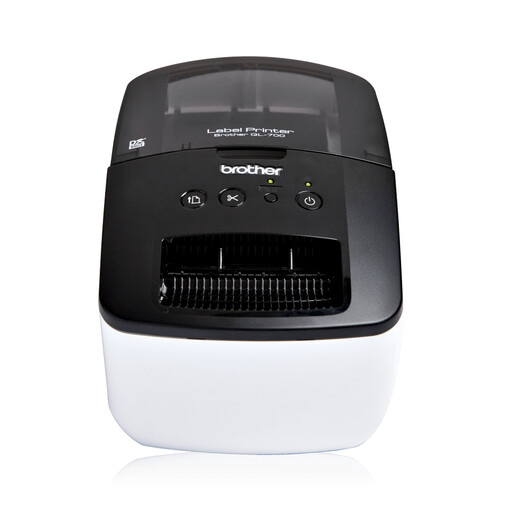
Suitable for creating archive folder labels from a computer; bear in mind that it operates via USB and label software.
The product description lists DK label stock, USB and an automatic cutter. It also specifies 300 dpi and a print speed of 150 mm/s.
 No image available
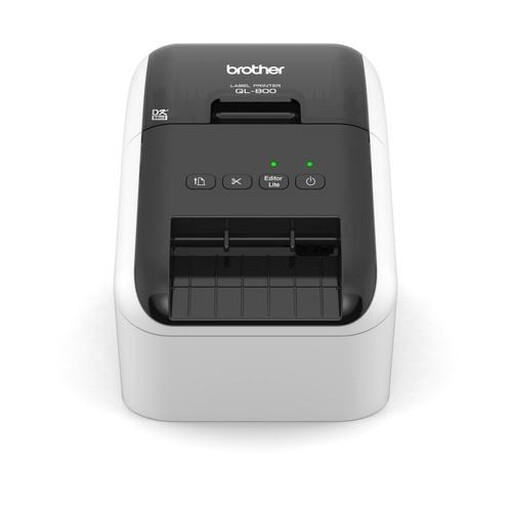
An option for printing batches of folder labels from a computer; this printer does not have its own keyboard for entering text.
The product description lists USB and a maximum label width of 62 mm. Brother specifies the 17 × 87 mm DK-11203 folder label for the QL-800.
It depends on the printer: measure the available space and compare it with the supported tape width or the pre-cut label’s overall dimensions. For example, Brother lists a 17 × 87 mm DK folder label for the QL-800; the PT-D210VP prints tape up to 12 mm.
Yes. With a model that has its own keyboard, such as the Brother PT-D210VP, you can enter text on the device. Brother describes the QL-800 as a printer used with a computer via USB; the DYMO LetraTag 200B works with a phone or tablet and an app.
Note the exact model name and check the code for the corresponding cassette or roll. The QL-800 is listed with DK folder labels, the PT-D410VP with TZe tape and the LetraTag 200B with LetraTag tape; don’t assume these product ranges are interchangeable.
A name or code that can identify a pupil may count as personal data. The Dutch Data Protection Authority says schools must protect personal data and properly manage access to pupil records. So make sure the visible text complies with the school’s privacy and access policies.