
Shared case manager
Want to label cases quickly with a clear name or code? Legibility and a process everyone can follow are important considerations. Brother Nederland and DYMO describe label makers designed to create labels like these.


First, choose a tape that suits the case surface and how it will be used. Then decide whether you only need names or also codes, barcodes and wider labels. A Brother P-touch with TZe tape may suit short names, while a DYMO Rhino 4200 offers more options for fixed lengths and barcodes, but uses a different tape system. Manufacturers describe the features of their tapes; test the adhesive on your case before labelling several cases.
Want to label cases quickly with a clear name or code? Legibility and a process everyone can follow are important considerations. Brother Nederland and DYMO describe label makers designed to create labels like these.
If cases are handled or cleaned often, check the tape and test it on your case material. Brother and DYMO describe tapes with features for a range of uses, but that doesn’t automatically tell you how well a label will stick to every case.
If you want to label cables as well as cases, or use fixed codes and barcodes, check that your chosen printer supports those functions. DYMO describes the Rhino range as being for industrial labelling applications.
Choose the cassette and label width to suit the case and the text you want to use. Then compare the controls and features you actually need.
| What to consider | What should you look for? | Who is this important for? |
|---|---|---|
| Adhesion and legibility | Compare the case surface, cleaning requirements and suitable tape. Test the adhesive on an inconspicuous area first. | If I want names to stay legible on cases that are handled often, I first look at the tape and surface; around 33% of consumers prioritise adhesion and legibility. |
| Names and inventory codes | Decide what text will fit in the available space. Brother Nederland lists labels up to 12 mm for the PT-D210VP; the Dutch Rhino 4200 product page lists RHINO tapes up to 19 mm. | If everyone needs to recognise the same names or codes on the cases, a consistent layout is important; around 27% of consumers put uniform identification first. |
| On-site operation | Check the keyboard, screen, cutting mechanism and power supply for the exact version. Brother states that AAA batteries are not included with the PT-E110VP. | If I want to make labels on the spot at different locations without using a computer first, I look at the controls and power supply; around 20% of consumers prioritise on-site use. |
| Compatible tape and replacement | Check the cassette family, width and pack size. Brother TZe and DYMO RHINO are different tape systems, so don’t assume their cassettes are interchangeable. | If you want to weigh up the device and future tape purchases together, it’s worth checking the cassette you’ll need in advance; around 20% of consumers prioritise tape use and replacement. |
Brother TZe, DYMO RHINO and DYMO D1 are different tape systems. A label maker will only work for your task if the cassette and required width are compatible with the exact model.
Before buying, check the full model name, cassette family and required width side by side.
DYMO describes standard D1 labels for clean, flat surfaces, but that doesn’t prove how well they’ll stick to every case surface. Brother also offers TZe tape with different features.
Check the surface and test your chosen tape on one case first.
Epson Nederland lists the LW-C410 and LW-Z710 models reviewed as discontinued. A product page for compatible tape doesn’t confirm that the corresponding printer is still available new.
Check availability of the exact device and compatible tape separately.
The P-touch range includes models for short office labels and portable use. Your choice will also depend on which TZe tape suits the case surface.
The Rhino range may be worth considering if labelling cases goes hand in hand with using fixed codes, barcodes or cable identification. The Dutch product page describes the Rhino 4200 QWERTY.
LabelWorks offers tape options for organising equipment, but check that the specific device is available before considering this option.
This selection includes portable label makers for names and inventory or product labels on instrument cases. Before buying, check that the tape and label size suit the surface and the text you want to use.
 No image available
A portable option for anyone who wants to create labels for inventory and identification.
The product title states that one label roll is included.
 No image available
A portable label maker for anyone who wants to print names or codes on the go.
The stated label width is 0.59 inch.
 No image available
A suitable choice for anyone considering a Brother label maker for names or short codes and planning to use TZe tape.
The product name lists direct thermal printing, 180 x 180 DPI, 20 mm/sec and Bluetooth.
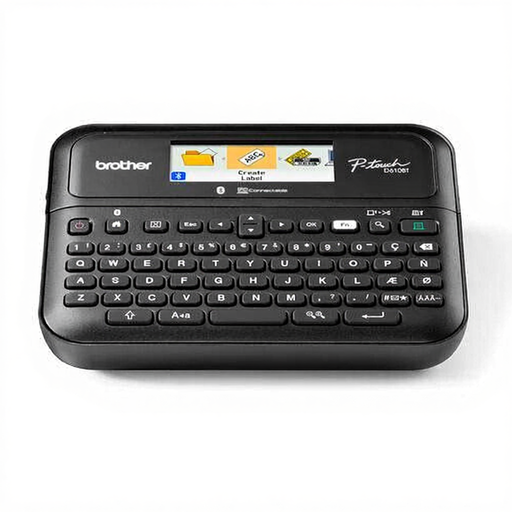 No image available
An option for anyone who wants to use Brother TZe tape and create labels from a connected device.
The product name lists 180 x 360 DPI, 30 mm/s, wired and wireless connectivity, and Bluetooth.
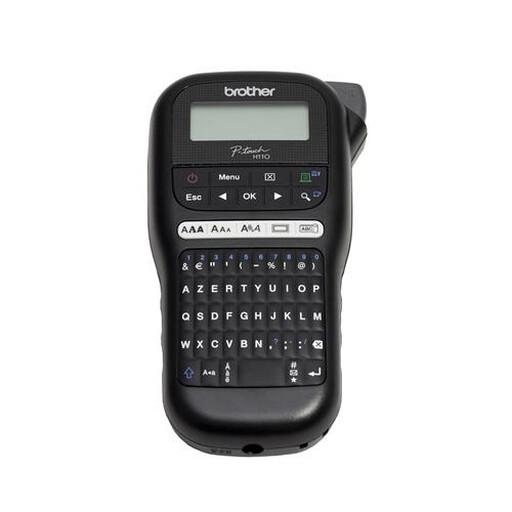 No image available
A handheld option for anyone who wants to make labels in the workshop and is considering Brother TZe tape.
The product name specifies the Italian version and black colour.
Don’t choose tape based on the material alone. Brother offers laminated and extra-strong adhesive TZe tape as different options; choose according to the actual surface and test the adhesive first. DYMO describes standard D1 labels for clean, flat surfaces, including plastic.
First, check that the cassette is compatible with the device. For a DYMO LabelManager, DYMO recommends keeping the print head and pinch roller free of dust, adhesive residue and tape obstructions if you have problems with printing or feeding. For other models, follow the relevant instruction manual.
Check the product and safety information for the exact version. According to the Dutch Ondernemersplein, electrical and electronic devices placed on the market must comply with applicable European rules. After assessing the relevant requirements, the manufacturer applies the CE marking and draws up an EU declaration of conformity. The CE marking is not an assessment of label quality.
Contact the seller. According to ACM ConsuWijzer, the seller must offer a solution if a product develops a fault under normal use sooner than you could reasonably expect. There isn’t one fixed statutory guarantee period that applies to every device.
For a device owned by a private individual, the Dutch Government lists options including handing it in when buying a similar new device, taking it to a collection point or bringing it to the local recycling centre. The old-for-new scheme described for private individuals doesn’t automatically apply to a printer bought for business use.