
For occasional folder labelling
You make a few year labels in different places and want to enter the text directly on the device.


For a few school year folders, a handheld label maker with a keyboard is handy if you want to work without a phone or computer. An app-based model is a good fit if you prefer to design labels on a mobile device and this is allowed under your school’s policies. For larger batches made at a fixed computer, a desktop printer with label rolls is another option. Before buying, check the available label size, the refill system and, when dealing with pupil data, your school’s privacy policies.
You make a few year labels in different places and want to enter the text directly on the device.
You make several labels at a fixed workstation and want to choose the label size and roll in advance.
You want to make labels on a phone or tablet, provided app use is allowed under your school’s policies.
A good fit if: you occasionally label folders in different places and want to type without using a phone or computer.
Bear in mind: the supported tape width and the correct cassette for your model.
A good fit if: you want to design labels on a phone or tablet and your school’s policies allow app use.
Bear in mind: you’ll need a mobile device, the app and the right refill.
A good fit if: you’re making a batch of folder labels at a fixed computer.
Bear in mind: this option requires a computer workstation and a compatible DK roll size.
| What to consider | What should you check? | Who is this important for? |
|---|---|---|
| Fit and readability | Measure the space available on the folder spine and compare it with the supported tape or label width. Make a test label if needed. | If I want the year to fit on the folder spine and be easy to read, I check the size first. Around 30% of consumers make this their main priority. |
| Making individual labels | Compare typing on the device with designing labels on a phone or tablet; consider where and how you want to work. | If I only label one folder now and then, I want to do it without an unnecessary design session. Around 30% of consumers mainly want to make individual labels quickly. |
| Making a batch of labels | Check the computer connection and whether the available roll size is suitable for the folder. | If I’m labelling several folders in a row, a fixed workstation is practical for me. Around 20% of consumers prioritise making a batch at one workstation. |
| Compatible refills | Check the exact model and whether it uses TZe cassettes, DK rolls or another specific label type. | If I want to keep using the device regularly, I want to know in advance which refill it takes. Around 20% of consumers focus mainly on compatible refills and running costs. |
A brand may offer several tape widths, while a particular device supports only some of them. According to Brother, the Brother PT-H110 supports TZe tape up to 12 mm wide.
Before buying, check the specifications for the exact model and the cassette width.
The DYMO LetraTag 200B is operated via a mobile app. If you want to use it to process pupil data, the school remains responsible for that processing, even when an external digital application is used.
Check that app use is allowed under your school’s policies, and don’t enter pupil data until the data processing has been assessed.
P-touch, QL, LetraTag and LabelManager models use different consumables. A refill for one system won’t necessarily work with another.
Look up the full model number and check which type of cassette or roll it uses before ordering refills.
Brother offers both handheld P-touch models with tape cassettes and desktop printers that use DK rolls.
The LetraTag 200B is an option for designing labels on a mobile device, while LabelManager models use a separate tape system.
NIIMBOT offers, among other options, portable direct thermal B models and thermal transfer M and N models.
This selection includes handheld models, app-operated label makers and desktop printers for folder labels. The right option depends on factors such as the number of labels, your workstation and the refill you need.
 No image available
A portable, app-controlled option if you want to design folder labels on a phone or tablet.
Bluetooth app control; label widths of 20–50 mm; batch printing; rechargeable battery. Operated via the Print Master app.
 No image available
A mobile option if you want to design labels using the LetraTag Connect app and app use is allowed under your school’s policies.
Bluetooth; controlled via a mobile app; label width up to 12 mm. Make sure you order LetraTag labels for this model.
 No image available
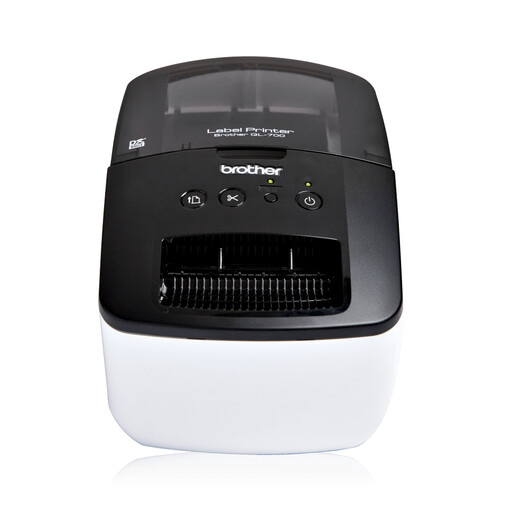
A desktop option for making a batch of folder labels from a fixed computer.
USB connection; DK rolls; maximum label width 62 mm; automatic cutter. Check that the roll size is suitable for the folder.
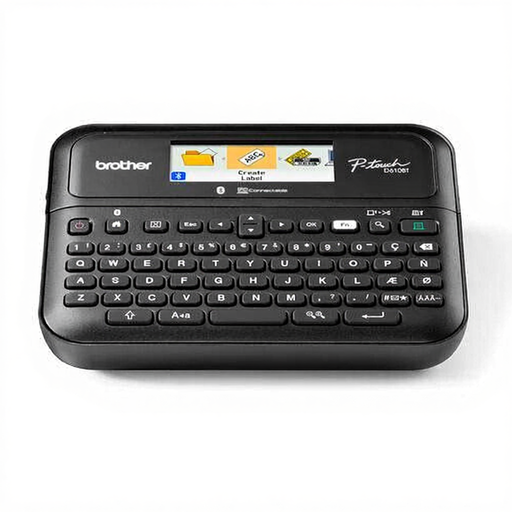 No image available
An office option if you want to make labels with TZe tape and need Bluetooth or wired operation.
Thermal transfer printing; TZe tape; Bluetooth; wired and wireless connectivity; print speed 30 mm/s.
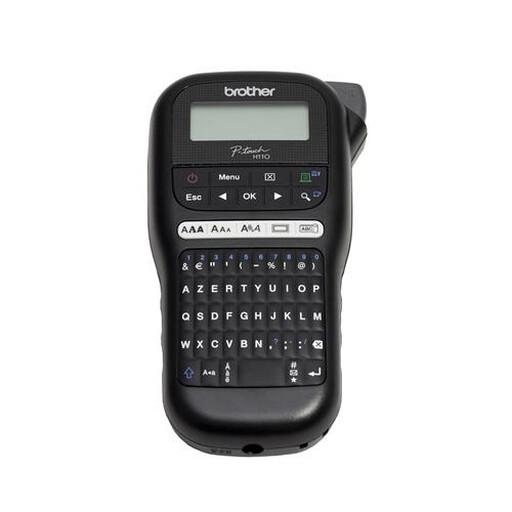 No image available
A handheld option if you want to enter individual folder labels directly on the device.
According to the product information, it supports TZe cassettes in 3.5, 6, 9 and 12 mm widths. Check that your chosen width fits on the folder spine.
Measure the space available on the folder and, if necessary, make a test label using your chosen cassette or roll. According to Brother, the PT-H110 supports TZe widths from 3.5 to 12 mm, so don’t choose based on the full TZe range alone.
Check the full model number: the PT-H110 uses compatible TZe cassettes, the QL-700 uses DK rolls and the LetraTag 200B uses LetraTag labels. Don’t assume refills are interchangeable between these systems.
This depends in part on your school’s policies for processing personal data. The Dutch Data Protection Authority stresses that the school remains responsible for personal data processed through a digital application, even when that processing is outsourced to another party. So check the app and your school’s procedures before entering pupil data.
No. A year label doesn’t determine how long the contents must be kept. The Dutch Government states that primary schools may keep most records for two years after a child has left the school; don’t assume this applies to every record in the folder without checking.