
Vandaag of morgen in huis

Kwaliteit gegarandeerd

Welkomstaanbiedingen ontgrendelen: GRATIS bezorging | Tot 80% korting | Gratis 30 dagen JoyPlus-proefperiode
Download de app
If you want to buy konjac jelly, the choice may seem simple: choose a flavour, check the price and place your order. However, these jelly snacks can vary significantly in nutritional value, portion size, sweeteners and packaging. For example, a product with “fruit” on the front may contain only a small percentage of fruit juice. “Konjac” also does not automatically mean that a jelly is low in calories or sugar-free.
As a Joybuy Product Recommendation Officer, I filter the most important product information so that you can compare marketing claims with verifiable details on the label.
A fruity name does not mean that a product contains a lot of fruit. According to the product information, for example, WANT WANT Konjac Jelly Orange contains 0.1% concentrated orange juice. The flavour therefore also comes from flavourings and other ingredients. Orihiro Prunto Konjac Jelly Peach, on the other hand, lists 23% fruit juice, including peach and apple juice.
That is why you should check the ingredients list and the quantitative ingredient declaration. These provide more information than an image of mango, peach or lychee on the packaging.
Nutritional values vary considerably:
A sugar-free jelly may therefore contain sweeteners such as sucralose, acesulfame-K, erythritol or steviol glycosides. If you want to avoid a particular sweetener, it is best to check the full label.
Konjac jelly has an elastic, chewy texture. Some packs are designed for the jelly to be pushed out a little at a time. The Orihiro packaging, for example, states that you should open the jelly along the perforated line and eat it in several bites. Do not swallow the jelly whole, and do not allow young children to eat this type of snack unsupervised.
Always follow the usage instructions on the packaging. The products are ready to eat, but the correct way to open and eat them varies depending on the format.
A 200-gram bag is convenient for sharing or enjoying over several occasions. Individual 20-gram portions, such as those offered by Orihiro, are easier to manage when you are out and about. Drinkable 150 ml varieties, such as Jelly B, fit easily into a bag or lunchbox.
Pay attention to the difference between net weight, number of portions and contents per pouch. A multipack containing 10 × 150 ml is practical for regular use, but takes up more storage space than a single 106- or 120-gram pack.
Ideally, compare products on the same basis: per 100 grams or per 100 ml. At a minimum, look at:
A low-calorie snack can still taste sweet because of sweeteners. If you specifically want to limit your sugar intake, you could compare a vegan konjac jelly with 0 grams of sugar with a traditional Japanese variety containing sugar or glucose syrup.
“Vegan” should be confirmed by the product information. The green grape variety, Delief Mango and Delief Lychee are listed as vegan. Peach and apple are listed as allergens for Orihiro Peach. Even with products containing fruit flavouring, always check the allergen information on the current packaging.
Japanese konjac jelly and Korean konjac jelly often differ in portion format and flavour profile, but origin is no substitute for checking the ingredients and nutritional values. According to the product information, the Shimonita varieties, among others, come from Japan, while several Delief and Jelly B products come from South Korea.
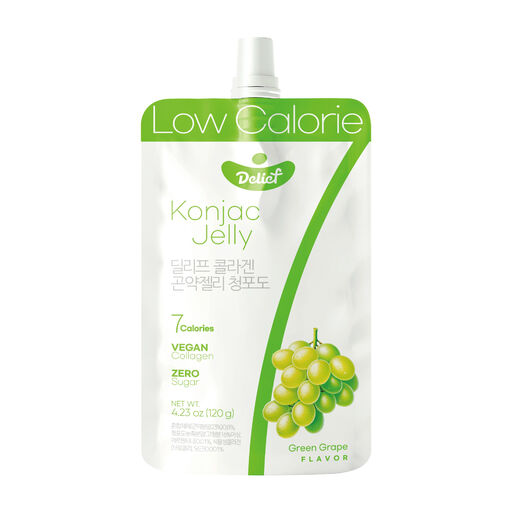
Why it suits this profile: A compact vegan option with green grape flavour for anyone wanting to try a low-calorie jelly without immediately buying a multipack.
The product information states 5 kcal and 0 grams of sugar per 100 grams. However, check the current ingredients list and sweeteners on the packaging.
Listed as vegan, with 120 grams of product, 5 kcal per 100 grams and 0 grams of sugar according to the available product data.
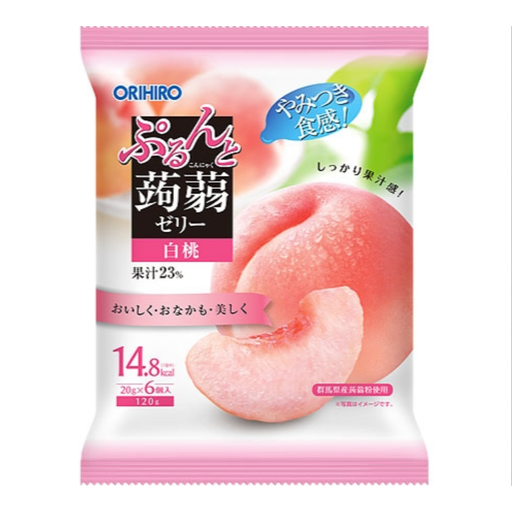
Why it suits this profile: For fans of Japanese konjac jelly with individual portions and a clearly stated fruit content.
The product information states a fruit content of 23%. The push-out packaging helps you eat the jelly in a controlled way.
Six 20-gram portions, 74 kcal per 100 grams, plus peach and apple juice according to the label.
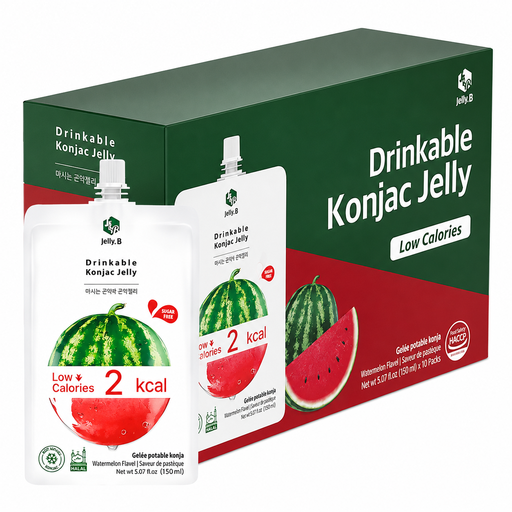
Why it suits this profile: Korean konjac jelly in a multipack, ideal for keeping at home or work and enjoying over several snack breaks.
The packaging states 10 × 150 ml and 1.6 kcal per 100 grams. The ingredients list makes it clear that erythritol and sweeteners are used.
Ten individual drinkable portions, watermelon flavour and 0 grams of sugar per 100 grams according to the product information.
We have put together a complete, up-to-date list of products that fully meet these strict selection criteria and the applicable European safety regulations.
No. Nutritional values vary depending on the recipe. Some varieties containing sugar or glucose syrup provide around 89 to 115 kcal per 100 grams. Other products containing erythritol or intense sweeteners contain only a few kcal per 100 grams. That is why you should compare the nutrition table rather than relying solely on the product name.
Only when this is stated for the product or clearly supported by the ingredients. The Green Grape Vegan, Delief Mango and Delief Lychee varieties are described as vegan. Check the current product information with every order, especially if you want to avoid allergens or animal-derived ingredients.
Store unopened jelly according to the instructions on the packaging, usually in a cool, dry place away from direct sunlight. The best-before date is shown on the product. Once opened, store a pouch according to the usage instructions and consume it promptly. Do not use damaged packaging, and check the label if in doubt.
