
Makers who want to show scarf colours
They want different yarn colours to remain recognisable under the same lighting, and to check the results before the exhibition.


For overview shots, your current camera or phone may be enough if a test photo shows sufficient detail and recognisable colours. Start with even lighting and a fixed set-up; Canon Europe points out that presentation and lighting make a big difference. If you want to capture individual stitches or crop your photos significantly, check the close-up capabilities of both the camera and lens, or compare the image resolution with your intended print size.
They want different yarn colours to remain recognisable under the same lighting, and to check the results before the exhibition.
As well as an overview shot, they need individual close-ups of the knitting, so they pay attention to how close the camera and lens they use can focus.
They take consistent overview shots or prints for the display, and check the framing, crops and colours of a test print.
Start with the lighting conditions and the type of photo you need; only then compare the camera or lens. Canon Europe explains how white balance and lighting affect colour reproduction. Canon Europe and Fujifilm also highlight the value of test shots, RAW files and print checks when you want to assess or edit colours.
| What to consider | What should you check? | Who is this important for? |
|---|---|---|
| Colour reproduction | Check the white balance and take a test photo under the lighting you plan to use at the exhibition. Shooting in RAW can give you more scope to adjust the white balance afterwards. | I want the yarn colours to remain recognisable under the exhibition lighting, so I check them with a test photo. Around 33% of consumers put colour reproduction first. |
| Stitches and yarn texture | Check the focusing distance of both the camera and the lens you plan to use with a detail shot. If you have a mirrorless camera, also check that the lens fits its mount. | If I want to show individual stitches or yarn fibres, I need to know that the camera-and-lens combination can focus at close range. Around 25% of consumers prioritise stitch detail. |
| Overview shots | Check that the whole scarf fits in the frame and that you can repeat the composition. A tripod helps keep the framing and background consistent. | I want to photograph several complete scarves from a similar angle against the same background. Around 25% of consumers prioritise an overview and a repeatable set-up. |
| Crops and prints | Find out the desired print size and assess the available image resolution after any cropping. Make a test print to check the colour reproduction. | If I want to crop or print my photos, I need to know in advance how much image area will remain and how the colours will look on paper. Around 17% of consumers prioritise print size. |
White balance and the colour of the light affect the photo, while your print workflow also plays a part in the final result.
Take a test photo first and, if you plan to print, make a test print before switching cameras because of a colour difference.
A test photo and, if needed, a test print take extra preparation to check the lighting and colour reproduction.
Your choice of lens partly determines how close you can focus, and not every lens fits every camera mount.
Compare the complete camera-and-lens combination using a detail of the knitting as your test subject.
For close-ups, you may need a compatible lens or a different camera system.
According to the manufacturer, the OM SYSTEM Tough TG-7 has a built-in close-up function, while a mirrorless camera offers a choice of lenses. Their stated resolutions and uses differ.
Choose based on the photo you actually need: a stitch detail, the whole scarf or a heavily cropped print.
The EOS R50 is an APS-C mirrorless camera to consider if you want to compare interchangeable lenses for overview shots and close-ups.
The Alpha 7 IV is a full-frame mirrorless camera to compare if generous cropping and broader photography use are important to you.
The X-T5 is a mirrorless camera to compare if you want to assess how much scope image files give you for cropping.
The Z50II is a mirrorless camera to compare if you want to use a movable screen and interchangeable lenses in your set-up.
The Tough TG-7 is a compact camera to consider if you want to photograph close-up details without changing lenses.
This selection includes compact cameras and cameras supplied with a zoom lens. For photos of stitches, also check how close the specific combination can focus.
 No image available
The zoom can be useful if you want to adjust the scarf framing; check separately whether the camera can focus close enough to capture stitches.
The product title lists 80 MP and 18× optical zoom.
 No image available
The zoom lets you adjust the framing; check the focusing distance if you want to photograph individual stitches.
The product title lists 12× optical zoom, 4K, 64 MP and WiFi.
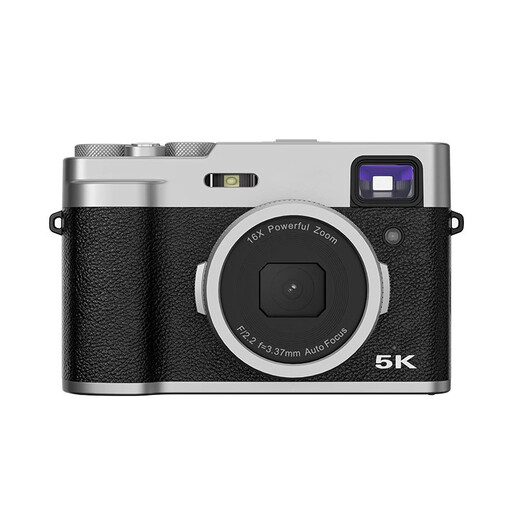 No image available
Autofocus is listed for this camera; take a detail shot to see whether it focuses well on the knitting.
The product information lists 48 MP, 5K, a 2.8-inch LCD screen and an optical viewfinder.
 No image available
The supplied zoom lens gives you different framing options; check its focusing distance for close-ups of stitches.
The product information lists an APS-C sensor and 24.2 MP. It also mentions a Product Showcase setting that shifts focus to an object.
 No image available
The supplied lens gives you different framing options; check its focusing distance if you want to capture small stitches individually.
The product information lists an APS-C sensor with 24.2 MP, an electronic viewfinder and a tilting screen.
No, not for an overview shot. First check that the whole scarf fits comfortably in the frame; close-up capability becomes particularly important when you need individual stitches to be visible. With a mirrorless camera, check the mount and focusing distance of the specific lens.
Use a fixed, uncluttered set-up and check the lighting. A tripod helps you repeat the same framing and background for each scarf. Check the colours with a test photo under the lighting you plan to use.
Check the white balance of the photo and make a test print. Canon Europe recommends using a calibrated screen and assessing the print under suitable viewing light for predictable results. Buying a new camera alone will not fix a difference between screen and print.
For an online purchase, you generally have a 14-day cooling-off period from delivery; check the exceptions and returns policy. You are also covered by the statutory guarantee if a product does not perform as you could reasonably expect under normal use, and the seller is your point of contact. ACM ConsuWijzer explains that the length of a manufacturer's warranty does not automatically determine how long the statutory guarantee lasts.
According to the Dutch Data Protection Authority, an organisation needs a lawful basis under the GDPR to use images of identifiable visitors. Consent is often the obvious choice, although another lawful basis may be possible in certain circumstances. Tell visitors how their images will be used, and do not treat their presence as automatic consent.