Who is this buying guide for?

If you have limited kitchen space

You usually make a kiwi smoothie at home and want an appliance that fits on your worktop and can be stored in a cupboard. Philips describes the HR2510/90 as compact; compare the dimensions of the model you’re considering with your available storage space.

If you want to take your smoothie with you

You want to blend directly in a drinking cup, so you don’t have to pour the smoothie into a separate bottle afterwards. The Consumentenbond describes this as a common feature of smoothie blenders with a small blending cup.

If you also use greens or frozen ingredients

You might blend kiwi with spinach and oats, for example, or use frozen fruit from time to time. The Voedingscentrum describes a green smoothie made with kiwi, spinach, soya drink and oats. If you use frozen ingredients, check what your blender can handle and follow its instructions.

What should you look for when buying?

Compact jug blender

A good fit if: you make one or a few portions at home and don’t need a travel cup.

Bear in mind: a jug isn’t automatically a drinking cup; check its capacity and the height it needs for storage, too.

Blender with a to-go cup

A good fit if: you want to blend directly in a cup and take your smoothie with you.

Bear in mind: the cup’s capacity limits the portion size; check that the cup you need and a drinking lid are included.

Cordless personal blender

A good fit if: you want to blend without a mains socket and a personal cup is big enough for you.

Bear in mind: you’ll need to charge the appliance, and its stated cup capacity may be smaller than that of a jug blender.

What to consider What should you check? Who should consider this?
Storage space Compare the height, width and depth with your cupboard and worktop space. Allow room for separate cups and lids, too. If I have limited cupboard space, I also want to know where I can store the separate parts. Around 36% of consumers prioritise storage space.
Portion size and taking it with you Compare the stated cup capacity with your recipe and check whether a drinking lid is included. If I want to take my smoothie with me straight away, the cup needs to suit my portion size. Around 29% of consumers prioritise portion size and portability.
Cleaning Check whether each part can be removed and whether it is dishwasher-safe according to the model instructions. If I use the blender regularly, I want to know how to clean the cup, lid and blades. Around 21% of consumers prioritise easy cleaning.
Frozen ingredients Check the model instructions and the permitted quantities of frozen fruit or ice; don’t judge suitability by wattage alone. If I use frozen fruit or ice as well as kiwi, I want to know whether the model is suitable. Around 14% of consumers prioritise these ingredients.

Common pitfalls

  • Assuming a high wattage guarantees a smooth smoothie

    Wattage alone doesn’t tell you how a blender will handle your ingredients. The Consumentenbond discusses making smoothies and crushing ice as separate uses.

    Choose based on what you usually make. If you use ice or frozen fruit, check what the specific model can handle and follow its instructions.

  • Measuring only the motor unit

    A model with a jug and a separate to-go bottle will also need space for those parts. Braun lists both for the JB1051BK.

    Measure the available cupboard and worktop space, allowing for all the included cups, lids and other separate parts.

  • Automatically treating a smoothie as a substitute for whole fruit

    The Voedingscentrum recommends eating vegetables and fruit rather than drinking them, and says smoothies aren’t necessary as part of a healthy diet.

    Choose a blender to make a drink, not on the basis of a health claim.

Brands to consider

Philips

The HR2510/90 is a compact jug blender; the Blend & Go HR2670/01 is a different product range with a small blending cup.

  • Philips says the parts of the HR2510/90 are dishwasher-safe.
  • The Consumentenbond states that the HR2670/01 should be used for no more than 60 seconds at a time. Don’t apply this model-specific guidance to the HR2510/90.

Bosch

The VitaPower Serie 2 MMB2111S combines a mini blender with a to-go cup.

  • Bosch lists a cup capacity of 0,6 l, dimensions of 367 × 122 × 126 mm and dishwasher-safe parts.
  • The cup capacity and appliance dimensions will determine whether this model suits your portion size and storage space.

Braun

The PowerBlend 1 JB1051BK is a jug blender, and Braun also lists a to-go bottle.

  • Braun specifies a glass jug with a working capacity of 1,25 l and an included to-go bottle.
  • You’ll need storage space for both the jug and the bottle. Braun says the parts are removable and dishwasher-safe.

Nutribullet

The Portable NBP003NBL is designed for blending in a personal cup without needing to stay connected to the mains.

  • Nutribullet specifies a 475 ml cup and USB-C charging.
  • For cordless use, you’ll need to charge the appliance; the stated cup capacity may be limiting for larger portions.

Blenders at Joybuy

This selection includes a hand blender, jug blenders, a blender with a to-go cup and a cordless personal blender, giving you different ways to make a smoothie.
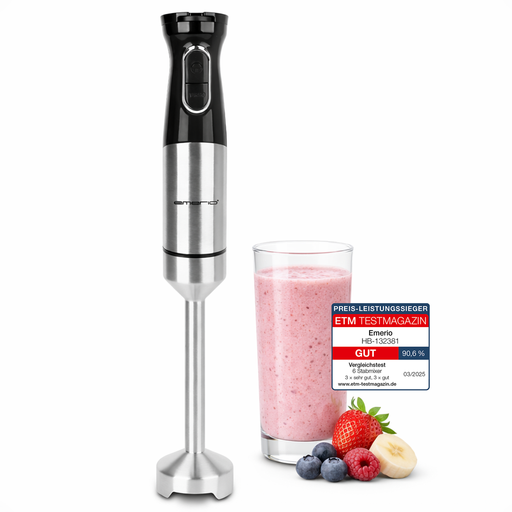
Emerio HB-132381 hand blender, 1000 W, variable speed, black and stainless steel

Emerio HB-132381 hand blender, 1000 W

The product description lists smoothies as one of its uses; you’ll need a suitable separate blending cup.

Variable speed and a removable stainless steel blending shaft with two blades are listed.

View at Joybuy

Philips 3000 Series Mini Blender HR2510/90, white and silver

Philips 3000 Series Mini Blender HR2510/90

A jug blender for home use; its stated capacity of 0,6 l is worth considering if you usually make one smoothie at a time.

The product information lists 350 W, dimensions of 123 × 119 × 350 mm and removable dishwasher-safe parts. The product title also mentions ice crushing; check the model instructions for ingredients and quantities.

View at Joybuy
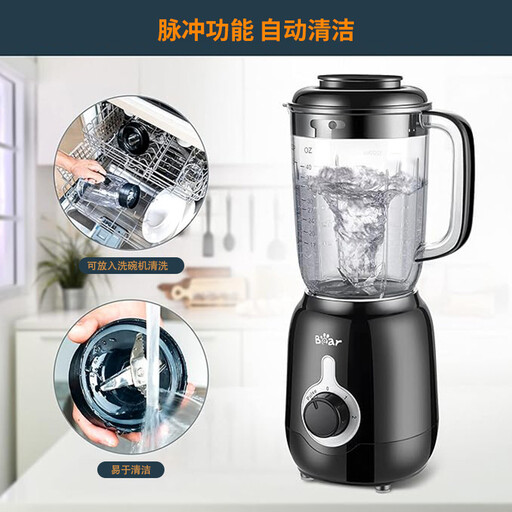
Bear Table Blender LLJ-B12K1, 1,2 l, 500 W

Bear Table Blender LLJ-B12K1, 1,2 l

The 1,2 l jug is designed for making more than one small smoothie portion; the instructions specify a minimum of 300 ml of liquid during use.

The product information lists 500 W, two speeds, a pulse function and four stainless steel blades.

View at Joybuy

Aigostar Marden BL-250 blender, 250 W, 500 ml

Aigostar Marden BL-250, 500 ml

The product description says you can blend in the 500 ml cup, which has a drinking lid, and take your smoothie with you.

The product information lists 250 W, dimensions of 13 × 13 × 35 cm and removable dishwasher-safe parts.

View at Joybuy

Nutribullet Portable personal blender, 475 ml, white and beige

Nutribullet Portable, 475 ml, white and beige

This personal blender has a cup with a drinking lid and is rechargeable for cordless use; remember to charge it before blending.

The product name lists a capacity of 475 ml and USB-C charging. According to the product information, removable parts can be rinsed clean.

View at Joybuy

Frequently asked questions

Can I blend kiwi without a special ice function?

You don’t need ice to make a smoothie with peeled, chopped kiwi and liquid. The Voedingscentrum uses kiwi with ingredients including soya drink in one of its smoothie recipes; check the instructions for your specific model if you’re using frozen fruit or ice.

How can I make sure a to-go cup is practical?

Compare the stated cup capacity with your recipe and check whether the cup and drinking lid are included. When cleaning, follow the model instructions for removable blades and dishwasher-safe parts.

How long can I keep a smoothie once it’s made?

The Voedingscentrum’s Bewaarwijzer recommends keeping an opened fruit smoothie in the fridge for 1–2 days, then checking its appearance, smell and taste. This is storage advice, not a feature of a blender.

What rules apply to a cup that comes into contact with my smoothie?

In the Netherlands, articles intended to come into contact with food must comply with the Warenwetbesluit and applicable European rules, including Regulation (EC) No 1935/2004. A retailer’s product listing alone doesn’t prove that a specific model meets all the applicable requirements.

Does Dutch law guarantee exactly two years of cover as standard?

No. According to the Rijksoverheid, there is no fixed statutory guarantee period in the Netherlands: what you can expect from a product depends, among other things, on the product itself and the circumstances. If a product is faulty, the seller must provide a solution; a manufacturer’s guarantee is separate.
