
Vandaag of morgen in huis

Kwaliteit gegarandeerd

Welkomstaanbiedingen ontgrendelen: GRATIS bezorging | Tot 80% korting | Gratis 30 dagen JoyPlus-proefperiode
Download de app
If you cook regularly, prepare meals in advance or provide meals for a family, you’ll soon realise how much time chopping by hand can take. However, it’s not wise to choose kitchen cutting tools based only on a low price or a long list of features. A vegetable slicer that’s difficult to clean, a mandoline without proper hand protection or a chopper with a bowl that’s too small may end up unused in a cupboard after just a few uses.
In this guide, you’ll find out what to look for in a vegetable slicer, electric food slicer, bread slicer, food chopper, grater or chip cutter. Our recommendations are based on verifiable product specifications and a range of usage scenarios.
A multifunctional kitchen slicer can slice, cut into strips and grate. That sounds useful, but first check how many of the attachments you’ll actually use. A 10-piece set takes up more space and often needs more cleaning than a simple grater or vegetable slicer.
Pay attention to the collection container too. A capacity of 0.3 litres is suitable for small portions, but less practical when you’re preparing vegetables for several people.
When it comes to an electric food slicer, wattage doesn’t tell the whole story. A 150-watt motor may be suitable for controlled slicing of bread, cheese and meat, while a 500-watt food chopper is designed for short bursts of chopping. Bowl capacity, blade design and maximum operating time are just as relevant.
A mini chopper with a 500 or 600 ml bowl is suitable for small amounts of herbs, onion or nuts. For larger portions, a model with a 2-litre bowl is more practical.
Sharp knives and blades require a consistent approach. Check whether the product comes with a hand guard, food holder, non-slip ring or safety lock. With electrical appliances, it’s important that the parts can be removed before cleaning and that the plug is disconnected from the socket.
A dishwasher-safe part is useful, but always check exactly which parts are suitable. The motor base should never be submerged.
An adjustable slicing thickness is important for a bread or meat slicer. According to the product information, the Fritel Slicer SL 3710 has a range of 0 to 20 mm, a blade diameter of 190 mm and a carriage set at an angle of 15 degrees. This lets you adjust the thickness to suit bread, cheese, charcuterie or vegetables.
A model with a large blade and a wide cutting area will need more storage space, though. Measure your worktop or kitchen cupboard beforehand.
With a food chopper, the capacity determines how many ingredients you can process at a time. The Kenwood Easy Chop+ has a 600 ml glass bowl and two speeds. According to the product information, the Bear QSJ-D03Q1 comes with 0.6 and 2-litre glass bowls. This difference matters for small portions and family meals respectively.
Don’t fill a bowl above the indicated mark. Too many ingredients can lead to uneven chopping or put extra strain on the motor.
Stainless steel is commonly used for graters, knives and cutting blades. Also check the base: non-slip feet or a non-slip ring help keep the tool steady during use. A collection container stops chopped vegetables from falling straight onto the worktop.
For manual models such as a potato cutter, chip cutter, vegetable slicer or mandoline, a sturdy handle, stable base and hand guard are especially important. After use, check whether food is caught between the blades.
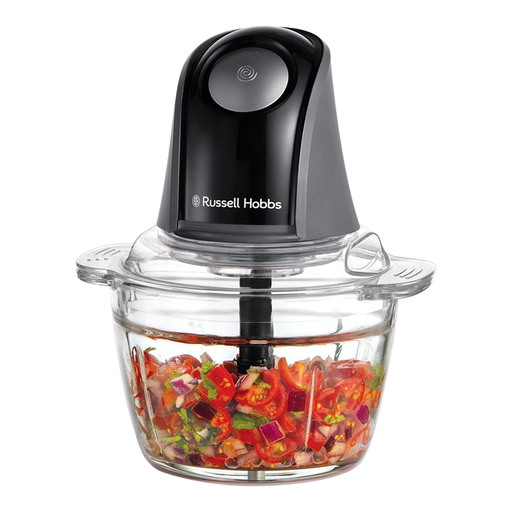
Why it suits this profile: A compact option for everyday small amounts of vegetables, herbs, nuts or meat. It’s operated with one large button.
The specifications state a filling capacity of 500 ml, so you’ll know in advance that this model is designed mainly for small portions.
200 watts, a glass bowl, stainless-steel blades and dishwasher-safe parts, according to the product information.
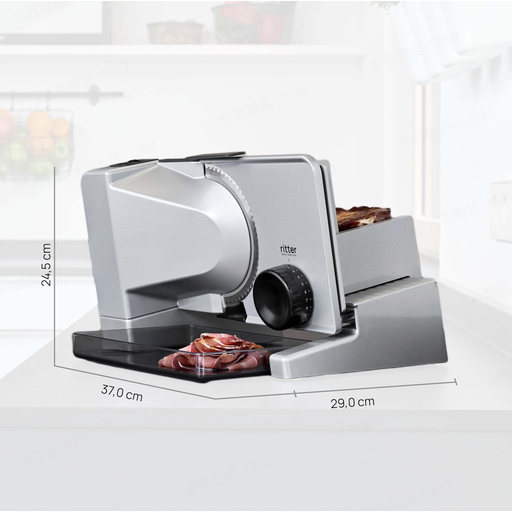
Why it suits this profile: Ideal if you often want to slice bread, cheese, meat and vegetables evenly.
The product description mentions a metal construction, removable carriage and adjustable slicing thickness of up to 23 mm.
Supplied with a serrated blade and a smooth blade; the slicing speed can be adjusted electronically, according to the product information.
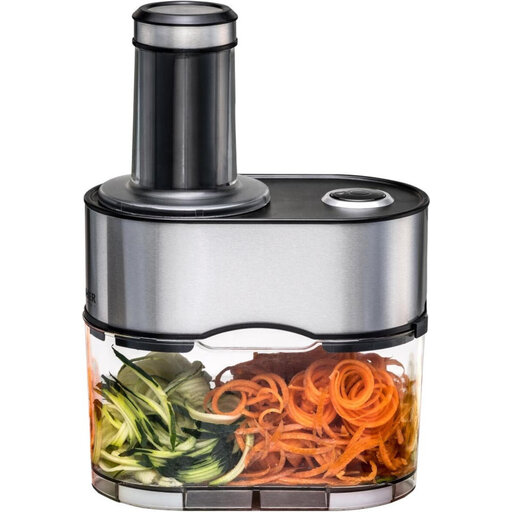
Why it suits this profile: For anyone who often makes vegetable or fruit spirals and wants an electric spiraliser for the job.
According to the product information, the collection bowl has a capacity of 2.5 litres, so larger quantities won’t fall straight onto the worktop.
Five blades, safety switches, a non-slip design and dishwasher-safe parts, according to the product description.

Why it suits this profile: The two bowls offer flexibility, whether you’re preparing a small amount or making larger portions for family meals.
The capacities are clearly listed as 0.6 and 2 litres. This lets you match the bowl to the portion size, rather than trying to use one that’s too small.
300 watts, two speeds, two glass bowls and two blade sets, according to the stated product specifications.
We’ve put together a complete, up-to-date list of products that meet these strict selection criteria and the applicable European safety regulations.
Always use a mandoline, grater, potato cutter or chip cutter on a stable, dry surface. Use the supplied hand guard to push ingredients towards the blade, not your fingers. With an electric food slicer, reset the thickness setting to the safe zero position after use if the instructions require it.
According to the product information, the electric appliances described are covered by a statutory guarantee of at least two years under European consumer rules. Keep your proof of purchase and contact the seller if a product develops a fault. A CE mark indicates that the product has been declared compliant with relevant European regulations, but in itself it says nothing about slicing speed, lifespan or the results you’ll get in your kitchen.
It depends on the ingredients. Choose a food chopper for onion, herbs, nuts and small portions. An electric food slicer makes more sense for bread, cheese and meat. If you mainly want to prepare vegetables in slices, strips or spirals, consider a vegetable slicer, vegetable mandoline or spiraliser.
Energy use depends on the power rating and how long you use it. An appliance that runs for just a few minutes per preparation will generally use less electricity than you might expect from extended use. Also check the maximum continuous operating time; some models need to cool down between uses.
Lifespan varies depending on the material, how often the tool is used and how well it’s maintained. Stainless-steel blades can stay usable for a long time if they’re cleaned correctly and stored dry. With electric models, it’s important to avoid straining the motor, overfilling the bowl or exceeding the recommended operating time.
