
Vandaag of morgen in huis

Kwaliteit gegarandeerd

Welkomstaanbiedingen ontgrendelen: GRATIS bezorging | Tot 80% korting | Gratis 30 dagen JoyPlus-proefperiode
Download de app
Anyone who cooks regularly knows the problem: chopping vegetables takes longer than expected, bread falls apart and a blunt knife makes it difficult to cut even slices. With the right kitchen cutting tools, you can prepare ingredients more quickly and consistently. However, a surprising number of products seem more versatile than they actually are in practice.
In this guide, you’ll learn what to look for in a vegetable slicer, mandoline slicer, food chopper, vegetable grater or electric slicer. We’ll also match different products to familiar cooking situations.
A multifunctional vegetable slicer with lots of attachments sounds convenient. In reality, loose parts can be difficult to store or may not lock firmly into place. So check whether the product has a collection container, hand guard or non-slip base. Without these features, using it can become awkward, especially with hard vegetables such as potatoes and carrots.
Not every vegetable slicer or bread slicer produces slices of the same thickness. An adjustable cutting thickness is important for bread, cheese and meat. A machine such as the FRITEL SL 3110 has, according to the product information, a range of 0 to 15 mm and a blade diameter of 17 cm. This gives you a clearer idea of its applications than a general claim such as “professional slicing”.
Cutting blades, graters and chopping knives can trap food residues in seams and holders. A product that requires extensive manual cleaning after every use may end up being left in the cupboard more often. Look for removable parts, the material used and cleaning instructions. A stainless steel blade is not automatically dishwasher-safe; always follow the manufacturer’s guidance.
For a manual vegetable slicer or vegetable grater, stainless steel blades are a practical choice. They are suitable for everyday use and, according to the product information for various models, can be used for vegetables, fruit, cheese and potatoes. Also check that the blade is securely fixed in its holder and that your hands remain a safe distance away.
For an electric meat slicer or bread slicer, the blade diameter, motor and cutting thickness also play a role. A larger blade can handle longer or wider ingredients, but it also requires more worktop space.
The capacity of the collection container determines how much you can prepare at once. A small food chopper with a 600 ml bowl is suitable for onions, herbs and small portions. For a family, a chopper with a 2-litre bowl may be more practical. Do not fill the bowl above the indicated mark, as the ingredients will then be processed less evenly.
Sharp blades require a stable work surface and straightforward controls. With electric models, look for:
With a potato slicer, mandoline slicer or manual chopper, a hand guard is an essential accessory rather than an unnecessary extra. Never use your fingers near the cutting surface when working with small pieces.
The following recommendations are based on verifiable details from the supplied product information, such as capacity, number of parts, cutting thickness and safety features.
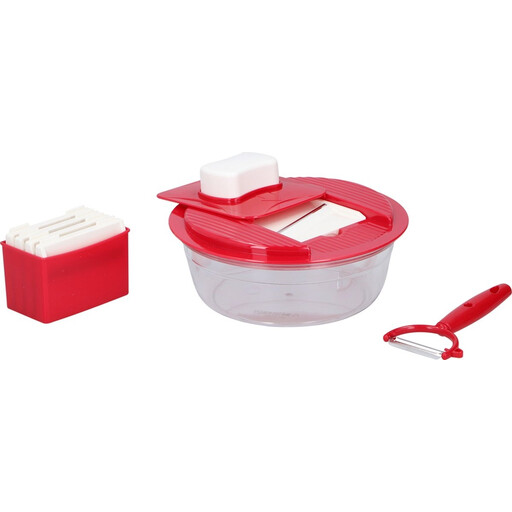
Why it suits this profile: This set offers multiple functions without requiring a power connection. It includes a collection container, various slicing and grating blades, and a safety handle for everyday food preparation.
The set clearly states which parts are included: a fine and coarse grater, slicing blades, collection container and safety handle. This means you do not have to rely solely on the word “multifunctional”.
7 parts, stainless steel blades and a collection container. The manufacturer recommends cleaning with a damp cloth and advises against placing it in the dishwasher.

Why it suits this profile: This model is designed for anyone who regularly wants to cut bread, cheese, meat, fruit or vegetables into even slices and values both the choice of materials and ease of maintenance.
The product information lists a removable carriage, an 18 cm cutting path and an adjustable thickness of up to 20 mm. You can therefore compare the required capacity with your ingredients in advance.
Removable carriage, a serrated blade and a shatter-resistant glass base plate, according to the product description. According to the manufacturer, the model is made in Germany.

Why it suits this profile: This electric food chopper is suitable for families and keen home cooks who want to process larger quantities of onions, herbs, nuts or meat in batches.
The 2-litre capacity and 300-watt power rating are clearly stated. The instructions also specify that large pieces should first be cut into pieces of around 2 cm and that the chopper should be operated using short pulses.
2-litre glass bowl, two speeds and 304 stainless steel blades. According to the instructions, the motor may run continuously for a maximum of 30 seconds.
We’ve put together a complete, up-to-date list of products that fully meet these strict selection criteria and the applicable European safety regulations.
A manual vegetable slicer, vegetable grater or potato slicer takes up little space and works without electricity. This type is suitable for smaller quantities and quick preparation. A set with multiple blades can also function as a mandoline slicer, but requires extra care when using the hand guard.
An electric slicer is particularly practical if you often prepare bread, meat or large quantities of vegetables. A bread slicer with a foldable design is easier to store. With electric kitchen knives, pay attention to the safety switch, the number of blades and how easy the appliance is to clean. An electric meat slicer is not the same as a food chopper: the former cuts slices, while the latter chops ingredients into smaller pieces.
That depends on your ingredients. For cucumber, carrots, cheese and potatoes, a manual multifunctional vegetable slicer is often sufficient. For bread, meat and larger quantities, an electric slicer or food chopper is more practical.
Its lifespan depends on use, maintenance and workload. Cut hard ingredients into smaller pieces beforehand, use short pulses and avoid overloading the appliance. Also check regularly that the blades, lid and non-slip components are still working properly.
Power consumption depends on the wattage and how long the appliance is used. A 100-watt model uses less energy during short periods of use than an appliance that runs for a long time. So don’t look only at the wattage; consider how often and for how long you use the appliance as well.
