
Vandaag of morgen in huis

Kwaliteit gegarandeerd

Welkomstaanbiedingen ontgrendelen: GRATIS bezorging | Tot 80% korting | Gratis 30 dagen JoyPlus-proefperiode
Download de app
A kitchen cooker hood needs to do more than complement your interior. It should extract cooking fumes, trap grease and operate comfortably without unnecessary noise or maintenance. Yet buyers often get it wrong because of marketing claims, incorrect measurements or installation that is unsuitable for their home.
1. Looking only at the highest m³/h figure
A high extraction capacity sounds appealing, but it does not tell you everything about performance in your kitchen. Results also depend on the length and diameter of the duct, the number of bends and the extraction setting selected. In a flat without an external exhaust connection, you will also need a recirculating cooker hood. Instead of venting air outside, it passes the air through a carbon filter and returns it to the room.
2. Buying a 60 cm model without measuring the hob
A 60 cm cooker hood often fits above a standard hob, but always check the actual width and available space. For a wide hob, a 90 cm cooker hood may be more practical, as it reduces the chance of fumes escaping around the sides. Also check the minimum distance from the hob and follow the installation instructions.
3. Ignoring noise levels and filter costs
A cooker hood that produces 60 to 70 dB at its highest setting can be noticeable in an open-plan kitchen. So check the figures for each setting, rather than relying on a general description such as “quiet cooker hood”. Also check whether the grease filter is washable and whether a carbon filter is included or needs to be purchased separately.
For a kitchen with a direct connection to the outside, a cooker hood with external venting can extract cooking smells and moisture through a duct. Check that the connection matches the diameter of the exhaust duct and that the installation route is not unnecessarily long or winding.
If your home does not have a suitable duct, choose a model with recirculation. A cooker hood with carbon filter can filter out some odours, but the filter must be cleaned or replaced according to the product instructions. A recirculating model does not replace ventilation for the room.
Treat the stated capacity as a technical product specification, not as a guarantee of identical performance in every kitchen. For the models below, the figures range from 199 m³/h to 730 m³/h, depending on the model and operating setting.
Measure more than just the width: also check the depth, height and space above the hob. With angled models, the clear space at the front may be greater, while the total height, including the chimney, must still fit.
Compare the maximum noise level in dB. For example, the Bosch DWK91LT60 lists 35 dB on its lowest setting, 51 dB on its maximum normal setting and 70 dB at intensive power. This is different from a model where only the highest noise level is stated.
You can identify an energy-efficient cooker hood by checking its energy label and stated annual consumption. Compare both together: a favourable energy class does not automatically mean that every model will use the same amount of electricity in identical conditions.
Also consider the filter type. A cooker hood with a dishwasher-safe grease filter can make cleaning easier. However, check the manual for the correct programme and cleaning frequency. Under normal use, various product instructions recommend cleaning aluminium grease filters approximately every two to four weeks.
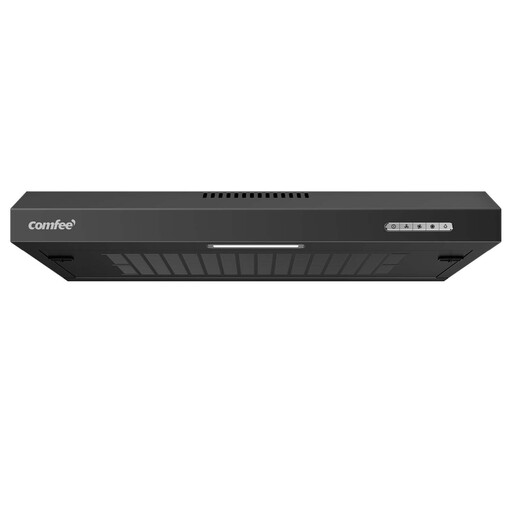
Why it suits this profile: This compact 60 cm stainless steel model has three speeds, LED lighting and a stated airflow of 200 m³/h. According to the product information, both external venting and internal recirculation are possible; the required cotton filter for recirculation is listed separately.
The two ventilation methods make this model more flexible than a cooker hood with only one installation option. The filter can be removed for periodic cleaning.
60 cm wide, three speeds, LED lighting and energy class B according to the product listing.
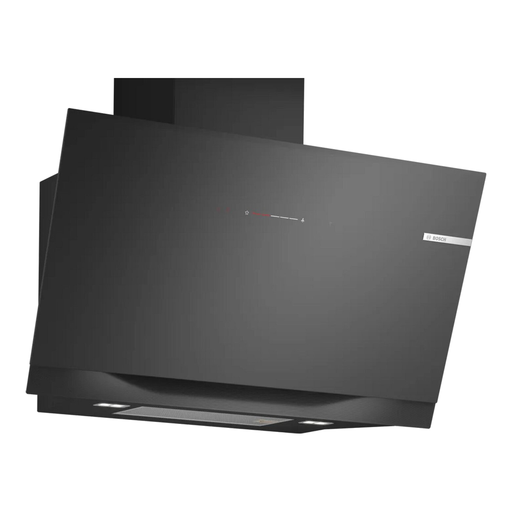
Why it suits this profile: This 90 cm black wall-mounted cooker hood is designed for spacious or open-plan kitchens. Its specifications include LED lighting, DirectSelect controls, an A+ energy label and a dishwasher-safe filter.
The noise levels are specified for each operating situation: 35 dB minimum, 51 dB maximum normal and 70 dB at intensive power. Recirculation requires a separately available kit.
90 cm wide, five speeds, LED lighting with adjustable colour temperature and a filter that, according to the product information, is dishwasher-safe.
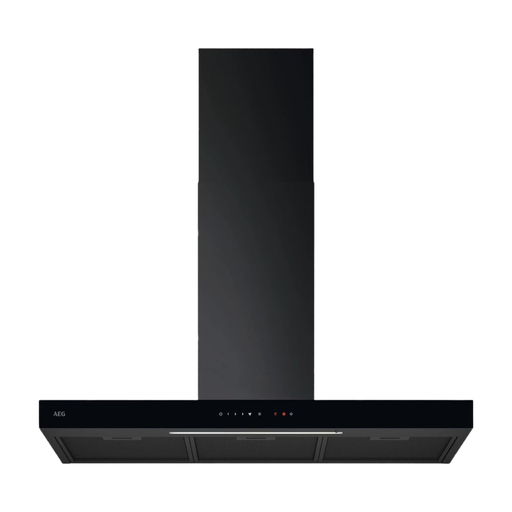
Why it suits this profile: This 90 cm-wide black wall-mounted cooker hood has a stated capacity of up to 730 m³/h, touch controls and a Hob2Hood function for compatible AEG hobs. The product specifications state energy label D; always check the current energy label.
Cleaning indicators for the grease and carbon filters make maintenance easier to plan. Recirculation is possible with a separate carbon filter.
Up to 730 m³/h according to the product information, 90 cm wide, LED lighting and touch controls.
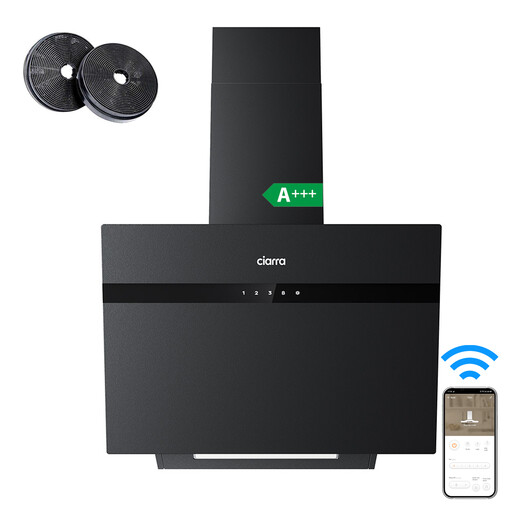
Why it suits this profile: This 60 cm black cooker hood has an angled glass front, sensor-touch controls, Wi-Fi and app connectivity, two LED levels and a stated capacity of 650 m³/h.
The product specifications list both recirculation and external venting. The aluminium grease filter is washable; when using recirculation, the carbon filter still needs to be checked.
A+++ energy label, maximum 58 dB according to the product listing, 650 m³/h and control via sensor-touch panel and app.
Before buying a cooker hood, check whether you are allowed to use an exhaust duct. Tenants may need permission from their landlord. Have the electrical connection and installation carried out in accordance with the manual and local safety regulations. A cooker hood must be securely mounted and must not be used above an open flame when flambéing.
Clean the grease filter regularly and wipe the exterior with a soft, damp cloth. Do not use abrasive products on stainless steel, glass or painted surfaces. With recirculation, you should also check how often the carbon filter needs to be replaced. LED lighting generally uses little electricity, but check whether the bulbs can be replaced before ordering.
We have put together a complete, up-to-date list of products that fully meet these strict selection criteria and the applicable European safety regulations.
Not in every home. External venting can remove vapour and odours directly, but it requires a suitable, correctly installed duct. Recirculation is more flexible for flats or kitchens without an external exhaust. Take filter maintenance and additional ventilation into account.
That depends on the setting. Compare the minimum and maximum dB values in the product specifications. A model with a low figure on setting one may be noticeably louder on boost. In an open-plan kitchen, several settings and a practical low setting are often more important than maximum power alone.
Its lifespan depends on use, installation and maintenance. Cleaning the grease filter regularly prevents build-up and helps maintain performance. Also check the warranty, filter availability and installation requirements before making your final choice.
