
Vandaag of morgen in huis

Kwaliteit gegarandeerd

Welkomstaanbiedingen ontgrendelen: GRATIS bezorging | Tot 80% korting | Gratis 30 dagen JoyPlus-proefperiode
Download de app
When buying kitchen tools, people often look first at the number of functions or the motor power. That may seem logical, but this is exactly where unsuitable purchases can arise. An appliance may come with lots of accessories and still be impractical for your recipes. A compact garlic press can be more useful every day than a large food processor that usually stays in the cupboard.
This guide helps home bakers, cooking enthusiasts and households in the Netherlands compare kitchen tools based on verifiable features, ease of use and maintenance.
With a food processor, stand mixer, hand mixer or hand blender, motor power is often prominently advertised. However, a higher number does not automatically mean that an appliance is pleasant to use. Also consider the recommended maximum quantity, permitted operating time, number of speeds and stability on the worktop.
For example, a food processor with a large bowl may be appealing for bread dough, but only if the bowl, dough hook and motor are suitable for your quantities. Always check the instructions and do not exceed the maximum capacity.
A multifunctional kitchen appliance with a chopper, blender, whisk and meat grinder may save space, but every component needs to be stored and cleaned. Parts that are not dishwasher-safe can make everyday use less convenient.
So do not compare only the number of accessories. Look at the accessories you genuinely need: a grater for cheese and vegetables, a vegetable slicer for evenly sized slices, a chopper for onions and herbs, or a hand blender for soup and sauce.
A garlic press, grater, meat slicer and vegetable slicer all use sharp edges. A hand guard, secure grip and stable base are more important than eye-catching design. With electrical appliances, keep hands, clothing and kitchen utensils away from moving parts.
Only use accessories in the way specified by the manufacturer. With electrical kitchen appliances, always unplug them before changing parts or cleaning them.
Match the capacity to your household and recipes:
A 6-litre bowl does not always mean that you can fill it completely with dough. Some product descriptions state a capacity of 6 litres but recommend a lower working capacity.
For knives, graters and presses, stainless steel and 304 stainless steel are commonly used materials. Also check whether the bowl, cup or container is suitable for food contact. A glass bowl can be useful for viewing the ingredients, while plastic is lighter.
For coatings, check the product information and care instructions. Only wash accessories in the dishwasher if this is explicitly stated. Abrasive sponges can damage metal surfaces and coatings.
Multiple speeds provide greater control when mixing, whisking and puréeing. A pulse function is useful for short processes, such as when using a chopper. Also check:
Claims about quiet operation or long-lasting performance sometimes come directly from the brand. Treat such figures as product specifications from the description, rather than a guarantee for every kitchen or user.
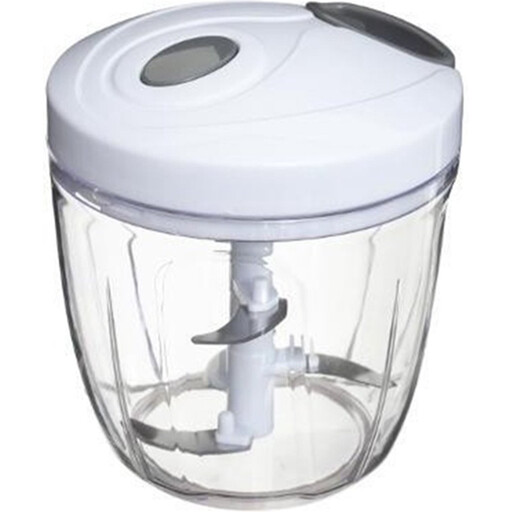
Why it suits this profile: A manual chopper that does not require a power connection is suitable for small everyday preparations, such as onions, herbs and soft vegetables.
Its function is clearly defined: manually chopping and mixing in a 900 ml bowl, without unused electrical accessories.
Five blades, removable blades and a non-slip base; according to the product information, it is not dishwasher-safe.
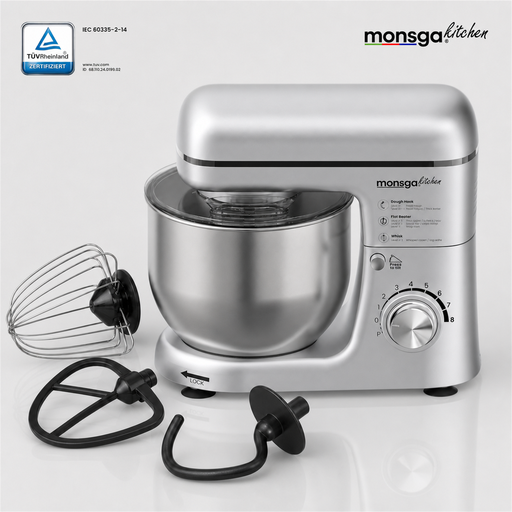
Why it suits this profile: This stand mixer is ideal for home bakers who regularly prepare bread, cakes, biscuits or cream.
The product information states a recommended capacity of 5 litres for a 6-litre bowl. This clearly distinguishes the bowl capacity from the working capacity.
1000 W peak power, eight speeds, a stainless-steel bowl and a tilt-back head; the product description states that the accessories are dishwasher-safe.

Why it suits this profile: The combination of a food processor, blender and meat grinder is ideal for households that want to prepare different dishes with one base appliance.
The description mentions a safety lock on the tilt-back head and states that the appliance is intended for household use only.
1300 W motor power according to the product description, a 6 QT bowl and eight speeds with a pulse function; the accessories can be fitted without tools.

Why it suits this profile: This portable blender is designed for one serving of a smoothie or shake, for example at the office, while travelling or after exercising.
The 0.48-litre capacity makes it clear that this is not a replacement for a large blender or food processor.
USB-C charging, a weight of 717 grams and a Tritan cup; according to the product description, the battery is designed to provide more than fifteen blends per charge.
We have put together a complete, up-to-date list of products that fully meet these strict selection criteria and the applicable European safety regulations.
Clean knives and graters immediately after use to prevent food residue from drying on them. For electrical appliances, use a damp cloth on the motor housing and never immerse it in water. Regularly check that blades, lids and locking mechanisms are securely fitted.
With a stand mixer, it is advisable not to overfill the bowl and to knead heavy doughs at a low to medium speed. A hand mixer or hand blender is generally more suitable for smaller quantities. This helps reduce unnecessary strain on the motor.
For many households, a garlic press, grater, vegetable slicer and chopper are practical additions. If you often make soup, sauce or smoothies, you may want to consider a hand blender or portable blender. Home bakers will generally get more use from a food processor or stand mixer with a dough hook and whisk.
Its lifespan depends on usage, maintenance, storage and following the maximum capacity. An appliance that is consistently overloaded may wear out more quickly. Always check the instructions, allow the motor to cool when required and use only approved accessories.
Manual tools such as a garlic press, grater or 5five chopper do not use electricity. With electrical models, power, operating time and frequency determine consumption. A short preparation with a chopper or hand blender will generally use less electricity than prolonged use of a large food processor, but the exact cost depends on the local electricity tariff and usage time.
