
Coffee maker who cooks at the same time
You want to keep track of your coffee brewing time without losing sight of another dish. Decide whether you need separate timers that can run at the same time.


Choose a timer with a count-up function if you mainly want to track how long your coffee has been brewing. If you’re making coffee and dishes with different finish times, you’ll need independently adjustable timers. A coffee scale with a timer combines weighing and timing when making coffee, but it won’t automatically replace several kitchen timers. Check the timer functions, controls and power requirements for each model.
You want to keep track of your coffee brewing time without losing sight of another dish. Decide whether you need separate timers that can run at the same time.
When making coffee by hand, you want to track the weight and elapsed time in one place. Compare a coffee scale with a separate timer to find the right option.
You want to time different dishes independently and easily tell their alerts apart.
| What to consider | What should you look for? | Who is this important for? |
|---|---|---|
| Elapsed coffee brewing time | Check whether the model has a count-up function or stopwatch, and whether you can read the display while brewing. | If I’m preparing other dishes while making coffee, I want to be able to see the elapsed extraction time easily. Around 36% of consumers put tracking coffee brewing time at the top of their buying priorities. |
| Several preparations at once | Check how many timers can run independently and whether you can tell their alarms apart. | If my coffee and several dishes each have their own finishing time, I don’t want to have to combine everything on a single countdown timer. Around 29% of consumers give top priority to timing several preparations at once. |
| Weighing and timing | Check whether the scale has the timer start option you want and, if needed, a tare function. | When making coffee by hand, I want to track weight and elapsed time together. Around 21% of consumers prioritise this combination over separate cooking alarms. |
| Simplicity and battery | Consider readability, placement and controls, as well as the battery type; check whether a battery is included. | If I’m mainly looking for a simple timer, I want to know where I can put it and what power source it needs. Around 14% of consumers rank simplicity and power requirements above their other buying needs. |
Counting up and counting down are different ways of tracking one period of time. They don’t automatically mean you can time several preparations independently.
Check how many timers can run at once and whether you can hear or see which task each alarm relates to.
A scale with a timer helps you track weight and time while making coffee, but it doesn’t automatically offer several independent cooking timers.
Choose a scale for weighing and timing, then consider separately whether you need additional timers for other dishes.
Features can vary between models. For example, the manufacturer lists a count-up and countdown timer for the GastroMax 6669-1; don’t assume it has other features without checking.
Compare the exact model with the features you need before choosing a version.
Power supplies vary by model. For example, IKEA states that the LJUNGPIPARE needs one AAA battery, sold separately.
Check the battery type and what’s included in the box. Orthex Group states that a battery is included with the GastroMax 6669-1.
The 6669-1 digital kitchen timer is designed for counting up and down, without a built-in scale.
The Triple Task Timer is designed to time several kitchen tasks at once.
The V60 Drip Scale VSTN-2000B combines weighing with elapsed-time tracking when making coffee by hand.
The Basic 2.0 is a coffee scale with a timer and tare function.
The LJUNGPIPARE is a magnetic clock with timer and stopwatch functions, designed for a permanent place in the kitchen.
This selection includes coffee scales with timers for coffee extraction, as well as a separate timer for tracking elapsed time or counting down a cooking step.
 No image available
An option if you want to weigh your coffee and use the timer and water-flow functions while brewing.
The product name lists a timer, coffee-to-water ratio, water-flow function and switchable ounce/kg units. The product name indicates that it’s suitable for espresso and pour-over brewing.
 No image available
A coffee scale that combines time tracking with coffee-specific measuring functions while you brew.
The product name lists a timer, coffee-to-water ratio, water-flow function and switchable ounce/kg units. It also specifies that the scale is suitable for espresso and pour-over brewing.
 No image available
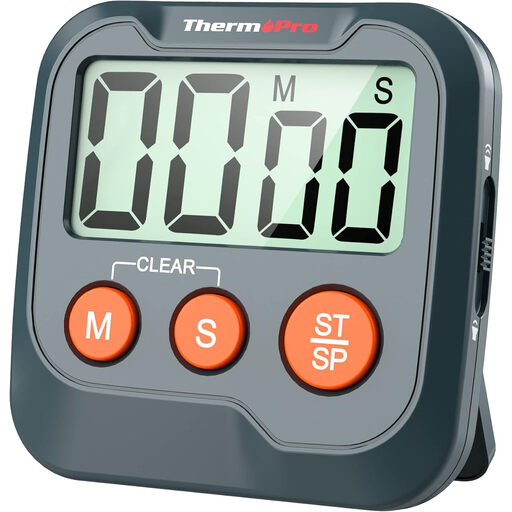
A separate timer option if you want to track elapsed extraction time and also count down a cooking step.
The product name lists a maximum of 99 min. 59 sec. and adjustable volume.
 No image available
An option if you want to track time and weigh your coffee during extraction.
The product name lists 0.1 g precision, a capacity of up to 3 kg, a timer, a heat-resistant platform and a tare function.
 No image available
An option for tracking weight, time and water flow when making pour-over coffee.
The product name lists an automatic timer, flow-rate function, 0.1 g precision and a capacity of 2000 g.
Not based on the stopwatch function alone. Check whether the model can track several times independently and simultaneously: OXO lists three timers for the Triple Task Timer, while Orthex Group specifies count-up and countdown functions for the GastroMax 6669-1.
Not automatically. A coffee scale with a timer combines weighing and timing when making coffee, but check separately whether you also need several independent cooking timers.
It depends on the model. Orthex Group says a battery is included with the GastroMax 6669-1; IKEA specifies one AAA battery for the LJUNGPIPARE, sold separately. Check the packaging for the version you choose.
You may be; according to the Dutch government, there’s no fixed statutory guarantee period in the Netherlands. Whether you’re entitled to a remedy depends, among other things, on what you could reasonably expect from the product and the cause of the fault. The retailer is your point of contact.
According to the Dutch government, as a private individual you can return an old appliance to the retailer free of charge when buying a similar new appliance, including when shopping online. Used batteries must not go in the bin; you can take them to collection points, including those at shops that sell batteries.