
Vandaag of morgen in huis

Kwaliteit gegarandeerd

Welkomstaanbiedingen ontgrendelen: GRATIS bezorging | Tot 80% korting | Gratis 30 dagen JoyPlus-proefperiode
Download de app
A kitchen slicer can be useful for bread, cheese, cold meats, vegetables and fruit. However, not every model is suited to the same tasks. An electric slicer takes up more space, while a manual vegetable slicer costs less and does not use electricity. The right choice therefore depends on what you usually slice, how often you use the appliance and how much control you want over the slicing thickness.
A multifunctional vegetable slicer with several blades may seem appealing. In practice, you may only use two of the inserts. So check which slicing techniques you really need: slices, julienne strips, grating or coarse shredding. Extra components also mean more storage space and more cleaning.
For bread, cheese and cold meats, an adjustable slicing thickness is important. A range from 0 to 20 mm offers plenty of adjustment options, but only if the dial works securely and the carriage moves smoothly. With manual models, check whether the desired thickness can actually be fixed securely.
A sharp stainless-steel slicing blade requires a good food holder, stable feet and a clearly marked on/off control. The blade should also be removable or cleanable according to the instructions. Check whether the components are dishwasher-safe; this varies from product to product. A safe slicer cannot eliminate every risk, but a finger guard and non-slip base make it easier to use safely.
An electric slicer is suitable if you regularly want to cut several slices in succession. The wattage tells you something about the motor, but it is not the only factor affecting the final result. Also look at the drive system, the stability of the carriage and the maximum operating time. The Fritel SL 3710, for example, has a geared motor, 150 watts of power and a slicing thickness from 0 to 20 mm.
A manual kitchen mandoline or vegetable slicer is compact and quick to get ready for use. It is particularly suitable for cucumber, potato, carrot, onion and fruit. For bread or large pieces of meat, an electric bread slicer or meat slicer is more practical.
A larger blade can be useful for wide or firm ingredients. The Fritel SL 3655 has a 17 cm serrated stainless-steel blade. The Fritel SL 3710 has a 19 cm blade. According to the product information, a serrated blade is suitable for crusty bread and firm cold meats. For finely sliced meat, a smooth blade may be more convenient; the Severin AS 3915 comes with both a serrated and a smooth blade.
Also check how the blade is removed. With electric models, you must unplug the appliance before loosening the blade. After use, reset the thickness to zero if this is specified in the product instructions.
A metal housing can contribute to a sturdy feel, but pay particular attention to the overall construction. Check for:
An electric slicer with a pulse switch is useful for short processing tasks. A continuous setting may be suitable for longer batches, but always follow the operating time stated in the instructions. The Fritel SL 3710, for example, specifies a maximum of 10 minutes of continuous use, followed by a cooling period.
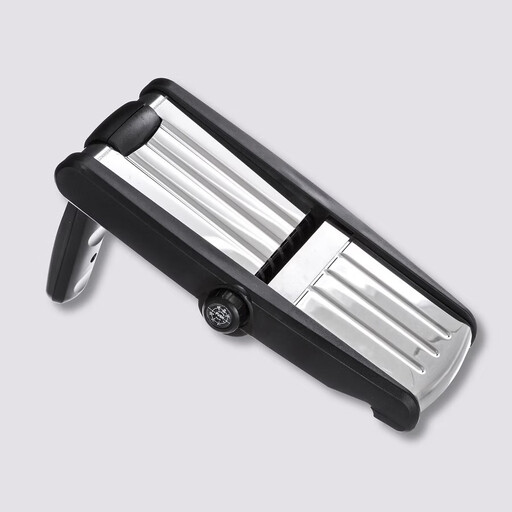
Why it suits this profile: According to the product information, this manual model is compact and weighs 360 grams. It is suitable for users who occasionally slice vegetables or other ingredients without having to place an electric appliance on the worktop.
The set includes three stainless-steel blades and a plastic holder. However, check which slicing thicknesses are available beforehand, as the product information does not mention continuous millimetre adjustment.
Manual operation, stainless-steel blades and a compact size of 23,5 x 13 x 5 cm.

Why it suits this profile: This electric slicer is suitable for households that regularly slice bread, cheese, cold meats and vegetables, and value a metal construction and removable carriage.
The product information mentions a removable carriage and a safety switch for momentary and continuous operation. Check the instructions for cleaning and operating times.
Slicing thickness from wafer-thin slices up to 20 mm, metal construction and a removable carriage with an 18 cm cutting path.

Why it suits this profile: This model is designed for users who slice several types of food and want to combine a wide slicing range, larger blade diameter and collection tray.
The product description mentions a food holder, non-slip feet, an angled carriage and a three-position switch. According to the instructions, the appliance must not run continuously for more than 10 minutes.
0–20 mm slicing thickness, 19 cm blade, metal housing, collection tray and geared motor.
We have put together a complete, up-to-date list of products that fully meet these strict selection criteria and the applicable European safety regulations.
For everyday slicing of cucumber, carrot, potato or onion, a kitchen mandoline may be sufficient. According to the product information, the 5five multifunctional vegetable slicer offers five slicing techniques, a collection tray and stainless-steel blades. The Alpina Multi Grater 7pc consists of seven components, including a safety handle, collection bowl, grater and blades for thin and thick slices.
An electric chopper works differently from a slicer. The Rommelsbacher MZ 500 has a power output of 500 watts, a 1.5-litre glass bowl and a four-blade stainless-steel knife. This appliance chops ingredients finely rather than producing even slices. So do not choose a chopper if you mainly want neat slices of bread or cheese.
Place an electric slicer on a dry, level surface. Always use the supplied food or residual holder and keep your hands away from the blade. Unplug the appliance before removing a blade or cleaning it. Do not allow children to operate the appliance.
A longer lifespan starts with using the appliance for its intended purpose. Do not slice ingredients that the blade is not designed for, do not force the carriage and clean away any residue immediately after use. According to the product information for several of the models mentioned, the statutory consumer guarantee in the EU applies for at least two years; if a fault occurs, you can contact the seller to discuss the available solution.
Electricity consumption depends on the wattage and operating time. A 150- to 180-watt model mainly uses electricity while slicing. For small quantities, a manual vegetable slicer is often simpler. When slicing several loaves of bread or large quantities of cold meats, electric operation can save time and effort.
A low setting is useful for thinly sliced cold meats, while bread often calls for slightly thicker slices. A range of 0 to 20 mm gives you more flexibility than a model that goes up to 15 mm. The ideal setting depends on the ingredient and the texture you want.
Switch off the appliance, unplug it and follow the instructions. Removable blades and carriages can be cleaned separately when permitted. Do not use an abrasive scourer on stainless steel and do not clean electrical components under running water. After cleaning, check that everything is dry and correctly assembled before storing the appliance.
