
Vandaag of morgen in huis

Kwaliteit gegarandeerd

Welkomstaanbiedingen ontgrendelen: GRATIS bezorging | Tot 80% korting | Gratis 30 dagen JoyPlus-proefperiode
Download de app
A kitchen slicer can save you plenty of preparation time. Think evenly sliced cucumber, grated cheese, chips cut from potatoes, or thinly sliced bread and meat. However, not every vegetable slicer, mandoline or kitchen slicing machine is suitable for every task.
The right choice depends on the ingredients you want to prepare, the thickness you need, safety and ease of cleaning. Read on to find out which common pitfalls to look out for and which specifications to check before you buy.
A multifunctional vegetable slicer with lots of blades may seem handy, but more parts also mean more storage space and more cleaning. So, check which features you’ll actually use. For everyday grating and slicing, a compact vegetable slicer with a collection container may be all you need. If you want to make chips, you’ll be better off with a potato or chip cutter.
Thin slices of cheese call for a different setting from bread or meat. On an electric meat slicer, the thickness setting should be easy to read. Check the maximum thickness too. A machine that can be set from 0 to 20 mm offers different options from a basic vegetable slicer with a single fixed blade.
Sharp blades call for a good finger guard, a stable position and clear instructions for use. A collection container also helps catch ingredients and keep your worktop tidy. Check the cleaning instructions after you buy, too: some plastic parts aren’t dishwasher-safe, while other products have parts that can go in the dishwasher.
Stainless steel is a commonly used material for grating and slicing blades. It stands up to daily contact with moist ingredients and can be rinsed clean, provided the manufacturer’s instructions allow it. The housing may be made of plastic or metal. Plastic is often lighter, while a metal construction can add weight when slicing.
Don’t just look for the term ‘stainless steel’; check which parts are made from it. For example, the blades on the Alpina Multi Grater 7pc are made of stainless steel, while the other parts are plastic.
For a meat slicer, the adjustable slicing thickness and blade diameter are important considerations. According to the product information, the Fritel Slicer SL 3710 has a blade diameter of 190 mm and an adjustable thickness of 0 to 20 mm. With an electric machine, you should also check the recommended usage: the instructions say not to run this Fritel for more than 10 minutes at a time, followed by a cooling period.
For a chopper, bowl capacity and power are more relevant. The Rommelsbacher MZ 500 has a power rating of 500 W, one speed and a 1.5-litre glass bowl. This type of kitchen appliance is suitable for chopping ingredients such as onions, herbs, nuts and meat, but it’s no substitute for a slicer that makes even slices.
Check whether the product has non-slip feet, a pusher or a finger guard. Never use your fingers to push a small piece of vegetable over the blade of a mandoline. With an electric bread or meat slicer, use a holder to move the food towards the blade.
You should be able to store the blade safely after use. The advice for the Fritel Slicer SL 3710 is to reset the setting to 0 after use. Always unplug electrical appliances before removing the blade or cleaning the appliance.
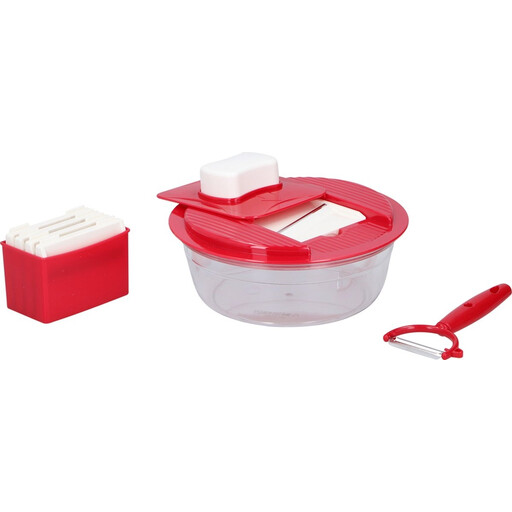
Why it suits this profile: This set combines grating and slicing across seven parts, and includes a collection container and safety handle. It’s a practical choice for households that prepare a variety of vegetables, fruit, potatoes and cheese without wanting to buy an electric appliance.
The functions and parts are clearly specified: coarse and fine grating, thin and thick slicing, and a flat slicing blade. Bear in mind that the instructions say to clean it with a damp cloth and that the set isn’t dishwasher-safe.
Seven parts, collection container, safety handle and stainless-steel blades with a plastic housing.

Why it suits this profile: If you regularly want to slice bread, cheese, charcuterie and vegetables evenly, this model offers a metal construction, electronic speed control and a slicing thickness of up to 23 mm, according to the product description.
The product information lists a removable carriage, collection tray and separate blades for bread and other foods. Before buying, check that the dimensions and weight suit your worktop.
All-metal construction, slicing thickness of up to 23 mm, electronic speed control and a 24 cm cutting track.

Why it suits this profile: This electric kitchen slicer is designed for bread, cheese, charcuterie, vegetables and meat. Its angled housing, 15° tilted carriage and adjustable slicing thickness of 0 to 20 mm make it well suited to regular use.
The instructions mention a food holder, non-slip feet, a pulse switch and a maximum continuous running time of 10 minutes. Always use the holder and let the appliance cool down afterwards.
150 W motor with gear drive, 190 mm blade diameter, slicing thickness of up to 20 mm and a food holder included.
We’ve put together a complete, up-to-date list of products that meet these strict selection criteria and the applicable European safety requirements.
For vegetables, a vegetable slicer, vegetable plane or multifunctional vegetable slicer can be a practical choice. Choose a model with several slicing thicknesses if you want to make both thin slices and larger pieces. A collection container is handy if you want to work quickly and neatly.
It can, if the product description lists bread as a suitable use and the appliance has an appropriate blade. According to the listed specifications, the Fritel Slicer SL 3710 is designed for bread, cheese, charcuterie, vegetables and meat, among other foods. Use the food holder and follow the maximum usage time.
Its lifespan depends on the materials, how often you use it, how you clean it and how you store it. Store blades dry, don’t put them in the dishwasher unless this is allowed, and don’t force the appliance to cut hard ingredients. Many products sold in the EU come with a legal conformity guarantee of at least two years; additional rights may depend on the applicable national rules.
