
Workshop leader dividing ingredients into portions
You want to weigh raisins in grams for several participants and easily reset the empty bowl to zero.


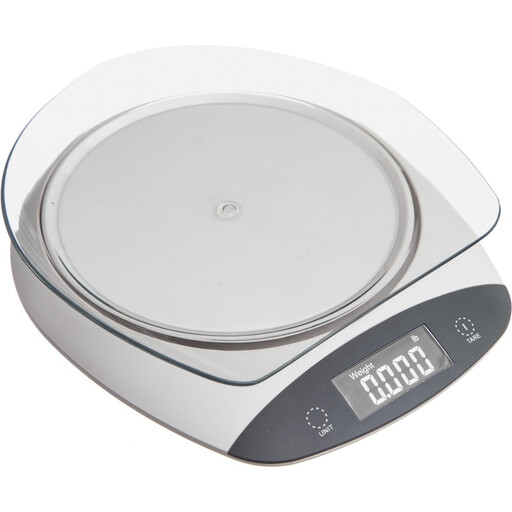
For weighing raisins in a bowl, a digital kitchen scale that displays grams and has a tare function is a practical choice: place the empty bowl on the scale, reset it to zero, then add the raisins. If several people will be using it, a clear display, easy-to-reach buttons and simple cleaning matter too. A flat model requires you to bring a suitable bowl, while the bowl supplied with the Beurer KS 25 has a maximum capacity of 3 kg. The Consumentenbond treats accuracy and consistency as separate test criteria: 1 g increments alone do not show how consistently a scale gives the same reading when used repeatedly.
You want to weigh raisins in grams for several participants and easily reset the empty bowl to zero.
You want to be able to read the weight and use the tare function while a bowl is on the scale.
You’re weighing up whether you’d rather clean a separate bowl or wipe down a platform, and checking which batteries you’ll need before the workshop.
A good fit if: participants are using different bowls and you want to tare the scale before adding the raisins.
Bear in mind: you’ll need to bring a suitable bowl; check that it won’t obscure the display or buttons.
A good fit if: you want to use and clean the same removable weighing bowl throughout the workshop.
Bear in mind: the Beurer KS 25 has a maximum capacity of 3 kg, including the bowl and its contents; the manufacturer gives the bowl’s capacity as 1.2 litres.
| What to consider | What should you look for? | Who is this important for? |
|---|---|---|
| Weighing portions | Check that the scale displays grams, has a tare function and can handle the combined weight of the bowl and its contents. | If I want to weigh a portion of raisins for each participant or recipe, I want to exclude the bowl’s weight from the measurement. Around 36% of consumers give portion weighing top priority. |
| Reading and using the scale | Check how easy the display is to see and whether you can reach the tare or zero button with the bowl in place. | At a shared table, I want to see the weight and use the scale without removing the bowl. Around 29% of consumers prioritise readability and ease of use. |
| Bowls and cleaning | Check which parts the instructions say can be cleaned, and whether the bowl suits your portions. | When using the scale repeatedly, I want to know whether I can wipe down a separate bowl or clean the one supplied. Around 21% of consumers prioritise bowl choice and cleaning. |
| Batteries and portability | Check the battery type, whether batteries are included and how much space all the equipment takes up. | If I’m taking the scale to a workshop venue, I want to know whether it’s ready to use and easy to store. Around 14% of consumers focus mainly on power and portability. |
A display that changes in 1 g increments describes the scale’s resolution, but doesn’t tell you how consistently a model measures when used repeatedly. The Consumentenbond assesses accuracy and consistency separately.
Use the scale’s increments as one factor when choosing, and look for independent test results for the exact model if available.
The shape and height of the bowl can make the display harder to read or the controls more difficult to use. The bowl’s weight also counts towards the scale’s maximum capacity.
Try the bowl you plan to use on the platform, and check the total weight against the specifications for the exact model.
Cleaning instructions vary between models and parts. For example, Beurer specifically states that the removable bowl of the KS 25 is dishwasher-safe.
Read the instructions for both the bowl and the weighing unit before choosing a model for repeated workshop use.
The flat 80880037 model is designed to be used with your own bowl.
The Tasty+ Dark Grey is a flat model with a backlit display and a hanging option.
The KS 25 has a removable bowl, while the KS 19 Pure White is a flat model. The specifications apply to the versions named here.
The flat 492943 is designed for use with a separate bowl.
This selection includes flat kitchen scales for use with a separate bowl, a model with a removable bowl and a coffee scale. Check each model’s capacity, controls and any usage restrictions before choosing one for a workshop.
 No image available
The flat design and tare function are useful if you want to weigh raisins in your own bowl.
The product description says it is for household use and excludes commercial weighing; check whether this suits your workshop.
The description recommends cleaning the surface with a soft, damp cloth. This model is not dishwasher-safe.
 No image available
This coffee scale is an alternative to consider if you want to weigh coffee as well as ingredients for your workshop.
The stated maximum capacity is 2,000 g; remember to include the combined weight of the bowl and its contents.
 No image available
This flat model is designed for weighing with your own bowl; check that you can easily reach the controls with the bowl in place.
The battery is not included. Check which type you’ll need before the workshop.
 No image available
A fixed, removable bowl could suit a workshop where everyone uses the same weighing bowl.
It requires two AAA batteries, which are not included. The dimensions are 20.5 × 18 × 4.5 cm.
 No image available
The product title states a capacity of 10 kg and 1 g increments. On their own, these details don’t show how consistently the scale gives the same reading when used repeatedly.
For cleaning, the description recommends using a soft, damp cloth; do not immerse the scale in water.
Place the empty bowl on the scale and press tare or zero before adding the raisins. Check that the total weight is within the chosen model’s maximum capacity.
Don’t assume you can: follow the instructions for the exact model and component. Beurer says the removable bowl of the KS 25 is dishwasher-safe; for the Brabantia Tasty+, wiping down the glass surface is recommended, while Princess specifies a damp cloth for the 492943.
If you buy as a consumer in the Netherlands, you’re entitled to a product that works properly; there is no fixed statutory warranty period that applies to every product. If something is wrong, contact the seller. A manufacturer’s warranty is in addition to your statutory rights, according to the Rijksoverheid.
If you’re a business supplying food to consumers, the NVWA says you must tell them about any allergens present. Different ways of providing this information apply to products sold or supplied without packaging than to food with a label. Check the ingredients in the specific recipe, including any allergens in the raisins you use; not every cookery workshop automatically falls under the same business requirements.