
For weighing individual portions
You weigh uncooked rice into a bowl for each person and want to reset the scale to zero easily for the next portion.


Weigh uncooked rice before cooking; the Netherlands Nutrition Centre explains that its weight changes during cooking. For individual portions, a compact model with a tare function is practical, while for one large bowl to share, the platform size and maximum capacity matter most. A 1 g increment does not, on its own, prove accurate weighing: the Dutch Consumers' Association assesses accuracy and consistency separately.
You weigh uncooked rice into a bowl for each person and want to reset the scale to zero easily for the next portion.
You weigh rice for several people in one bowl, so you need enough platform space and a suitable capacity.
Your priorities are an easy-to-read display, a stable setup and straightforward cleaning.
First decide how you’ll weigh the rice: in individual bowls for each person, or in one larger bowl for the group. Remember to include the bowl and its contents when checking the maximum capacity.
| What to consider | What to look for when buying | Who is this important for? |
|---|---|---|
| Weighing individual portions repeatedly | Check that it has a tare function, that you can still see the display with your bowl in place, and that the weighing range is suitable. | If I want to weigh a portion into a bowl for each person, I want to be able to reset the scale to zero easily. Around 36% of consumers say individual portions are their main concern when buying. |
| Weighing one large bowl for the group | Check the maximum capacity, the platform dimensions and whether you can see the display with your chosen bowl in place. | When weighing one bowl of rice for several people, I want to know that the bowl will sit securely and won’t be too heavy. Around 29% of consumers prioritise weighing one large bowl for the group. |
| Reading the display and cleaning | Check the display backlight, stability and cleaning instructions for both the bowl and the electronic parts. | If the scale is shared between participants, I want to be able to read the weight clearly and clean the surface easily after use. For around 21% of consumers, sharing and cleaning are the main priorities. |
| Power and aftercare | Check the battery type required, whether batteries are included and which terms apply to the exact model. | If I want to use the scale during a workshop, I want to know in advance which batteries I need and where to go for aftercare. Around 14% of consumers say this is their main concern when buying. |
The stated increments alone don’t tell you how accurately or consistently a scale actually weighs. The Dutch Consumers' Association assesses these qualities separately.
If you’re using independent test results, compare both accuracy and repeatability, as well as the stated increments.
The bowl also counts towards the maximum load. Models can differ: according to Beurer, the KS 25 has a maximum capacity of 3 kg, compared with 15 kg for the KS 34.
Check that the bowl and rice together stay within the maximum capacity and that the bowl fits securely on the platform.
The models reviewed differ in whether a bowl and batteries are included.
Before buying, check the contents of the box and the battery type required for the exact model.
The Page Compact 300 is designed for a small work surface and repeated weighing in your own bowl.
The battery-powered Tasty+ is designed for weighing on a flat glass surface, with a backlit display.
The KS 25 comes with a separate bowl, while the KS 34 has a larger platform for weighing one bowl for the group.
This selection is for weighing rice in a bowl during a workshop. One model is analogue, so choose it only if a digital display isn’t essential.
 No image available
The stated tare function makes it suitable for weighing individual portions in a bowl.
Dimensions: 17 × 13 × 2 cm.
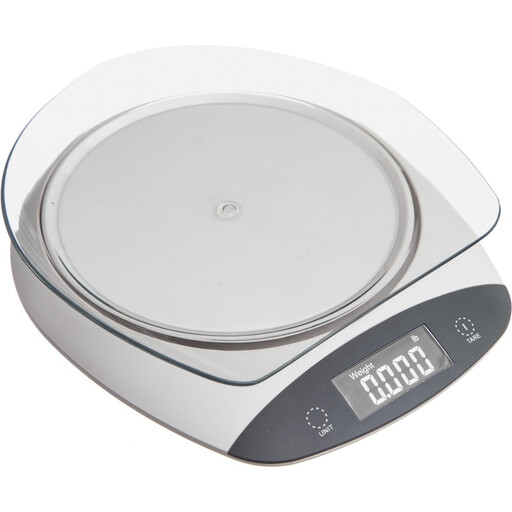 No image available
The removable bowl is handy for weighing successive portions in the same bowl.
Dimensions: 20.5 × 18 × 4.5 cm.
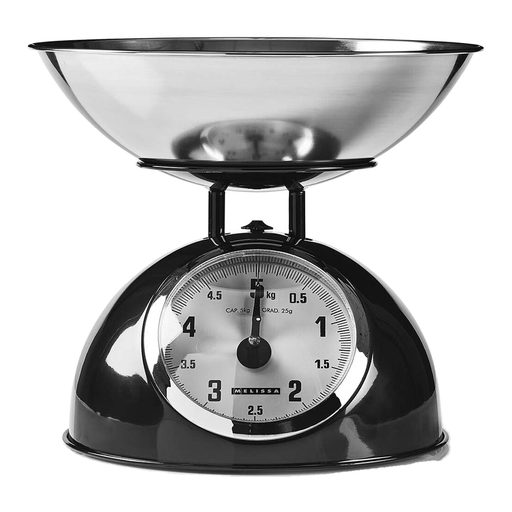 No image available
Choose this model only if you don’t need a digital display and want to weigh rice in a removable bowl.
The product name lists a maximum capacity of 5 kg and 25 g increments.
Weigh uncooked rice when deciding how much to cook. The Netherlands Nutrition Centre gives the example that 75 g of uncooked rice makes about 200 g of cooked rice; adjust the amount to suit the dish and the number of people eating.
Place a suitable bowl on the scale and reset it to zero using the tare function before adding the dry rice. Check the zero reading again with each new bowl, and make sure the combined weight of the bowl and its contents stays within the maximum capacity.
Don’t assume you can. Beurer lists only the removable bowl of the KS 25 as dishwasher-safe; Brabantia says the glass surface of the Tasty+ model reviewed can be wiped clean. Follow the instructions for the model you buy.
For a standard consumer purchase, your statutory rights apply alongside any manufacturer’s warranty. According to ACM ConsuWijzer, the retailer is your point of contact if a product breaks sooner than you could reasonably expect under normal use. Online purchases generally come with a cooling-off period of up to 14 days after delivery.
According to the Dutch government, you can return used batteries to shops and supermarkets that sell them, among other places. Don’t put them in general waste.