
Weighing portions for guests
You want to weigh out enough rice for each person before cooking, without automatically making too much. The Netherlands Nutrition Centre gives an example of the ratio between uncooked and cooked rice.


Weigh uncooked rice in a tared bowl, adjusting the quantity to the number of people and the portions you want. The Netherlands Nutrition Centre gives 75 g of uncooked rice as an example for around 200 g of cooked rice; this isn’t a set portion for everyone. Choose a compact model if the bowl and rice together fit within its weighing capacity, or pay extra attention to capacity and readability if you use a large bowl.
You want to weigh out enough rice for each person before cooking, without automatically making too much. The Netherlands Nutrition Centre gives an example of the ratio between uncooked and cooked rice.
You want to weigh rice for the whole group in one bowl. So, consider both the weight and the dimensions of the bowl.
You weigh several ingredients one after another while preparing a meal, so look for a tare function, an easy-to-read display and a surface that’s simple to wipe clean.
| What to consider | What to look for | Who is this important for? |
|---|---|---|
| Amount of dry rice | Decide on the portion you want and weigh the uncooked rice in grams. | When I’m cooking for guests, I want to work out the amount for each portion rather than automatically making too much. Around 36% of consumers say portioning for guests is their main buying priority. |
| Bowl and weighing capacity | Compare the maximum weighing capacity with the combined weight of the bowl and its contents. Also check that the bowl sits securely. | When using one large bowl, I want to know that the bowl and rice together are within the maximum capacity. Around 29% of consumers say this is their main buying priority. |
| Tare function and readability | Check whether you can reset the scale to zero with the bowl on it, and whether the bowl obscures the display. | I want to weigh rice in the same bowl and be able to read the result easily. Around 21% of consumers particularly value the convenience of weighing with a bowl. |
| Everyday use | Check how to clean the surface and what type of battery the model uses. | For regular use, I want a display that’s easy to read and a surface that’s simple to clean. Around 14% of consumers prioritise everyday convenience. |
A display that changes in 1 g increments doesn’t, by itself, tell you how accurately or consistently the scales measure. The Dutch consumers’ association Consumentenbond explains that kitchen scales can be tested for deviation and consistency.
Use the increments to compare features, but only judge measuring accuracy based on a test of the exact model.
The bowl counts towards the total load, and the tare function doesn’t change the maximum weighing capacity.
Compare the combined weight of the bowl and planned contents with the stated capacity, and check that the bowl sits securely without obscuring the display.
Consumentenbond identifies scales switching off too quickly as a usability issue with some tested models. Battery types can vary from one model to another.
Before choosing a model, check how its auto-off function works and what type of battery it needs, especially if you add ingredients slowly.
The Page Compact 300 is a compact option for weighing with a bowl, as long as the total weight stays within its 5 kg capacity.
The KS 34 is worth considering if you use a large or heavy bowl, or want to keep reading the measurement after weighing.
The battery-powered Tasty+ is designed for everyday weighing, with a backlit display and a glass surface.
Salter offers a range of kitchen scales, and specifications may vary between models.
These Joybuy picks are digital scales for kitchen and cooking use, including models with a separate bowl or a stated higher weighing capacity. Check whether each model’s features suit the way you weigh rice for your group.
 No image available
The product name refers to both coffee preparation and kitchen use. Check that the controls suit the way you weigh rice.
The product name lists a timer, a water flow function and a switch between ounces and kilograms.
 No image available
A compact option to consider if you weigh rice in a separate bowl. Check that the bowl and its contents together are within the maximum capacity.
The product name specifies stainless steel and dimensions of 17 × 13 × 2 cm. The product information lists a tare function and a maximum capacity of 5 kg.
Batteries are not included.
 No image available
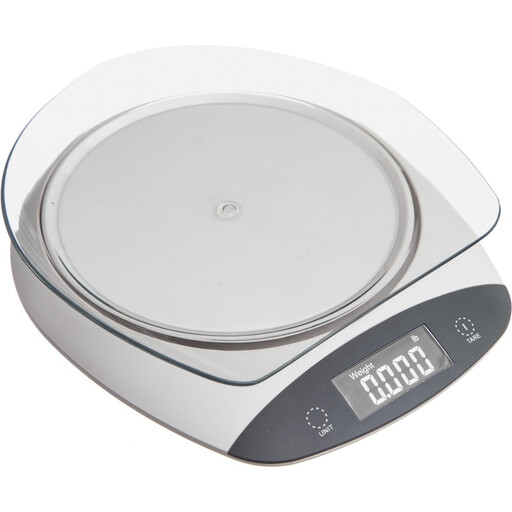
The removable bowl may suit you if you want to weigh rice directly in the bowl supplied. Remember to account for the combined weight of the bowl and contents when checking the maximum capacity.
The product name specifies a white model with a removable bowl, measuring 20.5 × 18 × 4.5 cm. The product information lists a tare function and a maximum capacity of 5 kg.
Batteries are not included.
 No image available
A model with a stated higher capacity to compare if you use a heavy bowl. Check that the bowl and contents together weigh no more than 10 kg.
The product name specifies a capacity of 10 kg, 1 g increments and a toughened glass surface. Increments of 1 g don’t prove the scale’s actual measuring accuracy.
 No image available
If you weigh rice in grams, check that the display and controls suit your needs and that the contents are within the scale’s capacity.
The product name specifies a capacity of 5 kg. The product information lists a gram display and a large colour screen.
Batteries are not included.
Weigh uncooked rice if you’re following a recipe or portion recommendation that gives quantities in grams of dry rice. The Netherlands Nutrition Centre gives 75 g of uncooked rice as an example for around 200 g of cooked rice; the result won’t be exactly the same with every cooking method.
Place the empty bowl on the scales and use the tare function to reset the display to zero before adding the dry rice. Remember to include the combined weight of the bowl and contents when checking the maximum capacity.
Compare the stated maximum weighing capacity with the weight of your empty bowl plus the amount of rice you want to weigh. The tare function resets the display to zero, but doesn’t increase the maximum capacity.
No. Increments describe how the measurements are displayed; on their own, they don’t prove how accurately or consistently a model measures. Look for a test of the exact model to assess its accuracy.
Check that the bowl sits securely without obscuring the display, and that you can read the measurement from where you’ll be standing. If the scales are battery-powered, it’s also worth checking the required battery type and auto-off setting beforehand.